


A research-led guide to airborne mold, houseplants and Indian humidity — what the science actually supports, which plants help, which quietly make the problem worse, and what genuinely clears spores from a room.
English Ivy (Hedera helix) is the only widely available houseplant with a published experiment measuring airborne mold reduction.
In research presented at the American College of Allergy, Asthma & Immunology annual meeting in 2005, ivy placed in a sealed container with moldy bread cut airborne mold by about 60% in six hours and roughly 78% over twelve hours.
That is the headline every website repeats. The part almost nobody tells you is what makes the answer genuinely useful (mold is also spelled mould in British usage — the two words describe the same fungi):
Four things worth knowing before you buy anything:
No houseplant is a mold remediation tool. Mold is a water problem. It is solved with drainage, ventilation and dehumidification — not foliage.
Leafy plants do capture fungal spores on their leaf surfaces. The effect is real, measurable in a chamber, and small in a real room with open windows.
Several of the most-recommended “anti-mold” plants — Peace Lily, Boston Fern, Areca Palm — release a great deal of water vapour. In an already damp monsoon bedroom, they can nudge humidity in the wrong direction.
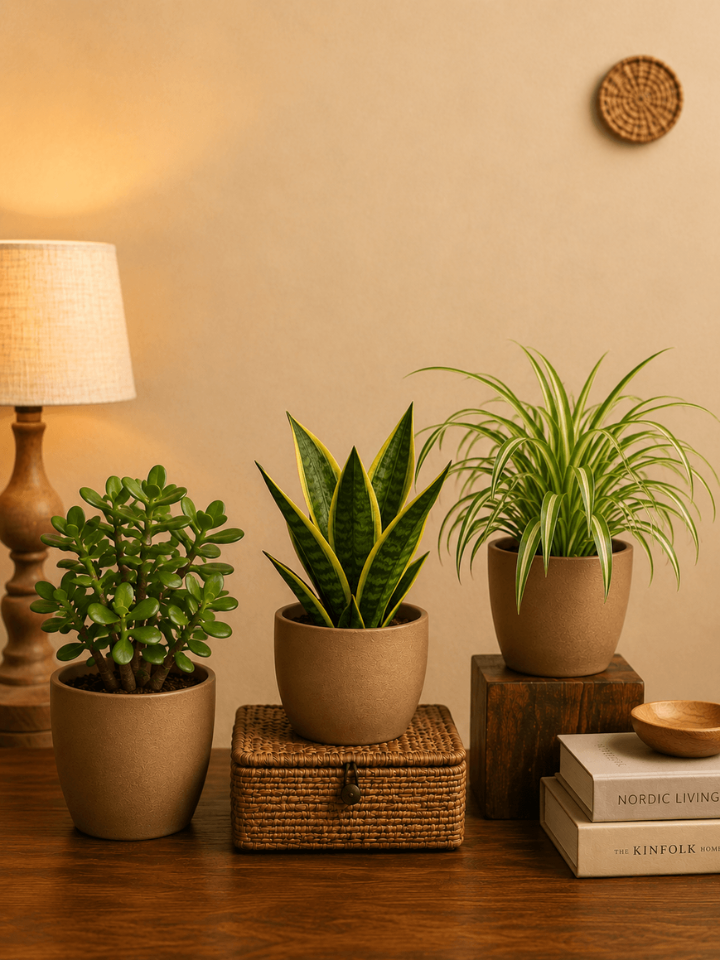
In a genuinely damp room, the better choice is a low-transpiration plant: Snake Plant, Elephant Bush, Haworthia, Christmas Cactus.
So the accurate answer to “what plant can remove mold spores from the air” depends entirely on how wet the room already is. A plant that helps in a dry, air-conditioned bedroom can be the wrong plant for a windowless bathroom in Kolkata in August. The rest of this guide explains why, and gives you a room-by-room decision you can actually act on.
If you want the recommendation before the reasoning, here it is.
Your situation | Best plant choice | Why |
Damp, poorly ventilated bathroom | Snake Plant, Haworthia, Christmas Cactus | Almost no water vapour released; tolerate low light and neglect |
Monsoon bedroom, no air conditioning | Snake Plant, Elephant Bush (Lucky Jade) | Succulent metabolism keeps room moisture unchanged |
Air-conditioned bedroom (dry air) | Peace Lily, Areca Palm, Boston Fern | Transpiration is a benefit here, not a liability |
Living room with good cross-ventilation | English Ivy, Rubber Plant, Areca Palm | Large leaf area captures airborne particles; ventilation offsets moisture |
Home with cats or dogs | Areca Palm, Spider Plant, Boston Fern, Bamboo Palm | Listed as non-toxic by the ASPCA |
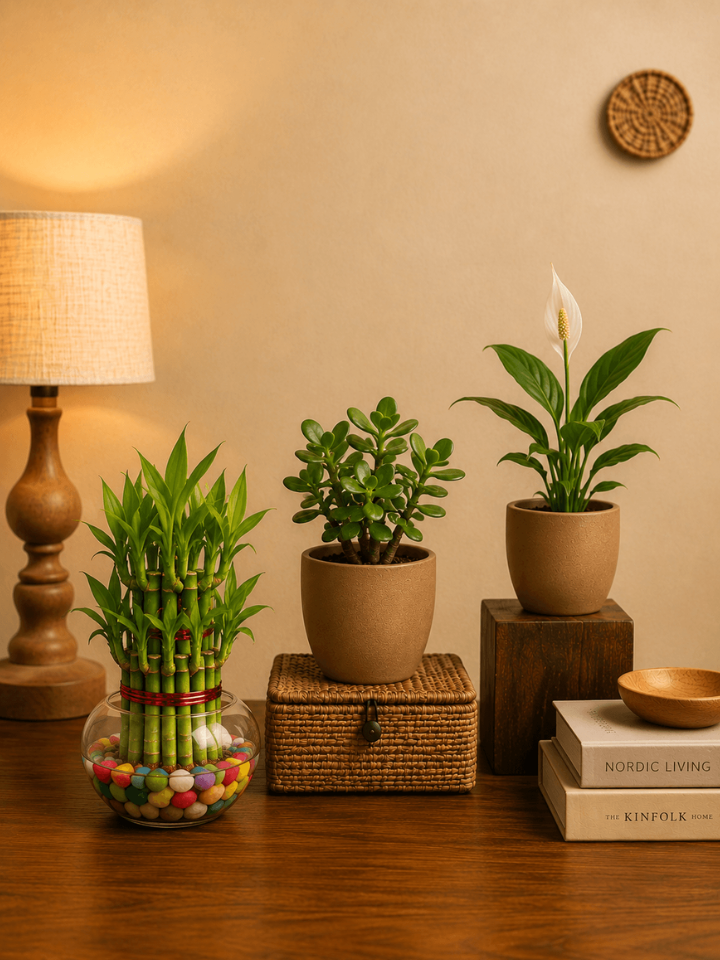
Household member is immunocompromised | Lucky Bamboo or Money Plant grown in water | Removes the potting medium, the main indoor fungal reservoir |
Wardrobe, storeroom, no daylight | No plant will survive | Use ventilation and moisture absorbers instead |
Why This Question Matters More in India Than Almost Anywhere Else
Most articles on this subject are written for homes in North America or northern Europe, where indoor humidity is a winter condensation problem confined to bathrooms and basements. In much of India it is a four-month structural condition, and the numbers make that clear.
The United States Environmental Protection Agency recommends keeping indoor relative humidity below 60%, and ideally between 30% and 50%, because above that threshold dormant fungal spores begin to germinate on ordinary household surfaces. Now compare that guidance with India Meteorological Department climate normals for Kolkata:
Month | Avg. RH, 08:30 IST | Rainfall (mm) | Mold risk |
March | 49% | 32 | Low |
May | 66% | 141 | Moderate |
June | 76% | 248 | High |
July | 81% | 367 | Very high |
August | 82% | 355 | Very high |
September | 81% | 282 | Very high |
October | 75% | 170 | High |
December | 66% | 7 | Moderate |
For roughly a third of the year, ambient conditions across the eastern and coastal belt sit far above the level at which fungi colonise plaster, wood, leather, paper and fabric. In a naturally ventilated flat without air conditioning, indoor humidity tracks outdoor humidity closely. This is not a housekeeping failure. It is climate, and it explains why the same wall stain returns every July no matter how many times it is scrubbed.
It also explains why the search for a plant-based solution is so appealing. A dehumidifier is expensive and noisy. A natural air purifier that sits quietly in the corner and looks beautiful is a far more attractive proposition. The honest position is that plants contribute something genuine — just far less than the internet claims, and only if you choose the right species and care for them properly.
What a Mold Spore Actually Is (And Why “Removal” Is the Wrong Frame)
Mold spores are microscopic reproductive units released by fungi. They are always present, indoors and outdoors, in every building on earth. You cannot sterilise the air in a home, and you should not try.
Understanding their size matters, because it determines what can and cannot capture them:
Common indoor genus | Typical spore size | Where it turns up in Indian homes |
Aspergillus | 2–3.5 microns | Damp potting mix, grain and spice storage, AC ducting |
Penicillium | About 3 microns | Water-damaged walls, old paper, refrigerated food |
Cladosporium | 3–8 microns | Window frames, curtains, cool damp surfaces, outdoor air |
Alternaria | 20–60 microns | Showers, drains, damp textiles; a major allergen |
For scale, a human hair is roughly 70 microns across. Spores are small enough to stay suspended for hours, and light enough that walking across a room re-suspends whatever has settled on the floor.
This is why “removal” is a misleading goal. The realistic objective in any home is not zero spores. It is to keep indoor concentrations at or below outdoor levels, and — far more importantly — to deny spores the moisture they need to germinate into a colony. A spore floating past your window is harmless. A spore that lands on damp plaster and starts growing is the actual problem.
Fungi need three things: moisture, an organic food source, and a moderate temperature. In an Indian home, food and temperature are permanently available. Moisture is the only variable you control. Remove it and everything else becomes irrelevant. This single insight reorders every recommendation in this article.
What the Research Actually Says: Three Studies Everyone Misquotes
Almost every claim online about plants and mold traces back to one of three pieces of research. Two are routinely misapplied, and the third is rarely mentioned at all.
1. The English Ivy Experiment (ACAAI, 2005) — the one real data point
Investigators placed moldy bread inside sealed containers, measured the airborne particle concentration, then introduced an English Ivy plant and re-measured at six and twelve hours. Airborne mold fell by around 60% at the six-hour mark and by roughly 78% at twelve hours. A parallel container using canine faecal matter showed a reduction of about 94%. The work was presented at the American College of Allergy, Asthma & Immunology annual meeting, with nurse practitioner Hilary Spyers-Duran of West Coast Clinical Trials among the authors.
What the study genuinely supports: a leafy plant placed in a small enclosed volume containing a concentrated fungal source will reduce the airborne particle count over several hours.
What it does not support:
- That the same percentage applies to a 12-by-14-foot bedroom. The container was a fraction of that volume with a single plant inside it.
- That the effect persists with ventilation. The container was sealed. A real room exchanges its entire air volume roughly once an hour, which resets the experiment continuously.
- That the finding survived peer review. It was a conference presentation, not a paper in a peer-reviewed journal, and it originated as a science project.
- That mold was destroyed. It was removed from the air by settling and adhesion. The spores still existed — on the leaves, on the soil, on the container walls.
One further detail is worth flagging, because it changes the practical advice. The investigators proposed that particles were absorbed through the roots and soil. That mechanism is difficult to defend for airborne particulate matter. The likelier explanation is simple physical deposition on the ivy’s broad, waxy leaf surfaces — which means wiping the leaves is not optional housekeeping, it is the maintenance step that makes the plant keep working. We have examined this study and its numbers in more depth in our dedicated breakdown of the surprising science behind English Ivy.
2. The NASA Clean Air Study (1989) — tested gases, not spores
The single most common error in this topic is citing NASA as evidence that plants remove mold. The NASA Clean Air Study measured the uptake of volatile organic compounds — formaldehyde, benzene, trichloroethylene — in sealed chambers designed to model a spacecraft. These are gas molecules, thousands of times smaller than a fungal spore, and they are removed by an entirely different mechanism involving stomatal uptake and root-zone microbial breakdown.
NASA never tested airborne mold. Any page claiming “NASA-approved mold-removing plants” has confused two unrelated bodies of research. The NASA work remains genuinely interesting for what it did study, and we have covered what NASA recommended for air purification separately — but it is not evidence about spores.
3. Cummings & Waring (2019) — the study that recalibrated everything
In 2019, Bryan Cummings and Michael Waring of Drexel University reanalysed decades of chamber experiments and converted the results into clean air delivery rate, the standard engineering metric used to rate air purifiers. Their paper, Potted plants do not improve indoor air quality, published in the Journal of Exposure Science & Environmental Epidemiology, found a median single-plant clean air delivery rate of just 0.023 cubic metres per hour.
The headline finding: to match the air-cleaning effect that ordinary outdoor-to-indoor air exchange already provides in a typical building, you would need somewhere between 10 and 1,000 plants per square metre of floor space.

For a 12-square-metre bedroom, the conservative end of that range is 120 plants. Opening a window for ten minutes achieves more.
That study examined volatile organic compounds rather than particulates, and the mechanisms differ — so it is not a direct refutation of the ivy result. But the scaling problem it exposes is identical, and it applies to any chamber study of any pollutant: a sealed box is not a room. You can read the full paper in the Journal of Exposure Science & Environmental Epidemiology if you want the underlying data.
Reading all three together
The defensible synthesis is this: houseplants have a measurable but modest ability to capture airborne particles, including fungal spores, primarily by physical deposition on foliage. That capacity is easily swamped by ventilation, and it is irrelevant compared with fixing the moisture source. Anyone selling you a plant as a replacement for a dehumidifier is overselling. Anyone telling you plants do nothing at all is overcorrecting.
Four Ways Plants Genuinely Interact With Airborne Mold
Most guides to plants for air purification stop at naming species. Stripping away the marketing, there are four real mechanisms — and the fourth one works against you in a damp room.
Mechanism 1 — Leaf-surface deposition (the one that matters)
Broad, waxy, textured or finely hairy leaves act as passive impaction surfaces. Air currents carry spores across the leaf, and a proportion adhere to the cuticle. Plants with high total leaf area relative to their footprint — Rubber Plant, English Ivy, Areca Palm, Spider Plant — perform best on this measure.
The catch: deposition is reversible. A dusty leaf that is knocked, brushed past or hit by a fan re-releases what it collected. Fortnightly leaf-wiping with a damp cloth is what converts temporary capture into permanent removal. A neglected, dusty plant is a spore reservoir, not a filter.
Mechanism 2 — Root-zone and substrate activity
The microbial community living around plant roots metabolises organic matter, including some deposited particulates. This is genuine biology, and it is the basis of engineered biofiltration walls. In an ordinary pot on an ordinary shelf, however, only a tiny fraction of room air ever passes through the substrate, so the practical contribution is negligible.
Mechanism 3 — Phyllosphere antagonism
Leaf surfaces host their own microbial communities, and some plants produce compounds that suppress fungal colonisation on the leaf itself. This keeps the plant healthy. It does not clear the surrounding air, and claims that a plant “kills mold in the room” have no basis in this mechanism.
Mechanism 4 — Humidity modulation, which cuts both ways
Every plant loses water through transpiration. For most tropical foliage species, this is a substantial daily volume — a mature Areca Palm or a well-watered Peace Lily can release most of the water you give it back into the room as vapour. In a dry, air-conditioned bedroom in Delhi in January, that is a benefit. In an unventilated Kolkata bathroom in August, you are adding moisture to a space that is already past the germination threshold.
Succulents and CAM plants behave differently.
Snake Plant, Jade, Elephant Bush, Haworthia and Christmas Cactus keep their stomata closed during the day and exchange gases at night, losing a fraction of the water a fern does. This is the single most useful and least-discussed criterion for choosing a plant for a damp room.
Transpiration level | Plants | Right room |
Very low | Snake Plant, Haworthia, Jade / Elephant Bush, Christmas Cactus, Aloe | Damp bathrooms, monsoon bedrooms, ground-floor rooms |
Moderate | English Ivy, Money Plant, Rubber Plant, Syngonium, Aglaonema | Living rooms with reasonable cross-ventilation |
High | Peace Lily, Areca Palm, Bamboo Palm, Boston Fern, Calathea | Air-conditioned rooms and dry-climate homes |
The Plant-by-Plant Verdict
Below is the assessment for the species most often recommended for mold, judged on three criteria: leaf area available for particle capture, water vapour released, and whether the plant will actually survive an Indian summer. Botanical names are given because pet safety and identification both depend on them.
Tier 1 — Best for genuinely damp rooms
These are the plants to choose when humidity is the underlying problem. Their contribution to particle capture is modest, but they add nothing to the moisture load — which in a damp room is the more valuable property.
Snake Plant (Dracaena trifasciata)
The strongest all-round choice for a humid Indian home. Its crassulacean acid metabolism means near-zero daytime water loss, its stiff upright leaves present a usable surface for settling particles, and it tolerates deep shade, irregular watering and the temperature swings of a monsoon flat. If you buy one plant for a damp bedroom or bathroom, buy this. Note that the ASPCA lists it as toxic to cats and dogs.
Elephant Bush / Lucky Jade (Portulacaria afra)
Frequently sold in India under the “lucky jade” name, and worth distinguishing from the true Jade Plant, Crassula ovata — the two look similar and are often confused. Portulacaria afra is a succulent with thick water-storing leaves, minimal transpiration and a genuine tolerance for bright indirect light indoors. Confirm the botanical name on the label before buying, particularly if pets are a consideration, since the two species differ in toxicity.
Haworthia cymbiformis
Small enough for a bathroom windowsill, entirely undemanding, and listed as non-toxic. Its contribution to air quality is close to nil given its size, but it is the rare plant that will genuinely survive a humid, low-light bathroom without becoming a mold source itself.
Christmas Cactus (Schlumbergera)
Tolerates the moderate humidity of a bathroom better than most succulents, flowers in the cooler months, and is listed as non-toxic to cats and dogs. A sensible choice where you want something living in a damp corner without adding vapour.
Tier 2 — The best evidence, with real practical caveats
English Ivy (Hedera helix)
The only plant with direct experimental data on airborne mold, and its broad waxy leaves make the deposition mechanism plausible. Two honest warnings before you buy. First, ivy is a temperate species: it struggles above roughly 32°C and will suffer in an un-air-conditioned room through an Indian summer, doing best on a shaded north-facing balcony or in a cooler hill-station climate. Second, it is toxic to cats and dogs, and it should never be planted into open ground, where it can become invasive.
Tier 3 — Excellent particle catchers, but watch the humidity
Areca Palm (Dypsis lutescens)
Enormous feathery leaf area, thrives in Indian conditions, and listed as non-toxic by the ASPCA — one of the few genuinely pet-safe options with real presence. Its drawback is transpiration: a large specimen moves a lot of water into the room. Superb in an air-conditioned living room, questionable in a damp unventilated one.
Rubber Plant (Ficus elastica)
Among the best passive particle surfaces available to an Indian home: very large, thick, glossy leaves that are easy to wipe clean. Moderate water use, tolerant of neglect, and handsome. Toxic to pets, and the sap irritates skin.
Peace Lily (Spathiphyllum)
Universally recommended for damp rooms, and the recommendation deserves more scrutiny than it usually gets. The peace lily plant has large glossy leaves that do capture particles well, but it is among the thirstiest common houseplants, it wilts dramatically when underwatered so owners tend to keep it constantly moist, and permanently damp potting mix is the most common indoor fungal reservoir there is. It is a fine plant for an air-conditioned bedroom and a poor first choice for a bathroom that is already wet. It is also toxic to cats and dogs.
Boston Fern (Nephrolepis exaltata)
Pet-safe, beautiful, and genuinely effective at trapping particles across its finely divided fronds. But it actively demands high humidity and will drop leaves without it — which makes it the right plant for a dry air-conditioned room and precisely the wrong plant for the damp bathroom it is so often recommended for.
Spider Plant (Chlorophytum comosum)
High surface area for its size, thoroughly forgiving, propagates itself, and non-toxic to pets. One of the best value choices among low maintenance indoor plants for a first-time plant owner, and well suited to a hanging position where air moves past it.
Bamboo Palm (Chamaedorea seifrizii)
Handles lower light than most palms, listed as non-toxic, and provides substantial foliage. The bamboo palm plant is a practical alternative to the Areca where light is limited, though it shares the same moderate-to-high transpiration profile.
Money Plant / Golden Pothos (Epipremnum aureum)
Nearly indestructible, thrives in Indian conditions, and produces dense trailing foliage that catches airborne dust efficiently. Toxic to pets. Its most useful property in this context is that it grows readily in plain water, which eliminates the potting medium entirely.
Summary comparison
Plant | Particle capture | Water vapour added | Pet safe (ASPCA) | Best placement |
Snake Plant | Moderate | Very low | No | Damp bedroom, bathroom |
Elephant Bush | Low | Very low | Check label | Bright damp room |
Haworthia | Low | Very low | Yes | Bathroom windowsill |
Christmas Cactus | Low | Very low | Yes | Damp corner, bright shade |
English Ivy | High | Moderate | No | Cool shaded balcony |
Rubber Plant | High | Moderate | No | Living room |
Areca Palm | High | High | Yes | AC living room |
Bamboo Palm | High | High | Yes | Low-light AC room |
Boston Fern | High | High | Yes | Dry AC room |
Peace Lily | High | High | No | AC bedroom |
Spider Plant | Moderate | Moderate | Yes | Hanging, any room |
Money Plant | Moderate | Moderate | No | Water culture anywhere |
Pet-safety note on pet friendly indoor plants: always verify by botanical name rather than common name. Indian retail labelling is inconsistent, and several unrelated plants share the names “money plant”, “jade” and “bamboo”. If you keep cats or dogs, check the ASPCA toxic and non-toxic plant register before purchase.
The Uncomfortable Part: When Houseplants Make Mold Worse
This section is the reason most articles on this topic are unreliable. A plant collection is one of the most common indoor fungal reservoirs in a home, and the person most likely to create one is the person who bought eight plants to fix a damp bedroom and then watered them all on Sunday morning.
Here is how it happens.
Permanently wet potting mix
The white or grey fuzz that appears on the surface of overwatered soil is saprophytic fungal growth — commonly Penicillium, Aspergillus, Mucor or Trichoderma. It is feeding on the organic matter in the mix. It is usually harmless to the plant, and it is an active spore source sitting at breathing height in your bedroom. It is also completely preventable.
Decorative pots without drainage
Ceramic cachepots sold without a drainage hole are the single most common cause of chronically waterlogged root zones in Indian homes. Water pools invisibly at the base and never evaporates. Always keep the plant in a plastic nursery pot with drainage, and use the decorative pot as a sleeve you can lift out and empty.
Standing water in saucers
Water left in a saucer for more than a day supports fungal and bacterial growth and keeps the lower substrate saturated. Empty saucers within half an hour of watering, every time.
Coco peat and peat-heavy mixes in monsoon
Coco peat is excellent for propagation and moisture retention, which is exactly the wrong property in July. During the monsoon, shift towards a coarser mix — add perlite, coarse river sand or fine gravel to improve drainage and shorten the wet period after each watering.
Fallen leaves left on the surface
Decaying leaf litter on damp substrate is ideal fungal food. Clear it weekly. This takes thirty seconds and eliminates a meaningful proportion of the risk.
Plants clustered too tightly
Grouping pots creates a stagnant humid microclimate exactly where you least want one. Leave 20 to 30 centimetres between pots so air can move through the collection, and run a ceiling fan on its lowest setting.
Wooden surfaces beneath pots
Staining, swelling or discolouration on a wooden windowsill or shelf under a plant is an early warning of repeated moisture contact. It does not prove a mold problem, but it does mean the watering routine needs correcting before the substrate underneath does.
The net effect: a badly maintained collection of ten plants in a damp room will raise the local spore concentration considerably more than any of those plants lowers it. A well-maintained collection of three will not. Care quality matters more than species selection.
What Actually Removes Mold Spores: The Honest Hierarchy
If your goal is genuinely to reduce airborne fungal load, here is the order of operations by effectiveness. Plants appear, but not near the top.
Priority | Action | Impact |
1 | Find and stop the water source — leaks, wall seepage, AC drain pans, unsealed bathroom skirting, condensation on cold walls | Decisive. Nothing else works until this is done |
2 | Ventilate — cross-ventilation for 15–20 minutes twice daily during dry spells; run the bathroom exhaust for 20 minutes after every shower | Very high, and free |
3 | Dehumidify — run air conditioning in dry mode, use a dehumidifier, or place calcium chloride absorbers in wardrobes and storerooms | Very high in enclosed spaces |
4 | Filter — a HEPA H13 unit captures 99.95% of particles at 0.3 microns, comfortably including 2–10 micron spores | High, within one room |
5 | Clean visible growth within 24–48 hours of it appearing; scrub hard surfaces, discard porous materials | High, and prevents escalation |
6 | Add plants — chosen for low transpiration, wiped fortnightly, watered correctly | Small but real, plus genuine wellbeing benefit |
One safety threshold is worth knowing: the EPA advises that visible mold covering more than about ten square feet — roughly a three-by-three-foot patch — should be handled professionally, because disturbing a large colony without containment releases an enormous quantity of spores at once. Their guide to mold, moisture and your home is a practical, non-commercial reference worth reading if you are dealing with an established problem.
Plants belong at position six. That is not a dismissal. A well-chosen plant improves a room in ways a dehumidifier never will, and the research on biophilic wellbeing — reduced stress, better focus, improved perceived air quality — is considerably more robust than the research on plant-based air filtration. Buy them for that, and treat the particle capture as a bonus.
Room-by-Room Guide for Indian Homes
The bathroom
The hardest case: high humidity, poor ventilation, and often no natural light. Most lists of indoor plants for bathroom spaces recommend ferns and Calatheas because those plants enjoy humidity — which is the opposite of what you need if the humidity is the problem.
- Choose: Snake Plant, Haworthia, Christmas Cactus, or Bamboo Palm if there is a window.
- Avoid: Boston Fern, Calathea and Peace Lily, unless the bathroom is well ventilated and you simply want the greenery.
- Non-negotiable: run the exhaust fan for twenty minutes after every shower. This does more than any plant.
The bedroom
The right answer depends entirely on whether the room is air-conditioned.
- Air-conditioned: AC strips moisture from the air, and rooms often drop below 40% humidity. Here a Peace Lily or Areca Palm is genuinely beneficial, restoring comfortable humidity while capturing dust.
- Not air-conditioned, monsoon: stick to Snake Plant or a succulent. Adding a heavy transpirer to a room already at 80% humidity is counterproductive.
The kitchen
Steam and cooking grease coat leaves quickly, which both reduces capture efficiency and makes the plant look poor. Money Plant and Betel Leaf Plant tolerate the conditions well. Wipe leaves weekly rather than fortnightly here.
The living room
Usually the best-ventilated space in the house, and the one where large-leaved plants earn their place. Rubber Plant, Areca Palm and a trailing Money Plant give substantial foliage area, and cross-ventilation offsets the moisture they release.
Wardrobes, storerooms and box rooms
An honest answer people rarely give: no plant will help here, because no plant will survive here. These spaces have no light and minimal air movement, which is exactly why they develop mold on leather bags, cotton saris and stored paper. Use calcium chloride moisture absorbers, silica gel sachets, dried neem leaves and camphor, and open the doors for an hour during dry spells. Save the plants for rooms with windows.
City-Level Notes: Where Mold Pressure Is Highest
Because India spans several climate zones, the same advice does not apply nationwide. A rough guide to where this problem bites hardest:
Region | Peak risk window | Local considerations |
Kolkata, Howrah, Hooghly | June–September | 1,700 mm annual rainfall, RH above 80% for four months; older lime-plastered buildings and shared walls retain moisture |
Mumbai, Thane, Navi Mumbai | June–September | Heaviest monsoon rainfall in urban India; coastal salt accelerates surface deterioration |
Chennai | October–December | Northeast monsoon shifts the risk window later; plan dehumidification for the last quarter |
Surat, Mangalore | June–September | Humid coastal conditions with limited dry-season relief |
Bengaluru | June–October | Moderate humidity, but poorly ventilated modern apartments trap moisture |
Hyderabad, Warangal | July–September | Shorter, more manageable window |
Pune, Nashik, Nagpur, Aurangabad, Solapur | July–August | Drier overall; risk concentrated in a few weeks |
Delhi NCR, Gurgaon | July–August | Brief humid spike; particulate pollution is generally the larger indoor air concern |
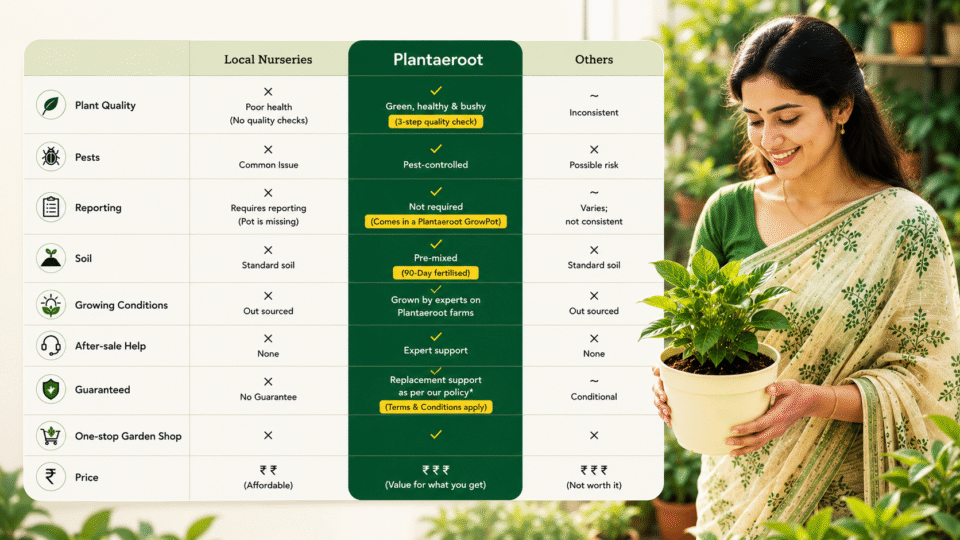
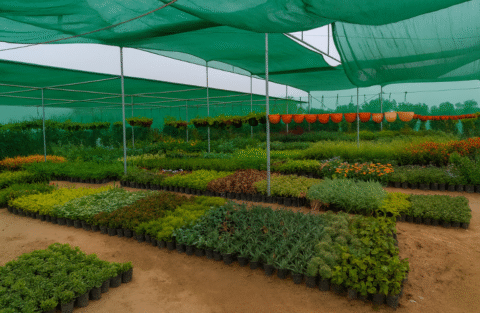
At Plantaeroot we ship pan-India from Rishra in Hooghly, so this seasonal pattern shapes what we recommend month to month. If you are buying indoor plants in Kolkata or anywhere along the eastern and western coastal belts, weight your selection towards the succulent end of the range through the monsoon and add the thirstier foliage plants once the dry season arrives in November.
Twelve Rules to Stop Your Plants Becoming a Spore Source
Follow these and your collection stays a net positive. Ignore them and it becomes the problem it was meant to solve.
- Check the top two to three centimetres of substrate before watering. If it is damp, wait. During monsoon, most plants need water half as often as in April.
- Water from below where practical — stand the pot in a tray for twenty minutes, then remove it. This keeps the surface layer drier.
- Never use a pot without a drainage hole. Use decorative ceramics as outer sleeves only.
- Empty the saucer within thirty minutes of watering. Every time, without exception.
- Top-dress with a one-centimetre layer of horticultural grit, pebbles or coarse river sand. This is the single most effective fix for surface mold, because it separates damp organic matter from open air.
- Clear fallen leaves and spent flowers from the substrate weekly.
- Wipe leaves with a damp cloth every two weeks. This is what actually removes the particles the plant has captured, rather than letting them re-suspend.
- Space pots 20 to 30 centimetres apart and avoid dense clustering against a wall.
- Run a ceiling fan on its lowest setting. Gentle continuous air movement dries substrate surfaces and disrupts the stagnant layer where fungi establish.
- Increase the drainage fraction of your mix in monsoon — more perlite and coarse sand, less coco peat.
- Sterilise reused pots with hot water and a mild bleach solution before repotting. Old pots carry spores.
- If white fuzz appears, scrape off and discard the top two centimetres of substrate, let the surface dry fully, then dust lightly with cinnamon powder, which has mild antifungal properties. Move the plant somewhere brighter and better ventilated.
Bonus: during dry spells, move plants onto a balcony for a few hours of indirect sunlight and moving air. Nothing suppresses surface fungal growth as effectively as light and airflow.
A Note for Allergy Sufferers and Immunocompromised Households
This deserves its own section because the standard advice changes materially.
For people with asthma, allergic rhinitis or a diagnosed mold allergy, the potting medium is a genuine consideration. Aspergillus and Penicillium species are routinely present in commercial potting mixes, and a plant with damp substrate beside the bed is a continuous low-level exposure.
For anyone who is immunocompromised — undergoing chemotherapy, on immunosuppressive therapy after a transplant, or living with a condition that suppresses immune function — medical guidance is generally more cautious still, because Aspergillus can cause invasive infection in those circumstances.
Practical adaptations that keep the plants without the substrate:
- Grow in water culture. Lucky Bamboo, Money Plant, Syngonium and Peperomia all root and grow well in plain water, which removes the organic medium entirely. Change the water weekly.
- Use LECA or inorganic substrate. Expanded clay pellets support the plant without the decomposing organic matter fungi feed on.
- Keep soil-grown plants out of the bedroom of anyone at elevated risk, and top-dress those elsewhere with grit.
- Handle repotting outdoors, wearing a mask, and never in an enclosed room.
This is general information rather than medical advice. If someone in your home has a diagnosed respiratory condition or a compromised immune system, please raise houseplant placement with their treating doctor — the right answer varies considerably by individual circumstance.
Six Myths Worth Retiring
Commonly repeated claim | What is actually true |
“English Ivy removes 78% of mold from your home” | That figure came from a sealed container with a concentrated mold source over twelve hours. A ventilated room resets those conditions continuously |
“NASA proved plants remove mold spores” | NASA measured volatile organic compounds — gases — not fungal spores. The two are unrelated mechanisms |
“More plants means proportionally cleaner air” | Peer-reviewed analysis puts the requirement at 10–1,000 plants per square metre to match ordinary air exchange |
“Peace Lily absorbs dampness from the air” | It absorbs water through its roots and releases most of it as vapour. Net effect in a room is added humidity, not less |
“Snake Plant fights mold because it makes oxygen at night” | Night-time gas exchange is a water-conservation adaptation. It has no bearing on fungal spores. The plant is still a good choice — for the transpiration reason, not this one |
“A few plants can replace an air purifier” | A HEPA unit and an open window each outperform an entire room of plants for particle removal |
Frequently Asked Questions
English Ivy is the only common houseplant with published experimental data on airborne mold, showing roughly 78% reduction in a sealed container over twelve hours. In practice, for a damp Indian home, a Snake Plant is usually the better choice because it captures particles on its leaves without adding water vapour to the room. No plant, however, substitutes for fixing the moisture source.
In the specific conditions of that experiment, yes. Those conditions were a small sealed container holding a concentrated mold source, measured over twelve hours with no air exchange. A ventilated room replaces its entire air volume roughly once an hour, so the real-world effect is far smaller. Treat 78% as a laboratory result, not a household expectation.
A Snake Plant if the bathroom has any light at all, or a Haworthia or Christmas Cactus on a windowsill. Avoid Boston Fern and Calathea despite their frequent recommendation — they thrive on humidity and release moisture back into a space that already has too much.
Yes, and this is common. Overwatered potting mix, pots without drainage holes, water standing in saucers and fallen leaves on the substrate all create fungal growth at breathing height. A poorly maintained collection raises the indoor spore load rather than lowering it. Correct watering and a grit top-dressing eliminate most of the risk.
Marginally, and only if you choose low-transpiration species. Most plants marketed for air purification release significant water vapour, which works against you during monsoon. Ventilation, an exhaust fan and running air conditioning in dry mode will each do more than any plant.
It is widely recommended and rarely a good first choice for a damp room. Its large leaves do capture airborne particles, but it is among the thirstiest houseplants and its constantly moist substrate is a common source of surface fungal growth. It performs well in an air-conditioned bedroom where the air is dry.
Ventilation, followed by dehumidification and HEPA filtration. Opening two windows for fifteen minutes exchanges more air than a room full of plants could process in a day. If mold is already visible, cleaning it within 24 to 48 hours matters more than anything else.
Not meaningfully. Its advantage is that it releases very little moisture, because its crassulacean acid metabolism keeps stomata closed during the day. That makes it neutral in a damp room, which is better than the alternatives, but it is not a dehumidifier.
Peer-reviewed analysis of chamber studies puts the figure between 10 and 1,000 plants per square metre of floor to match the cleaning that ordinary air exchange already provides. For a typical bedroom that is well over a hundred plants. Buy plants for how they make a room feel, and manage air quality through ventilation and filtration.
Air plants in the Tillandsia genus and some epiphytic bromeliads do take up atmospheric moisture through their leaves. The quantities are tiny — grams per day against the many litres of water vapour in a humid room. They are lovely plants and negligible dehumidifiers.
It is saprophytic fungus feeding on organic matter in a substrate that is staying wet too long. It is usually harmless to the plant. Scrape off the top two centimetres, let the surface dry completely, top-dress with grit, water less often, and improve light and airflow around the pot.
Areca Palm, Bamboo Palm, Spider Plant, Boston Fern, Haworthia and Christmas Cactus are listed as non-toxic by the ASPCA. English Ivy, Snake Plant, Peace Lily, Money Plant and Rubber Plant are all listed as toxic. Always verify by botanical name, since common names are used inconsistently.
Usually yes, with adaptations. Choose water-grown plants such as Lucky Bamboo or Money Plant, or use an inorganic substrate like LECA, to remove the potting medium that hosts fungi. Keep the number modest, top-dress any soil-grown plants with grit, and discuss placement with your doctor if your asthma is mold-triggered.
The Snake Plant, comfortably. It tolerates low light, irregular watering, heat and humidity, adds almost no moisture to the room, and presents broad leaves that collect airborne dust and are easy to wipe clean. If pets are a factor, the Areca Palm or Spider Plant are the pet-safe equivalents.
If a single plant has to carry the answer, it is English Ivy — because it is the only one anybody has actually tested against airborne mold. But the more useful answer is that the right plant depends on the room, and in most Indian homes during monsoon the right plant is a Snake Plant or a succulent that adds nothing to an already saturated atmosphere.
What no plant will do is fix a damp wall, a leaking joint or a bathroom without an exhaust fan. Those are the things that create mold, and those are where the effort belongs. Handle the moisture first, then ventilate, then filter — and then choose plants for the pleasure and calm they bring to a room, with their modest contribution to particle capture as a genuine but secondary benefit.
That framing is more useful than a list of miracle plants, and it will keep both your home and your plants healthier through the season.
Choosing plants for a humid home? Plantaeroot can help.
Explore our range of air purifying plants and indoor plants for Indian homes, each shipped with care guidance written for the local climate. You may also find our comparison of which indoor plant purifies the air the most and our ranked assessment of air-cleaning houseplants useful next reads.
Free delivery on orders above ₹499 • Dispatch within 2–3 business days • Delivery in 2–7 business days across India
Sources referenced: research presented at the American College of Allergy, Asthma & Immunology annual meeting (2005); NASA Clean Air Study (1989); Cummings & Waring, Journal of Exposure Science & Environmental Epidemiology (2019); US Environmental Protection Agency mold and moisture guidance; India Meteorological Department climate normals, 1991–2020; ASPCA toxic and non-toxic plant register.