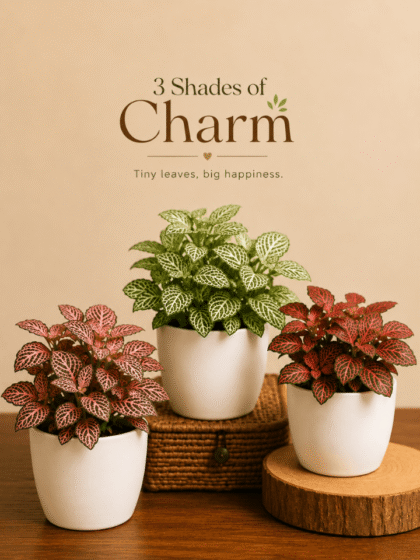
What is the Combo of 3 Minimalist Plant Set? It is a curated trio of three compact, low-light-tolerant houseplants — a Green Fittonia, a Money Plant Golden and a Money Plant N'Joy — supplied in three individual pots with well-draining soil, a care card and eco-safe packaging. The set is designed for Indian apartments, work desks, bedside tables and shaded balconies, and needs watering roughly once every five to seven days.
Three plants. Three pots. One quietly beautiful corner. The Combo of 3 Minimalist Plant Set brings together a nerve-veined Green Fittonia, a heart-leaved Money Plant Golden and a marbled Money Plant N'Joy — a trio chosen for its calm colour palette and forgiving nature. Each plant arrives healthy, potted in a nutrient-rich, well-draining mix, with a care card and a thank-you note tucked inside eco-safe packaging. Ideal for bedside tables, study desks, shelves and shaded balconies, this set is one of the easiest ways to begin indoor gardening in India — and one of the loveliest ways to gift it.
There is a particular kind of stillness that enters a room when living greenery arrives in it. Not the loud, jungle-in-the-living-room kind, but something quieter: a small trio of leaves on a shelf, catching the last of the afternoon light. That is exactly what this three-plant set was built to do.
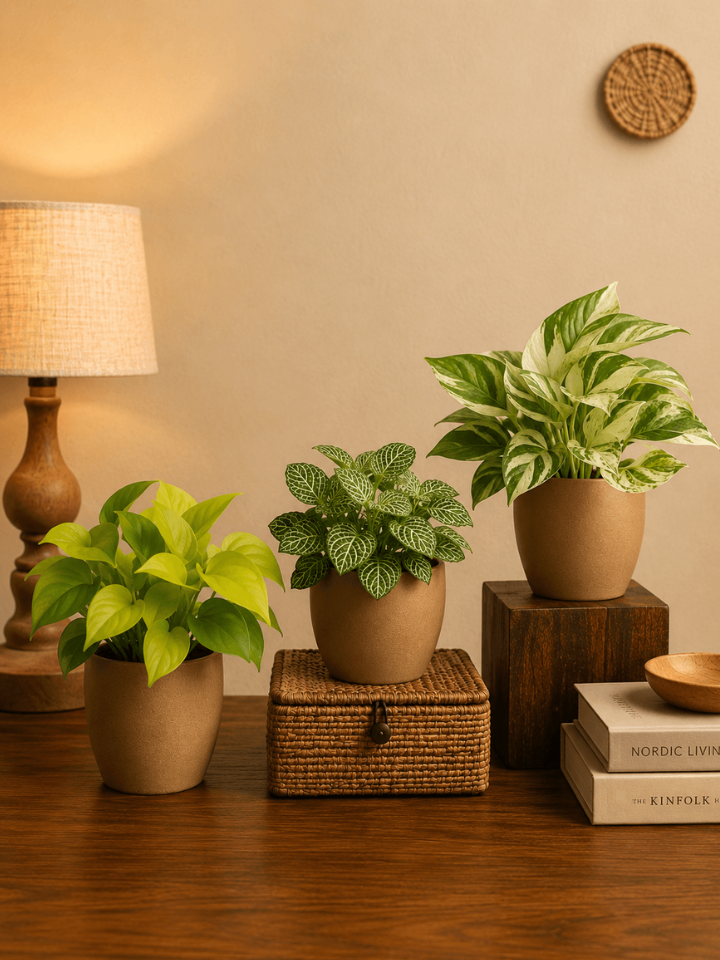
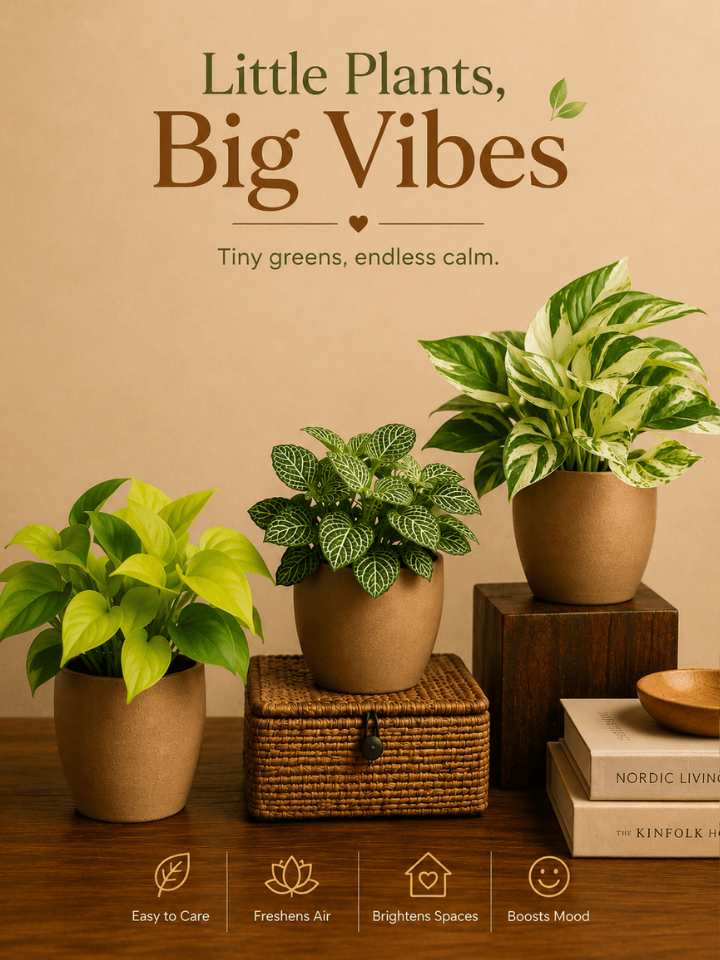
The Combo of 3 Minimalist Plant Set pairs a Green Fittonia — a low, spreading plant whose leaves are stitched through with pale veins — with two trailing pothos varieties: the sunny Money Plant Golden and the softly marbled Money Plant N'Joy. Together they occupy very little floor area, ask for very little of your time, and give back a great deal in mood, texture and freshness.
We designed this combination after watching what actually works in Indian homes. Flats are getting smaller. Balconies are half-enclosed. Many rooms receive bright light for two hours and gentle shade for the rest of the day. Air conditioners run for months, drying the air. Working hours are long, and nobody wants a plant that punishes a missed watering. So we selected three species that thrive under precisely those conditions, then packed them so they arrive in the same condition they left our nursery.
If you have been searching for a straightforward way to buy indoor plants online without a spreadsheet of care rules, this set is where most of our customers begin. It is also, quietly, where many of them stay — because three well-chosen species in three good pots often look better than fifteen unrelated ones.
Below you will find everything: botany, benefits, styling, room-by-room placement, a complete care manual, troubleshooting tables, seasonal advice for the Indian calendar, and more than twenty answers to the questions we are actually asked over WhatsApp every week.
Why This Plant Combo Is Perfect for Modern Homes
Modern Indian interiors have changed faster than the plant catalogues serving them. The 3BHK with a garden has given way to the 2BHK with a grill-enclosed balcony. Furniture has become lighter, palettes have become neutral, and clutter has fallen out of favour. Into that setting, a giant fiddle-leaf fig can feel like an obligation rather than a pleasure.
Minimalism is not about owning less for its own sake. It is about ensuring that everything present earns its place. Three plants, deliberately chosen and deliberately spaced, do more visual work than a crowded windowsill — and they take about eight minutes of attention a week between them.
There is also a practical argument. Beginners fail with houseplants for predictable reasons: they buy species that need conditions they cannot supply, then water on a schedule instead of on demand. Every plant in this set tolerates medium and low light, forgives a forgotten week, and signals its needs visibly. The Fittonia droops theatrically when thirsty and recovers within hours. Pothos leaves yellow slowly and give you ample warning. You learn to read plants on species that are willing to teach you.
Finally, the trio works as a system rather than three separate purchases. Two trailers and one spreader create the layered look that interior stylists build with pots at three different heights. That is the whole design principle behind the set, and it is why it photographs so well on a bookshelf.
If you can remember to check one pot every Sunday, you can grow all three of these. That is the entire commitment.
Meet the Plants in This Combo
Green Fittonia Plant
Botanical Information
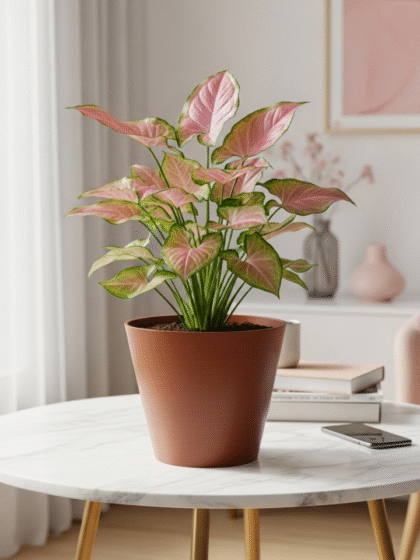
Fittonia albivenis belongs to the Acanthaceae family and originates in the humid understorey of the Peruvian and Colombian rainforest, where it carpets the forest floor beneath a dense canopy. Its common names — nerve plant, mosaic plant, silver-net leaf — all describe the same feature: a network of pale veins running across a deep green leaf like fine embroidery. It rarely exceeds 15 to 20 centimetres in height and spreads outward instead, forming a low cushion of foliage.
The genus honours Elizabeth and Sarah Fitton, the nineteenth-century Irish botanical writers. The species name albivenis translates directly as "white-veined". Under laboratory conditions it produces small, unremarkable spikes of cream flowers; indoors it almost never bothers, which is fine, because nobody buys this plant for its blooms.
Features
- Deep green leaves veined in white or pale silver, arranged in opposite pairs along a soft, trailing stem
- Compact spreading habit, ideal for shallow bowls, terrariums and desk pots
- Thrives in exactly the light that reaches the interior of an Indian flat — bright, indirect, filtered through a curtain
- Non-toxic to cats and dogs, confirmed against the ASPCA's plant database
- Highly expressive: the leaves collapse dramatically when the soil dries and re-inflate within two to four hours of watering
Benefits
The Fittonia is the beginner's best teacher. Because it wilts visibly rather than silently declining, you learn the single most important skill in indoor gardening — reading the plant instead of the calendar. It is also the colour anchor of this set. Where the two pothos contribute yellows and creams, the Fittonia contributes contrast: cool green shot through with silver, which reads as calm against warm wood and white walls.
Its rainforest ancestry makes it a natural for humid micro-zones. A bright bathroom shelf, a kitchen windowsill away from the flame, or a glass terrarium will all suit it better than an air-conditioned bedroom. Grouped with other pots, it raises local humidity for its neighbours through transpiration.
Customers who want to Buy Fittonia Plants as a standalone usually return for the combo, because the plant looks considerably better with a trailing companion beside it.
Care Requirements
| Requirement | Fittonia albivenis |
| Light | Bright indirect; tolerates medium shade. Never direct midday sun |
| Water | Keep evenly moist. Water when the top 1 cm feels dry — typically every 3–5 days |
| Humidity | 50–70% preferred. Mist in winter or group with other pots |
| Soil | Peat- or cocopeat-rich mix with perlite; must drain but never bake dry |
| Temperature | 18–28 °C. Protect from cold draughts and direct AC blast |
| Feeding | Balanced liquid feed at half strength, once a month, March to September |
Money Plant Golden
Botanical Information
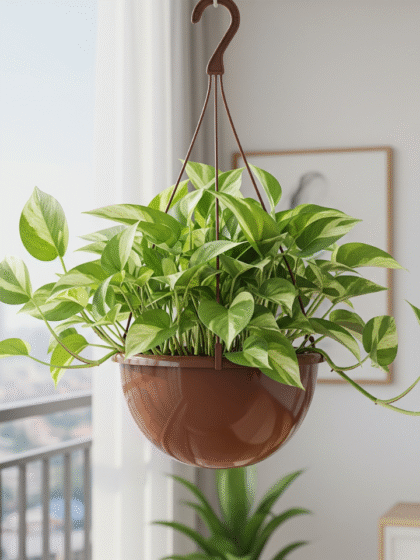
Epipremnum aureum — golden pothos to botanists, money plant to nearly every household in India — is an aroid native to the Solomon Islands and naturalised across the tropics. It climbs in the wild by clinging to tree trunks with aerial roots, and its leaves, which are modest and heart-shaped indoors, can grow to the size of dinner plates when the vine is allowed to ascend a mature tree.
Its foliage is bright green, splashed and streaked with buttery gold. That variegation is unstable and light-dependent: brighter positions produce more gold, deep shade produces solid green. This is a feature, not a fault, and it gives you a diagnostic tool. If your vine is reverting to plain green, it wants more light.
Features
- Vigorous trailing or climbing vine with glossy, gold-marbled foliage
- One of the most shade-tolerant vines in commercial cultivation
- Grows equally well in soil or in a plain glass of water, making it endlessly propagable
- Roots readily from a cutting with a single node — one plant eventually becomes many
- Long-lived; a well-kept vine will outlast most of the furniture around it
Benefits
This is the workhorse of Indian indoor gardening, and for good reason. It grows where almost nothing else will: the dim corner beside a wardrobe, the shelf above a staircase, the north-facing balcony that never sees the sun. It appeared in NASA's original 1989 Clean Air Study as an effective absorber of formaldehyde, benzene and xylene under sealed chamber conditions.
Culturally it carries additional weight. In Vastu Shastra, money plant placed in the south-east zone of a home is associated with prosperity and the flow of positive energy. Whether or not you subscribe to that, the plant is a fixture in Indian homes for practical reasons: it is nearly impossible to kill and free to multiply.
For a hallway or a stair landing, it belongs among the best good indoor hanging plants available anywhere.
Care Requirements
| Requirement | Epipremnum aureum |
| Light | Medium to bright indirect. Survives low light with reduced variegation |
| Water | Allow the top 3–4 cm to dry, then water thoroughly. Roughly weekly |
| Humidity | Adaptable. 40% and above is comfortable |
| Soil | Any free-draining potting mix; also grows hydroponically in water |
| Temperature | 15–32 °C. Genuinely hardy across the Indian plains |
| Feeding | Monthly during the growing season; skip December and January |
Money Plant N'Joy
Botanical Information
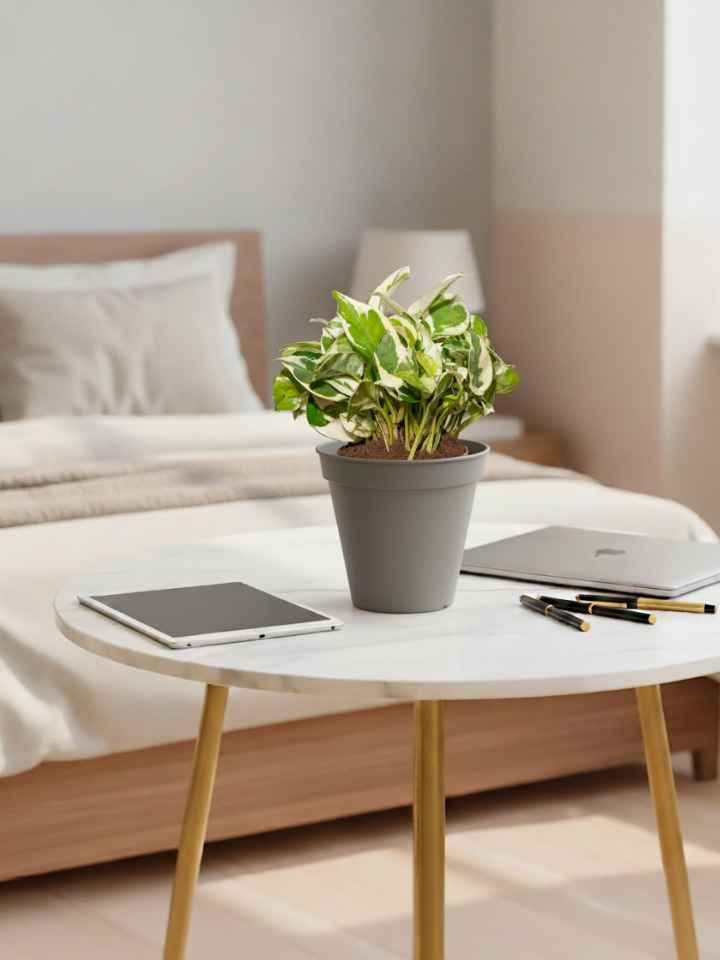
Epipremnum aureum 'N'Joy' is a patented cultivar of the same species, selected in the early 2000s for its distinct, sharply defined variegation. Where the Golden blurs green into gold, the N'Joy paints in clean blocks: creamy white islands against mid-green, with crisp borders and no bleeding between the two.
It is a smaller, denser, slower plant than its parent. Leaves are shorter, internodes are tighter, and the vine stays neat rather than sprawling. Because a larger share of each leaf carries no chlorophyll, it photosynthesises less efficiently — which means it needs brighter light than the Golden to hold its colour.
Features
- Sharply defined white-and-green variegation, unusually clean for a pothos
- Compact, bushy growth; ideal for small pots and short trails
- Slower and tidier than the Golden — it will not overrun a shelf
- Same easy propagation from nodal cuttings
- Reads as white in a photograph, which is why it dominates interior design feeds
Benefits
If the Golden is the workhorse, the N'Joy is the stylist. Its white variegation lifts a dark shelf, breaks up a monochrome wall and provides the visual gap that makes a grouping of pots feel considered rather than crowded. It carries the same cultural associations as the Golden in Vastu practice, and shares the same hardiness.
Because it stays compact, it is the plant in this trio most likely to end up as one of the small plants for office desk india — it will sit beside a monitor for years without ever needing to be moved.
Care Requirements
| Requirement | Epipremnum aureum 'N'Joy' |
| Light | Bright indirect, essential. Low light causes the white to fade to green |
| Water | Water when the top 3 cm is dry. Slightly less thirsty than the Golden |
| Humidity | 40–60%. Tolerant of dry air but happier with company |
| Soil | Free-draining mix with perlite or coarse sand; roots dislike waterlogging |
| Temperature | 18–30 °C |
| Feeding | Half-strength balanced feed monthly during active growth |
The Trio at a Glance
| Feature | Green Fittonia | Money Plant Golden | Money Plant N'Joy |
| Growth habit | Low spreading cushion | Long vigorous trailer | Compact bushy trailer |
| Light needed | Low to medium indirect | Low to bright indirect | Medium to bright indirect |
| Watering frequency | Every 3–5 days | Every 6–8 days | Every 6–8 days |
| Drought tolerance | Low (wilts, then recovers) | High | High |
| Safe around pets | Yes | No — keep out of reach | No — keep out of reach |
| Beginner difficulty | Easy with attention | Easiest | Easy |
| Best position | Desk, bathroom, terrarium | Shelf, hallway, balcony | Desk, bookshelf, console |
Benefits of Having This Plant Combo
Natural Air Purifier for Home
The phrase gets used loosely, so let us be precise about what the science supports. NASA's Clean Air Study, published in 1989, sealed individual plants in small chambers and measured the decline of volatile organic compounds. Golden pothos performed strongly against formaldehyde, benzene and xylene — compounds that leach from plywood, laminates, paints, adhesives and synthetic upholstery.
A 2019 review in the Journal of Exposure Science and Environmental Epidemiology reasonably pointed out that a real room is not a sealed chamber, and that matching a mechanical purifier through foliage alone would require an implausible number of pots. Both findings are true, and neither cancels the other.
What a trio of plants actually does in a living room is subtler and still worthwhile. Leaves intercept dust. Transpiration raises humidity in dry, air-conditioned air. Soil microbes metabolise a measurable fraction of airborne organics. Carbon dioxide falls slightly during daylight hours. And your nervous system responds to the presence of living green in ways discussed further below. Think of these as a natural air purifier for home use — a supplement to ventilation, never a replacement for opening a window.
Honesty here matters more than marketing. We would rather you buy this set for the reasons it delivers on than for a claim that would not survive scrutiny.
Indoor Plants for Bedroom
A bedroom asks two things of a plant: that it look calming, and that it not demand anything. The Fittonia's veined foliage is soothing at close range, and both pothos varieties will sit contentedly on a bedside table receiving only the light that reaches through a curtain.
The old anxiety about plants "stealing oxygen" at night deserves retiring. Respiration in a small potted plant consumes a quantity of oxygen so small it is dwarfed by the person sleeping beside it. A room with three pots is safer, greener and considerably more pleasant than a room without.
Position matters more than species here. Keep pots out of the direct path of an air-conditioner vent, which dehydrates foliage faster than any summer afternoon. Anyone building a collection of air purifier plants for bedroom corners will find this trio a sensible starting point.
Interior Plants for Offices
Desks are hostile environments: dry conditioned air, fluorescent overhead lighting, and an occupant who disappears for a fortnight over Diwali. The N'Joy and the Golden survive all three. The Fittonia will need a colleague to water it if you travel, but it takes up less room than a coffee mug.
Research from the University of Exeter, published in the Journal of Experimental Psychology: Applied, found that enriching a lean workspace with greenery raised measured productivity by roughly fifteen per cent, alongside improvements in reported concentration and workplace satisfaction. The effect was attributed to the plants' capacity to engage attention gently rather than demand it.
Practically: one pot on the desk, one on the filing cabinet, one trailing from a shelf. Three pots covering three sight-lines does more than one large specimen in a corner nobody looks at.
Plant Decoration in Living Room
The living room is where the set was designed to be seen. Layering is the whole trick. Place the Fittonia low — on a coffee table or the lowest shelf — where its cushion habit reads as a soft mass. Set the N'Joy at eye level, where the white variegation catches attention. Let the Golden trail from the top of a bookshelf or a wall bracket, so the eye travels upward and the room feels taller.
Odd numbers, varied heights, and a single repeated pot colour: that is the entire formula behind almost every indoor plants decoration in living room photograph you have saved.
Terracotta suits warm, wood-heavy interiors. Matte white or concrete suits cooler, greyer palettes. Avoid mixing more than two pot materials in one grouping — the plants should be the variety, not the containers.
Plants for Home Balcony
An Indian balcony is rarely a full-sun site. Grilles, overhangs and the neighbouring tower usually combine to produce bright shade, which happens to be the exact condition all three of these species prefer.
Keep the pots on the inner wall rather than the railing edge, away from harsh western afternoon sun that scorches variegated foliage within a week. During the monsoon, ensure water drains freely; standing water in a saucer will rot pothos roots faster than any pest. In peak summer, the Fittonia will need shifting indoors during the fiercest hours.
Handled that way, the set anchors a small balcony beautifully — and it pairs naturally with the flowering and foliage options in our best plants for balcony garden range.
Plants for Gifting
A living gift lasts. Housewarmings, first jobs, new apartments, recoveries, apologies — all are occasions where three small pots communicate more warmth than another candle set. The recipient does not need experience. The care card in the box tells them everything, in plain language, calibrated for the Indian climate.
This particular trio makes a good gift for a reason beyond sentiment: nothing in it is likely to die in the first month. That is not a small consideration when the person receiving it has never grown anything. Our full range of Plants for gifting includes larger statement pieces, but the combo remains the most-repeated purchase.
Ask us to include a handwritten note over WhatsApp and we will, at no charge.
Plant Combo Packs for Beginners
Buying plants individually is how beginners end up with a windowsill of species that want six different things. A combo removes that problem by design. All three of these tolerate the same light band, the same soil type, the same rough watering rhythm and the same feeding schedule. You learn one routine, not three.
Sets also solve the aesthetic problem. Curated combinations arrive pre-composed, so a shelf looks intentional the day it is unpacked rather than six months later. Our other Plant Combo Packs follow the same logic across different light conditions and price points.
Scientific Benefits of Indoor Plants
Three distinct bodies of research support keeping plants indoors, and it is worth separating them, because they are often blended into one overstated claim.
The first is environmental. Foliage and root-zone microbes remove a measurable quantity of volatile organic compounds from the air, and transpiration adds humidity. In sealed chambers these effects are large; in ventilated rooms they are modest but real.
The second is psychophysiological. Roger Ulrich's landmark 1984 study in Science found that surgical patients whose windows overlooked trees required less analgesic medication and were discharged sooner than matched patients facing a brick wall. Subsequent controlled work has repeatedly linked visual contact with vegetation to reductions in cortisol, blood pressure and self-reported stress.
The third is attentional. Attention Restoration Theory, developed by Rachel and Stephen Kaplan, proposes that natural stimuli engage involuntary attention — they are interesting without being demanding — allowing the directed-attention system exhausted by screens and spreadsheets to recover. This is the mechanism most often invoked to explain the productivity findings in office settings.
None of these require a rainforest. They require green within your field of view, most of the day.
Mental Wellness Benefits
The act of tending is doing much of the work. A 2015 study in the Journal of Physiological Anthropology compared participants who transplanted a houseplant against those who completed a short computer task, and found the horticultural group showed lower sympathetic nervous system activity and reported feeling more comfortable and soothed afterwards.
Caring for something that responds slowly is, in an environment engineered for instant feedback, an unusual and restorative experience. The Fittonia in this set is particularly good at this. It asks for attention every few days and rewards it visibly. That small loop — notice, act, observe recovery — is close to what therapists describe as behavioural activation.
There is also the matter of rhythm. Watering on a Sunday morning becomes a fixed point in a week that otherwise dissolves. Many customers tell us the ritual became the point, and the plants merely the excuse.
For anyone recovering from burnout, or simply working from a bedroom that has slowly become an office, a small living set at the edge of the desk is a low-cost, low-risk intervention.
Productivity Benefits
The Exeter research mentioned earlier is the most cited, but the pattern is broader. Studies across office environments consistently associate plant presence with improved concentration, higher reported job satisfaction, and reduced sick-building complaints such as headache, dry throat and eye irritation.
Three mechanisms are usually proposed. Plants raise ambient humidity, easing the mucosal dryness that conditioned air causes. They soften acoustic reflection slightly, reducing perceived noise in hard-surfaced rooms. And they provide a restorative visual target that allows the eye to refocus away from a screen at intervals — a genuine benefit for anyone experiencing digital eye strain.
Place one pot within twenty degrees of your monitor's edge. Look at it whenever you finish a task. That is the entire protocol.
Air Quality Benefits
Indian indoor air carries a specific load: cooking particulates from high-heat tempering, mosquito coil smoke, incense, dust ingress from construction, and off-gassing from the plywood and laminate that furnish most modern flats.
Pothos species address the last of these best. Formaldehyde is the principal off-gas from particleboard and adhesive, and it is among the compounds pothos absorbs most readily through leaf stomata and root-zone microbial activity. Benzene and xylene, present in paints and solvents, are similarly reduced under test conditions.
What plants do not do is filter particulate matter at any meaningful rate. If PM2.5 is your concern — and in most Indian cities during winter it should be — you need a mechanical purifier and closed windows. Keep both. Plants and machines address different pollutants, and a home benefits from each.
Three pots will not lower your PM2.5 reading. They will humidify dry air, capture dust on leaf surfaces, reduce VOC concentrations modestly, and change how a room feels. We would rather tell you that than sell you a promise the data does not carry.
Feng Shui and Vastu Benefits
In Vastu Shastra, the money plant is among the most frequently recommended indoor species. Convention places it in the south-east zone — the direction governed by Venus and associated with wealth — with the vine trained upward rather than allowed to trail on the floor, since ascending growth is read as rising fortune. Practitioners advise against placing it in the north-east, which is reserved for lighter, sacred plantings such as tulsi.
Chinese feng shui reaches a similar conclusion by a different route. The pothos is classed as a wood-element plant whose rounded, heart-shaped leaves generate soft, circulating chi, making it appropriate for the wealth corner and for softening the sharp energy that sha chi accumulates at protruding corners and beam edges.
The Fittonia has no strong traditional placement, but its low, spreading form and cool colouring make it a natural grounding element for a low table or an entrance console.
Two pieces of advice cut across both systems, and both happen to be horticulturally sound: remove dead and yellowing leaves promptly, and never allow the soil to sit in stagnant water. Stagnation is inauspicious in Vastu and fatal to pothos roots. The traditions and the botany agree.
Why These Are Among the Best Low Maintenance Plants for Indoors
"Low maintenance" is a slippery phrase in plant retail, so here is a working definition: a plant is low maintenance if it survives a fortnight of neglect, tolerates a wide light range, resists common pests, and communicates its needs before the situation becomes terminal.
Golden pothos meets every criterion comfortably. The N'Joy meets all four with a slightly narrower light tolerance. The Fittonia fails the fortnight-of-neglect test but passes the communication test spectacularly — it collapses, you water it, and it is upright by dinner.
| Criterion | Fittonia | Golden | N'Joy |
| Survives 14 days unwatered | No | Yes | Yes |
| Tolerates low light | Yes | Yes | Partially |
| Resists common pests | Moderate | Strong | Strong |
| Warns before serious damage | Excellent | Good | Good |
| Recovers from mistakes | Excellent | Excellent | Good |
That mixture is deliberate. Two plants that ask nothing, and one that asks a little, teaches a beginner the skills that eventually make a larger collection possible. If you would prefer three plants that ask for nothing at all, our indoor low maintenance plants category is the place to look.
How to Style This Plant Set at Home
Begin with a rule of thirds. Do not distribute one plant to each room. Group all three, then add a fourth object — a book stack, a ceramic vessel, a small lamp — to break the symmetry.
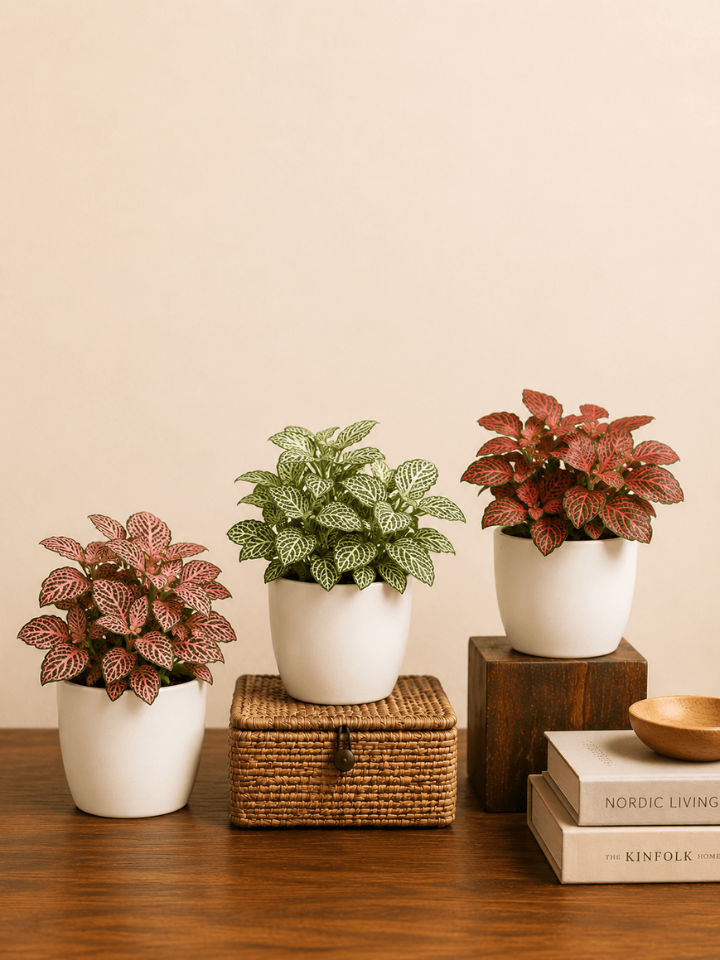
Vary height aggressively. If all three pots sit at the same level, the arrangement flattens. Raise the N'Joy on a stack of books or a small riser. Let the Golden trail from something higher. Keep the Fittonia low and forward, closest to the viewer, where its detailed veining rewards a close look.
Repeat one material. Three pots in the same finish and three different heights reads as designed. Three finishes and one height reads as accumulation.
Consider the background. Variegated foliage disappears against a busy wall and sings against a plain one. If your wall is patterned, place the Fittonia in front of it — solid green holds its shape where white variegation dissolves.
Light the group, if you can. A small warm-spectrum lamp aimed across rather than at the foliage will pick out leaf texture in the evening and make the corner feel intentional after dark. This is how professionals treat room decor plants, and it costs nothing to imitate.
Placement Ideas for Every Room
| Room | Best plant of the three | Position | Note |
| Bedroom | Money Plant Golden | Bedside table or wall shelf | Keep clear of the AC vent |
| Living room | All three, grouped | Bookshelf, console, coffee table | Layer at three heights |
| Home office | Money Plant N'Joy | Beside the monitor | Rotate the pot weekly for even growth |
| Study desk | Green Fittonia | Front-left of the desk | Its wilting reminds you to take a break too |
| Bathroom | Green Fittonia | Shelf near a frosted window | Only if the room receives daylight |
| Kitchen | Money Plant Golden | High shelf, away from the flame | Wipe leaves monthly; kitchen grease films them |
| Balcony | Golden and N'Joy | Inner wall, under the overhang | Shift the Fittonia indoors in peak summer |
| Entrance | Money Plant N'Joy | Console or shoe cabinet | White variegation lifts a dim foyer |
Pet Safety: An Honest Note
We are not going to be vague about this, because a search result should not send anyone to a veterinary emergency room.
The Green Fittonia is genuinely pet-safe. Fittonia albivenis appears on the ASPCA's non-toxic list for cats, dogs and horses. A curious animal that chews a leaf will be fine.
Both money plants are not. Epipremnum aureum, in the Golden and the N'Joy forms alike, contains insoluble calcium oxalate crystals. If a cat or dog bites a leaf, the crystals cause immediate oral pain, drooling, pawing at the mouth and sometimes vomiting or difficulty swallowing. Fatalities are rare; distress is common and genuine.
Hang or wall-mount both money plants where an animal cannot reach a trailing stem, or keep them in a room your pet does not enter. If ingestion occurs, rinse the mouth with water and call a veterinarian. For a set every member of the household can touch safely, browse our pet friendly indoor plants selection instead — it is exactly what that category exists for.
Many homes with pets keep pothos successfully. They simply keep it high. That is a reasonable choice, made with the facts in hand.
Plant Care Guide
Light Requirements
Bright indirect light means a position where you could read a book comfortably without switching on a lamp, but where no direct sunbeam falls on the leaves. In practical Indian terms: two to three feet back from an east-facing window, or beside a north-facing one, or behind a sheer curtain on a south or west aspect.
Direct sun scorches all three. Variegated foliage burns first because the pale tissue lacks the chlorophyll and protective pigmentation that green tissue carries. A single afternoon on an unshaded western sill can leave permanent brown papery patches on the N'Joy.
Deep shade is survivable but not free. The Golden reverts to plain green. The N'Joy loses its white. The Fittonia stretches, its internodes lengthen, and the cushion habit loosens into something straggly. Rotate every pot a quarter-turn each week so growth stays even rather than leaning.
Watering Guide
Water on evidence, never on schedule. Push a finger into the soil to the second knuckle. If it comes out damp, wait.
- Fittonia: water when the top centimetre is dry, roughly every three to five days in summer, every seven to ten in winter. It prefers evenly moist soil and will wilt if allowed to dry out — dramatically, but recoverably.
- Golden and N'Joy: allow the top three to four centimetres to dry completely, then water thoroughly until liquid runs from the drainage hole. Roughly every six to eight days in summer, every ten to fourteen in winter.
Empty the saucer within thirty minutes of every watering. Roots sitting in standing water begin to rot within days, and root rot is the single most common cause of pothos death in Indian homes — comfortably ahead of drought, pests and neglect combined.
Water quality matters more than most guides admit. If your municipal supply is heavily chlorinated, let it stand overnight in an open vessel. If it is very hard, the white crust that accumulates on soil surfaces is mineral deposit; flush the pot thoroughly every few months to clear it.
Humidity Requirements
The Fittonia wants between fifty and seventy per cent relative humidity. Indian coastal cities — Mumbai, Chennai, Kochi, Kolkata — supply this free of charge for most of the year. Delhi in winter and any air-conditioned room supply roughly half of it.
Three cheap fixes, in ascending order of effectiveness:
- Group the pots together. Transpiration from each raises the humidity around all of them. This is the entire argument for the combo as a physical arrangement rather than three scattered pots.
- Stand the pots on a shallow tray of pebbles topped up with water, keeping the pot bases clear of the waterline. Evaporation lifts local humidity without wetting the roots.
- Run a small humidifier nearby during the driest months. Misting is pleasant and briefly effective, but it evaporates within twenty minutes and, in cool weather, can encourage fungal leaf spot.
The pothos pair are far more tolerant and will manage at forty per cent without complaint.
Fertilizing Schedule
Potting mix is exhausted within eight to ten weeks of planting. After that, growth depends on you.
- Use a balanced liquid houseplant feed — an NPK ratio near 20:20:20 or 19:19:19 is standard — diluted to half the strength printed on the label.
- Apply once a month from March through September, when the plants are actively growing.
- Withhold entirely in December and January. A dormant plant cannot use nutrients, and unused salts accumulate in the soil.
- Always water lightly before feeding. Fertiliser applied to bone-dry soil burns fine root hairs.
Organic alternatives work well: a monthly drench of dilute vermicompost tea, or a teaspoon of well-rotted compost worked into the top layer each season. Yellowing between leaf veins while the veins stay green usually indicates iron or magnesium deficiency rather than a watering error.
Repotting Guide
Repot when roots emerge from drainage holes, when water runs straight through without wetting the soil, or when growth stalls despite good light and feeding. For all three species, that is typically every eighteen to twenty-four months.
Choose a pot two to five centimetres wider than the current one — no more. An oversized pot holds a volume of wet soil that the root system cannot drain, and that is root rot waiting to happen. Terracotta breathes and forgives overwatering; plastic and ceramic retain moisture and suit forgetful owners.
Repot in early spring, when the plant has energy to recover. Water the day before so the root ball slides out intact. Tease apart circling roots gently, trim anything blackened or mushy with clean scissors, and settle the plant at the same depth it sat before. Water in thoroughly and keep it out of direct light for a week.
A serviceable mix for all three: two parts cocopeat or good garden soil, one part perlite or coarse river sand, one part well-rotted compost. Add a handful of neem cake to deter soil-dwelling larvae.
Pruning Guide
Pruning is not optional for pothos. Left alone, a vine grows long and bare, with foliage only at the tip. Cutting it back forces branching at the nodes behind the cut, and the plant thickens.
Cut with clean scissors roughly one centimetre below a node — the small bump where a leaf joins the stem. Every cutting you take is a new plant: drop it in a glass of water, keep at least one node submerged and one leaf above the surface, change the water weekly, and roots will appear within two to three weeks. Pot it up once they reach five centimetres.
The Fittonia benefits from pinching rather than pruning. Nip out the growing tips with your fingers, and the plant bushes outward instead of running. Remove flower spikes if they appear; they consume energy the foliage could use.
Remove yellow and browned leaves whenever you see them. A dying leaf is not being rescued by the plant — it is being drained.
Pest Management
Indoor pests arrive on new plants, on open windows, and on cut flowers. Inspect the undersides of leaves once a month. That single habit prevents almost every infestation from becoming a problem.
| Pest | Signs | Treatment |
| Mealybug | White cottony clusters in leaf joints | Dab each with a cotton bud dipped in surgical spirit, then spray with neem oil solution |
| Spider mite | Fine webbing, stippled or bronzed leaves | Raise humidity; rinse foliage; apply neem oil weekly for three weeks |
| Fungus gnat | Small flies rising from the soil | Let the topsoil dry fully; add a sand layer; use yellow sticky traps |
| Scale | Brown limpet-like bumps on stems | Scrape off manually; treat with neem oil or horticultural soap |
| Aphid | Clusters on soft new growth | Spray off with water; follow with mild soap solution |
The standard neem treatment for Indian conditions: five millilitres of cold-pressed neem oil and two or three drops of mild liquid soap in one litre of water. Spray in the evening, never in direct sun, and cover leaf undersides thoroughly. Repeat weekly until the population collapses.
Isolate any newly purchased plant for two weeks before it joins the group. This costs nothing and saves entire collections.
Common Problems and Solutions
| Symptom | Most likely cause | What to do |
| Fittonia collapsed flat | Soil dried out completely | Water thoroughly; it should recover within four hours |
| Yellow lower leaves on pothos | Overwatering or poor drainage | Let the soil dry; check the drainage hole; empty the saucer |
| Brown crispy leaf edges | Low humidity or salt build-up | Raise humidity; flush the pot thoroughly with water |
| N'Joy losing its white | Insufficient light | Move closer to a bright window, out of direct sun |
| Golden reverting to plain green | Insufficient light | Same remedy; prune reverted vines back to variegated growth |
| Long bare stems, few leaves | Etiolation from low light | Increase light and prune hard to force branching |
| Black mushy stem base | Root rot | Unpot, cut away all rotten tissue, repot in fresh dry mix |
| Sudden leaf drop | Cold draught or AC blast | Relocate away from vents, doorways and open windows |
| White crust on soil surface | Mineral or fertiliser salts | Flush with three pot-volumes of water; reduce feed strength |
| Leaves dull and dusty | Airborne dust and grease | Wipe with a soft damp cloth monthly |
Seasonal Care Tips
Summer (March to June)
Growth peaks and water demand roughly doubles. Move all three pots away from windows receiving direct afternoon sun. Increase the Fittonia's watering to every two or three days if the room exceeds 32 °C. Feed monthly. Watch for spider mite, which thrives in hot, dry conditions and multiplies quickly under air conditioning.
Monsoon (June to September)
Humidity climbs, which the Fittonia enjoys and the pothos merely tolerates. Cut watering by roughly a third — soil dries slowly in damp air, and overwatering now is the commonest mistake of the year. Ensure balcony pots drain freely and never stand in collected rainwater. Fungal leaf spot and fungus gnats both peak; improve air circulation with a ceiling fan on its lowest setting.
Post-Monsoon and Autumn (October to November)
A second, gentler growth flush. This is the ideal window for taking cuttings, since rooting is fast and the plant has energy to spare. Prune leggy vines now so the plants enter winter compact. Deliver the final feed of the year in late October.
Winter (December to February)
Growth slows to near zero across northern India. Water only when the soil is genuinely dry — halve your summer frequency. Stop feeding entirely. Move pots away from windows at night, where temperatures can fall sharply and cold glass chills foliage. Indoor heating and dry Delhi air will stress the Fittonia; a pebble tray becomes worthwhile. Expect no new growth, and do not interpret its absence as failure.
Who Should Buy This Plant Combo?
- The first-time plant owner who has killed a succulent and concluded they lack the gene. They do not. They bought the wrong plant.
- The apartment dweller with limited floor area and a shelf that needs filling.
- The remote worker whose bedroom has become an office and needs a visual boundary between the two.
- The gift-giver who wants something living, appropriate for almost anyone, and unlikely to fail in the recipient's hands.
- The parent introducing a child to gardening, using the Fittonia as a plant that visibly responds to care.
- The collector who wants a coherent starting trio before expanding.
Who should probably choose differently: households with a cat that climbs, unless the pothos can be genuinely wall-mounted out of reach; and anyone whose only available position is a fully sunlit south-facing sill.
Why This Combo Makes an Ideal Gift
A gifted plant carries an implicit message — I think you will still be here, tending this, months from now. That is a quietly generous thing to say.
Practically, the combo gifts well because it is difficult to fail with. Three species, one care routine, no specialist equipment. It arrives potted, so there is nothing to assemble. It survives the recipient's first fortnight of learning.
It also scales across occasions. A single set suits a housewarming. Three sets suit a team. Add a ceramic planter from our accessories range and it becomes a wedding gift without looking like an afterthought.
Tell us the occasion on WhatsApp when you order, and we will pack it accordingly.
Why Beginners Love This Plant Set
Because it forgives them. Every experienced plant owner has a graveyard behind them, and most of those deaths trace to a mismatch between the plant's requirements and the buyer's circumstances.
This trio narrows that gap deliberately. The light band is wide. The watering rhythm is loose. The failure modes are visible and reversible. And when a beginner takes their first cutting from the Golden, watches white roots appear in a glass of water, and pots up a plant they made themselves — that is usually the moment the hobby takes hold.
Why This Combo Suits Apartments and Offices
Total footprint: less than the area of a laptop. Total watering time: under five minutes a week. Total light requirement: whatever reaches two feet inside a curtained window.
Apartments in Indian cities are optimised for everything except plants — sealed windows, deep floor plates, balconies converted into utility areas. Offices are worse. These three species evolved beneath a rainforest canopy, in permanent filtered shade. Your poorly lit flat is not a compromise for them. It is, more or less, home.













There are no reviews yet.