Kalanchoe blossfeldiana is a succulent from the highlands of Madagascar and a member of the Crassulaceae, the stonecrop family that also gives us the jade plant and the echeverias. Red is where the species started. When Robert Blossfeld introduced it to European growers in the 1930s the wild plant carried scarlet flowers, and every pink, yellow, orange and white kalanchoe on sale today descends from breeding work done on that red original. Buying the red one is, in a small way, buying the plant itself rather than a variation on it.
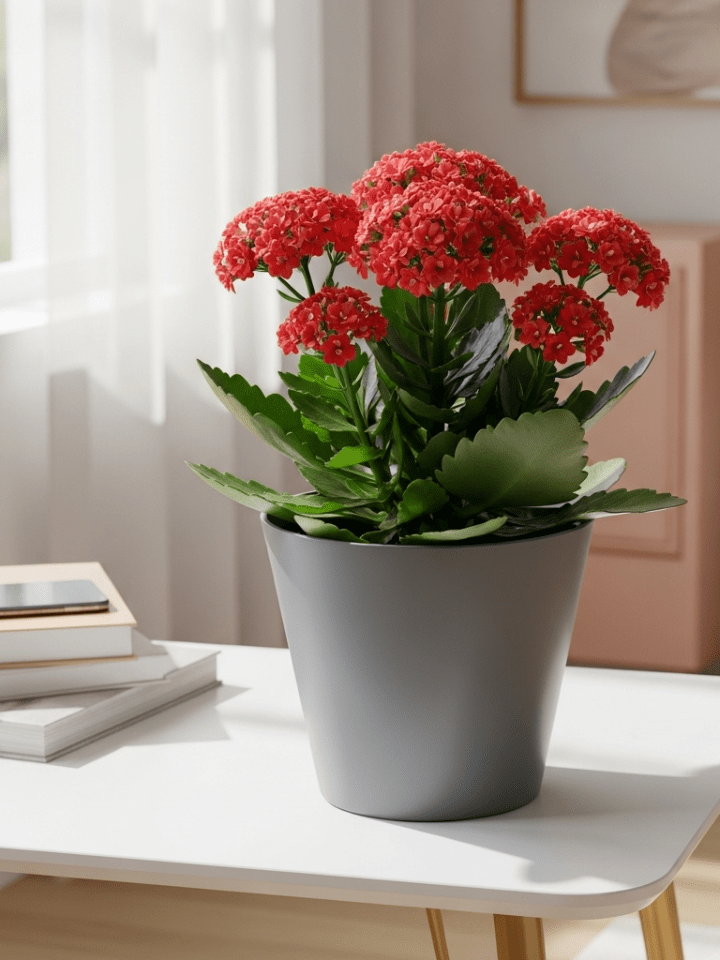
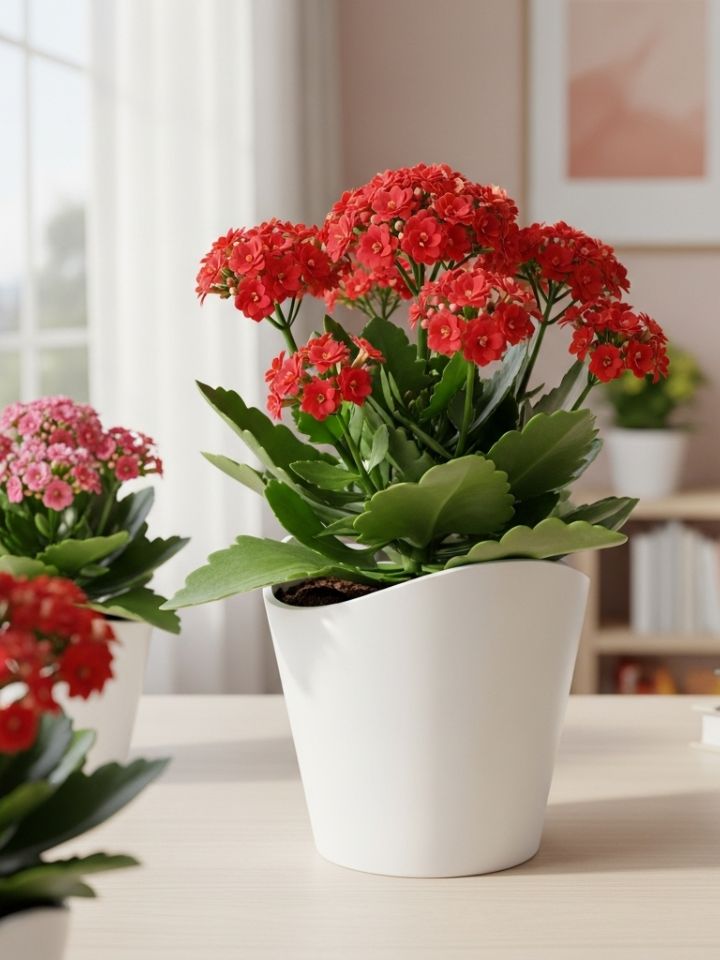
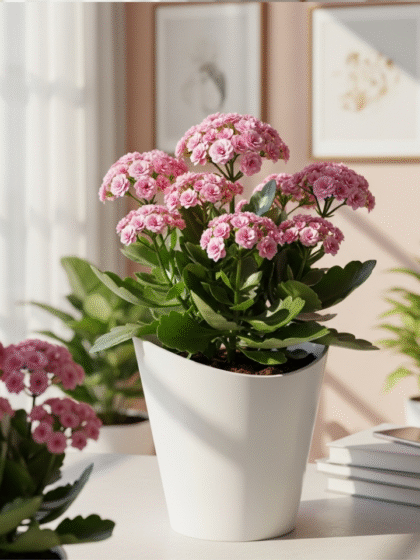
The habit is a low, branching mound of thick leaves — glossy, deep green, with soft scalloped edges and a slightly waxy surface that catches the light. Flowers are held clear of the foliage on short stalks in dense, flat-topped heads, each head made of dozens of small four-petalled blooms. Against dark green leaves the red reads almost lacquered, which is why this colour photographs better than any of the others and why it is the one that sells through December. Some cultivars carry double, rose-like flowers rather than the single four-petalled form.
What makes it easy is the same thing that makes it easy to kill. The leaves are a water store, so a plant forgotten on a shelf for three weeks is usually fine and a plant watered attentively every few days is usually dead. That single fact governs everything below, and it is why this one sits among the hardy indoor plants in our range and alongside the other succulent plant varieties we grow on our own benches. Growing rather than reselling is the whole reason we set up to buy live plants online from a nursery instead of a warehouse.
Where it looks and grows best
Light decides everything with this plant, and the requirement runs against the instinct most indoor growers have. Give it a south- or east-facing sill, the open end of a balcony, or the sunniest table you own. Four to six hours of direct morning sun produces short internodes, thick leaves and flower buds. A shaded corner produces a stretched plant with pale, widely spaced foliage and no blooms at all — and that, not watering, is the commonest reason a kalanchoe disappoints its owner in year two.
Because it wants sun and shrugs off dry air, it is one of the few genuinely good plants for an east-facing balcony in an Indian flat, where afternoon heat rules out most flowering pot plants. Indoors it belongs on the sill rather than the console table, though a bright bay window makes it one of the more rewarding living room plant ideas for the cooler half of the year, when almost nothing else in a collection is in colour. It sits comfortably among the other indoor plant varieties that ask for real light rather than tolerating the lack of it, and it earns its slot in a grouping of flower plants for the home precisely because it flowers when the rest of the shelf has stopped — which is also why it belongs with the winter flowers for pots.
Red also makes this the obvious one to give away. It arrives in colour, holds it for weeks rather than the four days a cut bouquet manages, costs less than the bouquet, and asks almost nothing of a recipient who does not keep plants. Through Diwali, Christmas and the New Year the colour does half the work of the wrapping, which is what makes it one of the more practical indoor plants for a gift on the site — with the caveat below about homes with animals.
Two places to avoid: anywhere a saucer can sit full of water, and an open balcony through the monsoon, where weeks of rain landing straight into a small pot will rot the roots before the leaves show anything is wrong.
Why red fades, and how to keep it saturated
Flower colour in this species is not fixed at the nursery. Two conditions set how deep the red runs, and both are in your control.
The first is light. Red kalanchoe pigment develops under strong light, so a plant that opens its buds on a sunny sill holds a deeper, more saturated colour than the same plant opening them two metres back in the room, where the flowers tend towards a washed brick-red. If the blooms on last year's plant looked thinner in colour than the ones it arrived with, light is almost always the answer.
The second is temperature. Colour holds best in cool conditions, which is convenient, because that is also when the plant flowers. A Kolkata December suits it exactly; a warm room with the flush opening in late February will fade faster.
One thing that is not a fault: the leaf margins often flush red or bronze in strong sun, most noticeably in April and May. That is a stress pigment doing its job, not sunburn, and many growers deliberately encourage it.
Will it flower again? A straight answer
This is the question the whole keyword cluster turns on, and almost no listing in this market answers it.
Kalanchoe is a short-day plant. It sets buds only when nights are long — roughly 14 hours of uninterrupted darkness a day for at least six weeks before buds initiate, then another six or so for them to open. In nature that timing lands over a north Indian or Bengali winter, which is why these plants come into colour from about November through February.
Here is the honest part. Indoors, that chain breaks easily. An evening lamp, a streetlight through a thin curtain, a room that stays warm after dark — any one of them tells the plant the nights are still short, and no buds form. Most kalanchoes bought in bloom never bloom again, and the cause is nearly always light at night rather than anything the owner got wrong with water or feed.
Getting a second year of colour takes about twelve weeks of mild discipline:
- When the last flowers brown, cut the spent stalks back to the top of the foliage and let the plant rest. Water sparingly.
- From late September or early October, give it eight to ten hours of bright light a day and put it somewhere genuinely dark for the other fourteen. A cupboard, an unused bathroom or a carton over the pot all work.
- Keep the nights cool where you can. Bud initiation slows above about 27 °C, which is why an October in eastern India can be marginal.
- Halve the watering through this stretch and stop feeding altogether.
- The moment you can see bud clusters forming, end the routine and move it back to its sunny sill.
Six weeks of covering a plant every evening is more than most people will do and treating it as a long-lasting seasonal flower and keeping the foliage afterwards is a perfectly sensible choice. But it is your choice, and you should know it exists.
Product Specifications
- Plant name — Kalanchoe Plant Red
- Botanical name — Kalanchoe blossfeldiana
- Also known as — Flaming katy, red kalanchoe, florist kalanchoe, Madagascar widow's-thrill
- Plant family — Crassulaceae (stonecrop family)
- Origin — Madagascar; red is the original wildflower colour of the species
- Plant type — Evergreen flowering succulent, perennial (commonly sold as though it were an annual)
- Foliage — Thick, glossy, deep green leaves with scalloped edges; margins often flush red or bronze in strong sun
- Flowers — Dense flat-topped clusters of small four-petalled scarlet blooms held above the foliage; some cultivars carry a double, rose-like form
- Flowering season — Typically November to February in Indian conditions; a single flush lasts roughly 6–8 weeks
- Flowering trigger — Short days. About 14 hours of uninterrupted darkness daily for six weeks or more is needed to set buds
- Growth habit — Low, rounded, branching mound
- Growth rate — Moderate through the growing season; slow in the monsoon
- Suitable placement — Sunny windowsill, bright balcony ledge, sunlit table; indoors or outdoors in unshaded light, under cover during heavy rain
- Light requirement — Direct sun. 4–6 hours of morning sun preferred; survives bright indirect light but flowers poorly in it
- Water requirement — Low. Water only when the soil is dry right through; roughly every 10–14 days in summer and every 3 weeks in winter
- Soil requirement — Gritty, free-draining cactus and succulent mix; sand and perlite added to ordinary potting soil works equally well
- Temperature — 15–30 °C. Bud initiation slows above about 27 °C; not frost-hardy
- Humidity — No special requirement; prefers drier air than most indoor plants
- Fertiliser — Balanced liquid feed at half strength monthly in the growing season; high-potassium feed before flowering; none in the monsoon
- Difficulty level — Easy to keep as a foliage succulent; moderate to bring back into flower
- Suitable environment — Bright, warm, dry indoor spaces and sheltered outdoor ledges
- Pet safety — Not pet-safe. ASPCA-listed as toxic to cats and dogs (bufadienolides)
- Propagation — Stem or leaf cuttings, callused for 2–3 days before planting
- Air purification — No meaningful effect; grown for its flowers
Care guide
- Light — Direct sun for several hours, morning for preference. Filter harsh May afternoon sun coming through west-facing glass, which will scorch the leaves.
- Water — Soak until it runs from the base, let it drain, then leave it entirely alone until the soil is dry right through. Roughly every 10–14 days in summer and every three weeks in winter. Water the soil, never the flower heads.
- Soil — Gritty and free-draining. A cactus and succulent mix, or ordinary potting soil cut about half-and-half with coarse sand and perlite. Heavy garden soil holds water in exactly the way these roots cannot survive.
- Drainage — Non-negotiable. Holes in the pot, and a saucer that gets emptied. More of these plants die of a full saucer than of everything else combined.
- Temperature — Happy between 15 °C and 30 °C, and at its best in the cooler end of that. It takes a Bengal winter in its stride and is not frost-hardy, which is not a concern in most of India.
- Feeding — A balanced liquid feed at half strength once a month through the growing season, switching to a high-potassium feed such as a tomato fertiliser in the run-up to flowering. Nothing during the monsoon, and nothing while it is in full bloom.
- Deadheading — Pinch each flower head off as it browns. It keeps the plant tidy and stops it spending energy on seed. Cut the stalks back to the leaves once the whole flush is done.
- Keeping it compact — Pinch the growing tips out once or twice after flowering. Left alone it goes leggy and bare at the base; pinched, it branches and thickens.
- Repotting — Every two years at most, in spring, one size up only. It flowers better slightly pot-bound, and a large pot simply holds water it does not want.
- Propagation — Very easy, and worth doing before the parent gets woody. Take a 6–8 cm stem cutting or pull a healthy leaf, let the cut end dry and callus for two or three days, then push it into barely damp gritty mix. Roots follow in two to four weeks. No water at all while it is callusing.
Growing it through the Bengal year
These notes come from raising succulents on our own benches, which is where the indoor plants in Kolkata we ship are actually grown.
Winter, late November to February. The plant's season, and the reason to own it. Cool nights, long darkness and dry air are the conditions it evolved for, and a red kalanchoe on a sunny sill in December is usually the only thing in the flat carrying colour. Water every three weeks or so and no more.
Summer, March to May. Growth continues; flowering stops. Water every ten days or so, pull it back from west-facing glass by late April, and expect the leaf margins to redden. Our guide to caring for indoor plants through a Bengal summer covers the rest of the collection in the same way.
Monsoon, June to September. The dangerous stretch, and the only months this plant needs real thought. Saturated air, soil that stays wet for weeks and a pot where rain can land add up to root rot, which on a succulent is usually fatal by the time the foliage looks wrong. Move it under cover, abandon any watering schedule, and check the soil with a finger before you even consider it. Through much of August the correct answer is to do nothing for a month.
Common problems and quick fixes
- Soft, yellowing, translucent leaves low on the plant — Overwatering, nearly every time. Stop watering, empty the saucer, let the soil dry completely. If the stem has gone soft at soil level, take healthy cuttings straight away; they root easily and will carry the plant on even if the parent is lost.
- Stretched growth with long gaps between the leaves — Too little light. Move it to the brightest spot available and pinch the tips back to force branching.
- No flowers in the second year — Almost certainly light at night. See the reblooming section above. This is a day-length problem, not a feeding one.
- Buds forming and then dropping before they open — A sudden change in temperature, position or watering while the plant was in bud. Settle it in one place and leave it there.
- Flower colour weaker than last season — Not enough direct light while the buds were opening, or a warm room. Both are covered in the colour section above.
- Brown, papery patches on the leaves — Sunburn, usually from harsh afternoon sun through glass. Move it to morning light. The marks do not heal.
- White cottony specks tucked into the leaf joints — Mealybugs, the commonest pest on this species. Touch each one with a cotton bud dipped in surgical spirit, then spray with diluted neem oil weekly for three weeks.
- Flowers finished and the plant looks bare — Entirely normal. Cut the spent stalks back, pinch the tips, and let it rebuild as a green succulent until next season.
Is the Kalanchoe Plant Red safe for cats and dogs?
No. The ASPCA lists Kalanchoe species as toxic to cats and dogs. The active compounds are bufadienolides — cardiac glycosides, which is a different and more serious category than the calcium oxalate irritants found in most toxic houseplants. In most reported cases a pet that chews a leaf gets vomiting and diarrhoea; the Pet Poison Helpline notes that abnormal heart rhythm does occur, but that it is rare and associated with larger ingestions.
The practical rule is straightforward. If you keep a cat that grazes on foliage or a dog that chews, this plant belongs on a high shelf, outdoors, or not in the house. If an animal has eaten a quantity of it, ring your vet rather than waiting to see what develops.
If that rules it out, the holiday cactus is the closest honest substitute we sell: ASPCA non-toxic to both cats and dogs, flowering in red on almost the same winter schedule, and asking for a similar dry-between-waterings routine. For something larger and green, the areca palm indoor plant is the other confirmed non-toxic option in the range, and the full list of cat-friendly plants is worth reading with the ASPCA database open beside it. If it was the succulent you were after rather than the flowers, the jade plant for an office desk wants the same sun and the same sparing watering and is safe around animals.
A straight answer on air purification
This plant appears on air-purifying lists because most succulents do, not because anyone tested it. No Kalanchoe featured in NASA's 1989 Clean Air Study, and in a real room the effect is negligible regardless — Cummings and Waring calculated in 2019 that you would need somewhere between 10 and 1,000 plants per square metre to match the air exchange an open window already provides. It does use CAM photosynthesis and so takes in carbon dioxide after dark, but the quantities are far too small to change the air in a room or affect anyone's sleep. Our explainer works through which indoor plant purifies the air the most and what the evidence actually supports. Buy this one for the flowers.
Red flowers, Vastu and Feng Shui
Red is the strongest colour in both traditions and the placements differ from what you would be told about a pink or white flowering plant. Feng Shui associates red with the fire element and the south sector, which governs reputation and recognition, and red flowering plants are often suggested there or near an entrance for vitality. Vastu practice generally places flowering plants in the east or north-east and tends to associate red blooms with the south and south-east; some practitioners keep sharply succulent plants away from the main door, and others do not.
Worth saying plainly: these plant-by-plant placements are modern convention rather than classical scripture, and no traditional text names a Madagascan species. They matter to a great many households and we are glad to note them, but this is a good-looking, hard-wearing flowering plant whatever you make of the tradition. Our room-by-room guide to plant direction as per Vastu sets the rest out properly.

































There are no reviews yet.