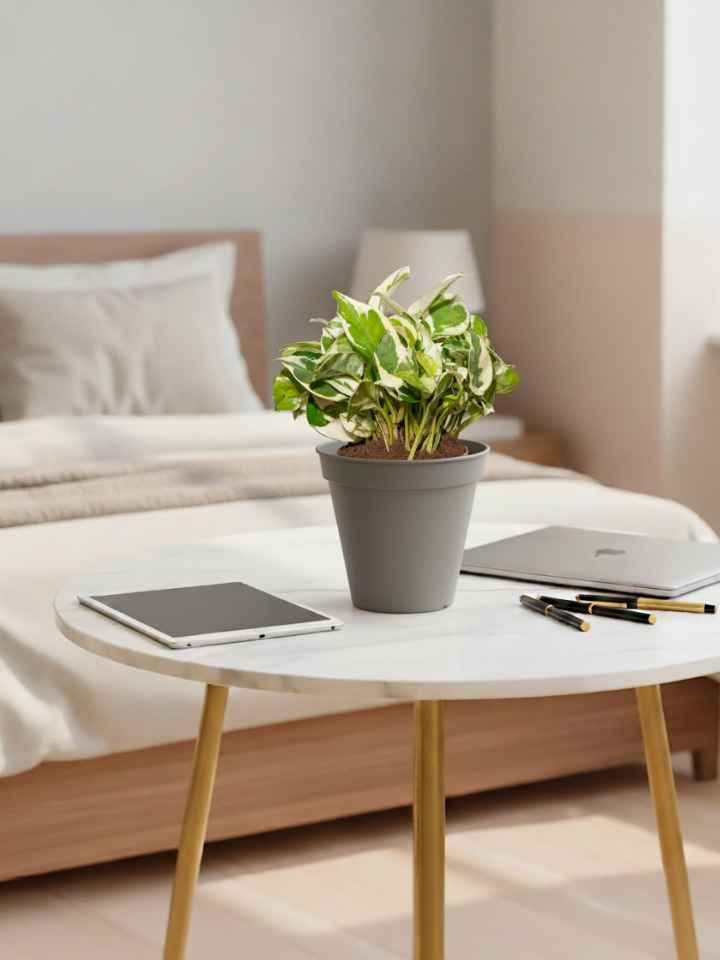
Money Plant Variegated is a cream-and-green form of Epipremnum aureum. That is the same species India calls money plant and the rest of the world knows as pothos. The familiar golden type is streaked with yellow. This one is marbled, flecked and sometimes brushed with creamy white instead: some leaves are almost entirely green, others close to half cream. That irregular pattern is the appeal. Each vine looks hand-painted.
The leaves are glossy, firm and heart-shaped. They sit on flexible stems that trail when left alone and climb when given something to hold. The cream sections carry little or no chlorophyll, so the plant grows at a steadier pace than its greener cousins. That works in its favour, because it stays tidy on a desk or shelf for longer and needs trimming less often.
Where it looks and grows best
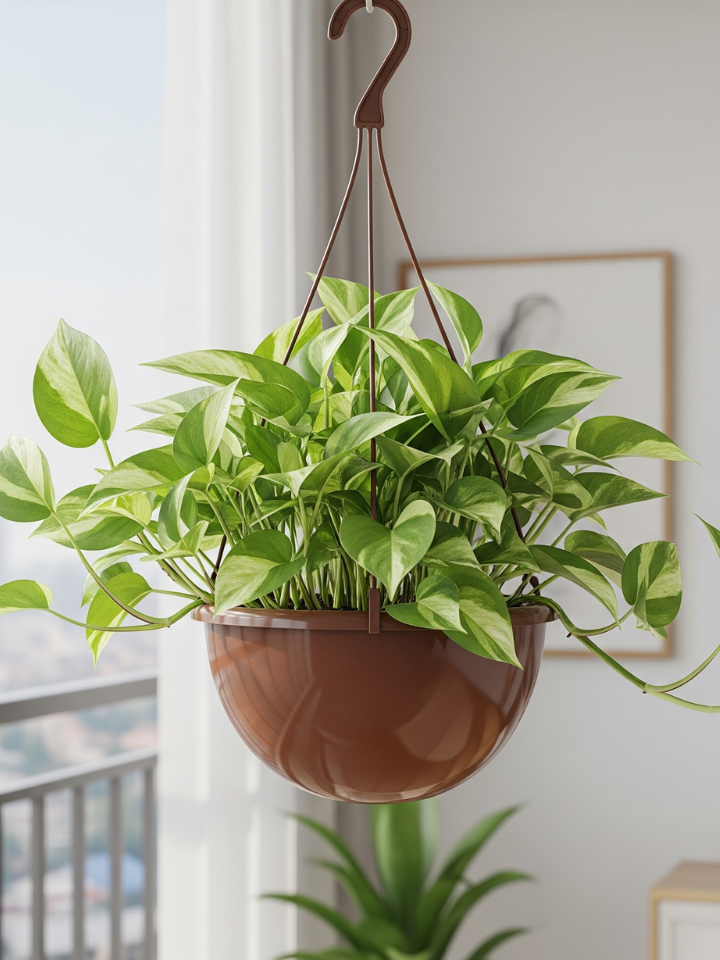
Pick the brightest spot you have that avoids direct sun. Good options are a metre or two back from an east- or north-facing window, a bright shelf in the living room, a bedroom ledge that gets good daylight, or an office desk near a window. A bathroom with a window suits it too, because it likes the humidity. It looks its best trailing from one of our hanging plants baskets at eye level, where you can see the marbling close up.
In a dim corner it will survive, but it gives up the cream first. New leaves come out smaller and plainer. If you only have a low-light spot, a plant that is naturally all green will do better there.
Variegated, golden or Chinese money plant — which is which?
| Sold as | What it is | What it looks like | Light it wants |
| Money Plant Variegated (this plant) | Epipremnum aureum, cream-variegated form | Heart-shaped leaves marbled green and creamy white | Bright indirect |
| Money Plant (Golden) | Epipremnum aureum | Heart-shaped leaves streaked green and yellow-gold; faster growing | Moderate to bright indirect |
| Money Plant N'Joy | Epipremnum aureum 'N'Joy' | Smaller leaves with crisp, clearly separated white and green sections; compact | Bright indirect |
| Variegated Chinese money plant | Pilea peperomioides — a different plant altogether | Round, coin-shaped leaves on upright stalks | Bright indirect |
Put simply, the variegated, golden and N'Joy money plants are all one species with different leaf colouring. The Chinese money plant only shares the nickname.
Product Specifications
| Specification | Detail |
| Plant name | Money Plant Variegated |
| Botanical name | Epipremnum aureum, variegated form (syn. Scindapsus aureus) |
| Plant family | Araceae (aroid family) |
| Also known as | Variegated pothos, marble money plant, variegated devil's ivy |
| Plant type | Evergreen perennial climber; trailing vine |
| Foliage | Glossy, heart-shaped leaves marbled green and creamy white. Pattern varies from leaf to leaf |
| Suitable placement | Hanging planter, shelf, living room, bedroom, office desk near a window, bathroom with natural light, covered and shaded balcony |
| Light requirement | Bright indirect light. Tolerates moderate light but loses variegation. Avoid direct afternoon sun |
| Water requirement | Moderate. Water when the top 2–3 cm of soil is dry: about weekly in summer, every 10–14 days in winter, less in monsoon |
| Soil requirement | Loose, well-draining potting mix. |
| Growth habit | Trailing or climbing. Moderate growth rate, slower than the golden money plant |
| Temperature | Most comfortable at 18–30 °C. Protect from temperatures below about 12 °C |
| Humidity | Average to high. Enjoys humid conditions |
| Difficulty level | Easy, beginner-friendly with good light |
| Suitable environment | Indoors or a shaded, covered balcony. Not suited to open sun or frost |
| Grows in water | Yes, stem cuttings root and grow in a jar of water |
| Propagation | Stem cuttings with at least one node, in water or soil. Roots in about 2–4 weeks |
| Pet safety | Not pet-safe. ASPCA lists it as toxic to cats and dogs |
Care guide
| Care | What to do |
| Light | Bright, indirect light all day. The more light it gets short of direct sun, the more cream you keep. Harsh afternoon sun through glass scorches the pale patches first |
| Water | Water thoroughly until it drains from the base, then wait until the top 2–3 cm of soil is dry. That is about weekly in summer and every 10–14 days in winter. A slight droop means it is thirsty, and it recovers within hours |
| Soil | lose, free-draining potting mix. Cocopeat, coco chips or coarse sand keep it airy. It must never sit in waterlogged soil |
| Feeding | Give a balanced liquid fertiliser at half strength once a month from March to September. Skip it in winter. Heavy feeding pushes lush green growth and does nothing for the variegation |
| Repotting | Every 18–24 months, one size up, or when roots start circling the drainage hole |
| Pruning | Cut long or bare vines just above a leaf node and the plant branches from that point. Remove any shoot that comes up entirely green |
| Support | Tie it to a moss pole or coir stick and the leaves grow noticeably larger. Left to trail, it stays small-leaved and neat |
Keeping the cream in your variegated money plant
Variegation is the reason to buy this plant, and light is what keeps it. In too little light the plant makes more green tissue to compensate, and new leaves come out steadily plainer. Sometimes a whole shoot reverts to solid green. Because green growth is stronger, it will slowly take over if you leave it. Cut any all-green stem back to a well-marbled leaf and move the pot somewhere brighter. The odd leaf that emerges almost pure white is striking but weak, since it cannot feed the plant, and it often browns early. That is normal and not a sign of disease.
Growing it through the Bengal year
Monsoon (June to September). The humidity suits it perfectly, but this is when most plants are lost to overwatering. Soil stays wet far longer than it looks in saturated air, and stems rot at the soil line while the leaves still seem fine. Water by feel, not by the calendar. Often that means once a fortnight or less. Keep it out of driving rain and somewhere the air moves.
Summer (March to May). Growth picks up, and so does thirst. Water every five or six days in the heat. Draw it back from any window that takes hard afternoon sun, because a May afternoon behind glass will brown the cream patches within days.
Winter (late November to February). Growth slows right down. Every 10–14 days is plenty. Kolkata winters are mild enough that no protection is needed but keep it off a cold window ledge on the chilliest January nights.
Common problems and quick fixes
| Symptom | Likely cause | What to do |
| Yellow leaves, starting low on the vine | Overwatering, especially in monsoon | Let the soil dry right through before watering again. Check that the pot drains freely |
| Brown, papery patches on the cream areas | Direct sun, very dry air, or erratic watering. Pale tissue is more delicate | Move it out of direct sun and water more evenly. Trim badly marked leaves |
| New leaves turning plain green | Too little light | Move it somewhere brighter and prune the all-green shoots out |
| Long, bare vines with widely spaced leaves | Low light | Give it more light and cut back to a node. It re-branches within weeks |
| Black, mushy stems at soil level | Root rot | Take cuttings from healthy upper growth and root them fresh |
| Sticky residue, webbing or white specks | Mealybug or spider mite | Wipe the leaves, then spray diluted neem oil weekly for three weeks |
| A few leaves dropping in the first week | Transit stress | Normal. Keep it bright, water sparingly, and it settles in 2–3 weeks |
Is it safe for pets?
No. The ASPCA lists Epipremnum aureum as toxic to cats and dogs. The leaves and stems contain insoluble calcium oxalate crystals. If chewed, they cause mouth irritation, drooling, pawing at the mouth and vomiting. It is rarely serious, but it is unpleasant. A hanging basket or a high shelf solves this for most homes. If your cat nibbles everything green, browse our pet-friendly plants instead. The Areca Palm does a similar decorating job and is not on the toxic list.
About the air-purifying claim
This plant sits in our air purifier plants collection, so here is what that means. Epipremnum aureum was one of the species in NASA's 1989 sealed-chamber study, where it removed measurable amounts of benzene and formaldehyde. That was a small airtight chamber, not a home. Later research found that you would need an impractical number of plants to match it in a real room, and ordinary ventilation does far more. It is a lovely plant to live with, but it is not an air filter. Our guide to which indoor plants actually purify the air goes through the evidence.
Vastu and placement
In Vastu practice, the money plant is traditionally kept in the south-east, the direction linked with wealth, and away from the north-east. Common guidance is to let it climb upward rather than trail down, and to keep the foliage healthy and trimmed. These placements are cultural tradition rather than something that can be demonstrated. We share them respectfully because they matter to many households. Browse our Vastu plants if that is what you are shopping for.





































There are no reviews yet.