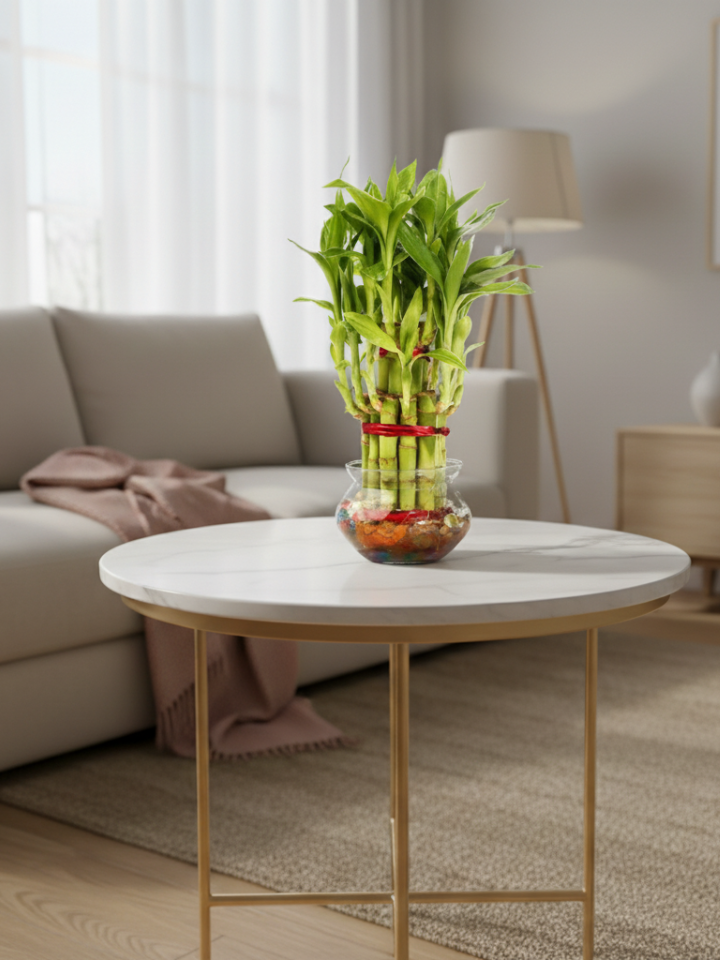
Dracaena sanderiana is the slender, upright foliage plant sold everywhere in India as lucky bamboo, and also as ribbon plant or Chinese water bamboo. The stalks are smooth and jointed, banded at intervals like a cane, and each one carries a loose spray of strap-shaped leaves in a deep, waxy green that holds its colour indoors all year.
| Light | Bright indirect. Copes with a low-light corner and with office tube lighting |
| Water | Keep the medium evenly moist; change vase water every 7–10 days |
| Pets | Not pet-safe — ASPCA-listed as toxic to cats and dogs |
| Difficulty | Very easy — a good first plant |
It is not a bamboo, and it is not from China
True bamboos are grasses. This is a dracaena — the same genus as the corn plant and the Brazilian wood plant — and it grows wild in the forest understorey of Central Africa, in Cameroon and thereabouts. That understorey origin is the single most useful thing to know about it: a plant adapted to dim; damp shade is exactly the plant that will sit happily on a reception counter or a bedside table with almost no direct light.
What the two layers are
The stalks in this arrangement are trained and tied at two heights, giving a stepped, tiered shape rather than a single flat bunch. Layering is a nursery styling technique — the plant does not grow that way on its own. The same patience produces the spirals you see elsewhere: growers rotate a stalk slowly against a one-sided light source for months so the stem curves as it reaches. None of it is genetic, and a stalk will not re-shape itself once you take it home.
Where to put it
A study or office desk, a reception counter, a bathroom shelf, a bedside table, or a shaded corner of a living room. Anywhere with steady ambient light and no harsh sun. Keep it off a west-facing windowsill in summer — a few hours of unfiltered afternoon sun will scorch the leaves within a week. It is also one of the easiest plants to gift, which is why it moves in volume through the plants for gifting range every festive season.
Does it clean the air?
It sits in our air purifier plants category because dracaenas performed well in the NASA chamber studies of the late 1980s. Those tests used sealed boxes, and later work shows the effect in a real, ventilated room is very small. Buy it because it is handsome and nearly unkillable, not as an air filter.
Product specifications
| Specification | Detail |
| Plant name | Lucky Bamboo Plant – 2 Layer |
| Botanical name | Dracaena sanderiana (also published as Dracaena braunii) |
| Also known as | Ribbon plant, Chinese water bamboo, Sander’s dracaena, Belgian evergreen |
| Family | Asparagaceae — not a true bamboo |
| Plant type | Evergreen perennial foliage plant |
| Arrangement | Two trained tiers of stalks |
| Suitable placement | Office desk, reception counter, study table, bedside table, living-room shelf, bathroom, entrance console, gifting |
| Light requirement | Bright indirect light. Tolerates low light and artificial office lighting. No direct sun |
| Water requirement | Moderate and steady. Keep the growing medium evenly moist; if grown in a vase, change the water every 7–10 days |
| Water quality | Prefers filtered, RO or rainwater. Fluoride and chlorine in tap water cause brown leaf tips |
| Soil requirement | Well-drained potting mix that holds some moisture. Also grows in plain water with pebbles |
| Growth habit | Upright, slow-growing, clump-forming; stays where it is put |
| Ideal temperature | 18 °C to 32 °C. Dislikes anything below about 15 °C |
| Feeding | Very light. A quarter-strength liquid feed every 6–8 weeks in the growing season, or none at all |
| Difficulty level | Very easy — beginner-friendly |
| Suitable environment | Warm, humid, shaded interiors. Ideal for rooms with little natural light |
| Pet safety | Not safe — ASPCA-listed as toxic to cats and dogs |
| Flowering | Effectively never indoors. Grown entirely for foliage |
| Lifespan | Several years in water; considerably longer once potted in soil |
Care guide
| Light | Bright but filtered. A metre or two back from a window is ideal for lucky bamboo, and an interior desk under steady overhead lighting works. Direct sun bleaches and scorches the leaves faster than any other mistake |
| Water | Keep the medium evenly damp — not wet, never bone dry. In a vase, keep 3–5 cm of water over the roots and replace it completely every 7–10 days rather than topping it up |
| Water quality | This is the detail almost nobody mentions. The plant is unusually sensitive to fluoride and chlorine. Filtered, RO or collected rainwater keeps the leaves clean-tipped; municipal tap water browns them within weeks |
| Soil | Any well-drained potting mix with a little coco peat for moisture retention. Drainage matters more than richness |
| Feeding | Almost none. Plain water carries no nutrients, so a single drop of dilute liquid feed every 6–8 weeks is enough. Overfeeding yellows the leaves faster than starving it |
| Repotting | Every two to three years, or when the roots crowd the pot. It is happiest slightly snug |
| Pruning | Trim any offshoot that spoils the tiered shape, cutting just above a joint. New shoots come from the cut point |
| Propagation | Easy. Cut a healthy offshoot with at least one joint, stand it in 5 cm of clean water, and change the water weekly. Roots appear in three to six weeks |
Water or soil — which should you choose?
Lucky bamboo grows either way, and this is the question buyers ask most often.
In water, it looks its best and needs the least thought: a glass vase, washed pebbles to hold the stalks upright, and clean water changed weekly. What it will not get is nutrition, so growth is slow and the plant thins after two or three years unless you feed it lightly.
In soil, it is longer-lived, greener and noticeably sturdier — quicker growth, broader leaves, and it forgives a missed week. This is how we grow it and how it ships to you.
Move between the two once, not repeatedly. Water to soil is easy: pot it up and keep the mix damp for a fortnight while the roots adapt. Soil to water is harder — wash every trace of mix off the roots, or what is left will foul the vase within days.
Growing it through the Bengal year
Monsoon, June to September. The humidity suits it better than any other season and the leaves look their best. Two things need watching: warm standing water turns green with algae within a week, and an untended vase is a mosquito nursery, which in a Kolkata monsoon is not a small point. A weekly water change and a rinse of the pebbles solves both.
Summer, March to May. The heat itself is not a problem. Sun is. A plant that spends April on a west-facing sill will show bleached, crisped leaves by the end of the month. Water evaporates fast, so a vase needs topping up midweek, and tap-water salts concentrate as it goes — this is when brown tips appear on plants that looked perfect in February.
Winter, late November to February. Kolkata’s winter is mild enough that it needs no protection, but keep it away from a window that stays open at night. Growth stops almost entirely; feed nothing at all and let it coast until March.
Common problems
| Symptom | Cause | What to do |
| Leaf tips brown and crisp | Fluoride, chlorine or salts in tap water — by far the commonest cause | Switch to filtered, RO or rainwater. Trim the brown tip off at an angle with clean scissors |
| Whole leaves yellowing | Too much direct sun, or too much fertiliser | Move it out of direct light, and stop feeding for three months |
| A stalk yellowing from the base upward | Rot, usually from stale water or a stalk standing too deep | Remove that stalk entirely. A yellowed stalk almost never recovers — the priority is saving the green ones |
| Water cloudy, green or smelling sour | Algae and bacteria in warm standing water | Change it weekly without fail, wash the pebbles, and keep the vase out of direct light |
| Roots brown-black and mushy | Water left too long between changes | Rinse the roots, trim the dead ones back to firm tissue, restart in clean water |
| Leaves pale, no new growth for months | Plain water carries no nutrients | One drop of dilute liquid feed every six to eight weeks. No more |
| Stalks leaning, new shoots crooked | Reaching for light | Turn the pot a quarter-turn every week |
| Small black flies around the pot | Fungus gnats in a constantly wet medium | Let the surface dry slightly between waterings; in a vase, change the water weekly |
Is it safe for pets?
No. The ASPCA lists Dracaena sanderiana as toxic to cats and dogs. The saponins in the leaves and stalks cause vomiting, drooling and loss of appetite if chewed, and cats may also show dilated pupils. It is rarely dangerous, but it is not a plant to leave within reach of an animal that samples foliage.
If you have a cat or a dog, browse the pet-friendly plants range instead — the Bamboo Palm gives you a similar upright, cane-like look and is not on the toxic list. Worth knowing that the two are unrelated despite both carrying “bamboo” in the name.
Placement, layers and Vastu
In Vastu practice and in feng shui this is among the most widely kept plants in Indian homes, associated with steady growth and calm. The placements most often followed are the east or south-east of a room, a work desk, or a console near the entrance — and it is generally kept out of bathrooms and away from the head of a bed.
Two honest qualifications, because they change what people buy.
First, the number symbolism people ask about — two for love and harmony, three for happiness, and the avoidance of four — traditionally counts stalks, not tiers. A layered arrangement is a nursery styling choice about shape, and the two conventions get merged constantly in online listings. If a specific stalk count matters to you, count the stalks rather than the layers.
Second, these plant-specific placements are modern convention rather than classical scripture. Plenty of households care about them and we are glad to note them; it is a good buy either way. If the tradition is what you are shopping for, start with the Vastu plants collection or the Set of 3 Vastu Plants.







































Neha Sharma –
Sleek, vibrant, and beautifully arranged. Absolutely love it.