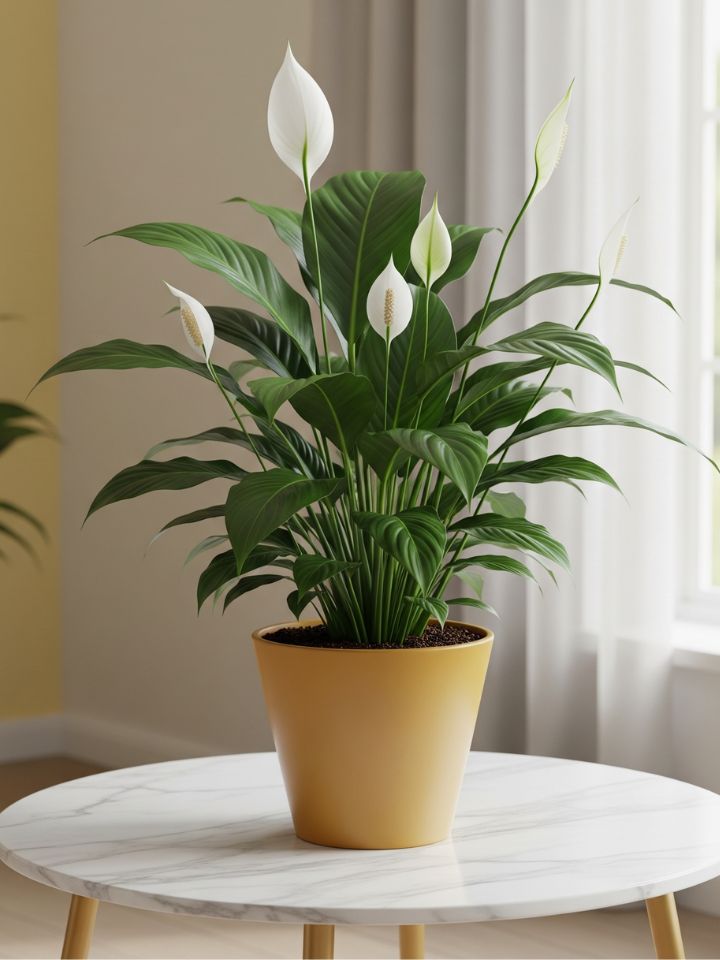
Spathiphyllum is grown for two things at once: foliage and flower. The leaves are long, ribbed and darkly glossy, rising directly from the base in a dense clump rather than from a central stem — so the plant reads as full and finished even in a small pot. Against that dark green, the blooms stand out sharply: a slim white hood on a slender stalk, held clear of the leaves.
Worth knowing what that white part actually is. It is a spathe — a modified leaf, not a petal — wrapped around the true flower, a small cream spike called the spadix. It opens white, stays that way for two to four weeks, then slowly turns green as it ages. That is the plant maturing, not failing.
Its parents grow on shaded rainforest floors in Central America, under a canopy, in warm and humid air. Everything about how it wants to be treated indoors follows from that: filtered light rather than sun, moisture rather than drought, and warmth.
Where to put it
A north- or east-facing windowsill, a side table a metre or two inside a bright room, a bathroom with a window, an office desk under steady artificial light, or a bedroom corner. It is one of the few flowering houseplants that will keep producing blooms away from direct sun — the reason it turns up in workplaces and rented flats far more often than fussier flowering plants.
Product specifications
| Specification | Detail |
| Plant name | Peace Lily |
| Botanical name | Spathiphyllum sp. |
| Also known as | Spathiphyllum, white sail plant, closet plant |
| Plant type | Evergreen flowering foliage plant, herbaceous perennial |
| Suitable placement | Living room, bedroom, office desk, bathroom with a window, reception areas, shaded balcony |
| Light requirement | Bright indirect to low light. Direct sun scorches the leaves |
| Water requirement | Moderate — keep the mix lightly moist, never waterlogged. Roughly every 4–6 days in summer, 8–12 days in winter |
| Soil requirement | Well-drained, organic-rich mix. Supplied in soil, coco peat and coco chips |
| Growth habit | Clump-forming, upright, arching foliage from a basal rosette |
| Flowering | White spathes, mainly spring through the warm months; repeat-blooms indoors in good light |
| Difficulty level | Easy — beginner-friendly |
| Suitable environment | Warm, humid indoor conditions, 18–30 °C. Tolerates air-conditioned rooms if kept off the direct airflow |
| Pet safety | Not safe. Toxic to cats and dogs if chewed |
Care guide
| Light | Bright indirect light gives the most blooms. It survives genuine low light, but flowers less and grows slowly there. Keep it out of direct afternoon sun, which bleaches and crisps the foliage |
| Water | Water when the top 2–3 cm of the mix feels dry. Empty the saucer afterwards — sitting water rots the roots faster than any other mistake |
| Soil | Rich but free draining. Ordinary potting soil loosened with coco peat and a handful of coarse sand or perlite |
| Humidity | Prefers humid air. Group it with other plants, or stand the pot on a tray of pebbles and water in dry months |
| Feeding | A balanced liquid feed at half strength, once a month from March to September. None in winter — over-feeding shows up as brown leaf tips |
| Repotting | Every 18–24 months, or when roots circle the base. Go up one pot size only |
| Grooming | Cut spent blooms at the base of the stalk. Wipe the leaves with a damp cloth monthly — dust genuinely reduces the light they receive |
Growing it through the Bengal year
Monsoon, June to September. Humidity is a gift for this plant — leaf tips stop browning and growth picks up. Watering is the trap. Air that stays saturated for weeks means the mix dries far more slowly than it looks, so check with a finger rather than a schedule, and expect to water perhaps half as often as in May. Fungus gnats appear in these months; let the surface dry between waterings and they disappear.
Summer, March to May. The thirstiest stretch. Move it back from any west-facing window by mid-April, where the glass turns harsh by four in the afternoon. If the room is air-conditioned, keep it out of the direct draught — dry moving air is what browns the leaf edges, not the temperature.
Winter, late November to February. Growth slows and watering drops to roughly every eight to twelve days. Kolkata winters are mild enough that nothing needs protecting but keep it off a cold windowsill at night and away from an open door.
Common problems
| Symptom | Cause | What to do |
| Whole plant drooping, leaves limp | Thirsty — the plant’s normal signal | Water thoroughly until it drains. It usually recovers within hours. Repeated wilting weakens it, so don’t use it as a schedule |
| Drooping and the soil is wet | Root rot from overwatering | Stop watering. Let the mix dry well down. Repot into a grittier blend if it continues |
| Brown, crisp leaf tips | Dry air, hard tap water or excess fertiliser | Trim the tip with clean scissors. Use stored or filtered water and halve the feed |
| Yellow lower leaves | Natural ageing, or too much water | One or two at a time is normal — remove them at the base. Several at once means check the watering |
| No blooms | Not enough light, or the plant is very young | Move somewhere brighter, out of direct sun, and feed monthly through the growing season |
| Blooms turning green | The spathe maturing | Nothing is wrong. Cut the stalk at the base once it looks tired |
| Pale, washed-out foliage | Too much direct sun | Move a metre or two back from the window |
Is it safe for pets?
No. The ASPCA lists Spathiphyllum as toxic to cats and dogs. The leaves contain insoluble calcium oxalate crystals, which cause mouth irritation, drooling, vomiting and difficulty swallowing if chewed. It is rarely life-threatening, but it is unpleasant, and this is not the plant for a household with an animal that samples foliage.
If you share the house with a curious cat, browse the pet-friendly range instead — the Areca Palm and Boston Fern are ASPCA non-toxic and cope with similar light.
An honest word on air purification
This plant appears on every “air purifying” list, so it is worth being straight about where that comes from. A 1989 NASA chamber study measured houseplants removing volatile compounds from sealed containers; a 2019 reanalysis of that body of research found that ordinary ventilation clears those compounds from a real room far faster than any realistic number of plants.
What it genuinely gives you is dense foliage, a little humidity, and flowers in a room that gets no direct sun. If clean air is the goal, open a window. More on the research: Air Purifier Plants.
Tradition and placement
In Vastu practice this plant is associated with calm and harmony and is usually placed in the north or east of a room, or near an entrance — kept away from bedheads and bathrooms. Many households care about this and we are glad to note it. These plant-specific placements are modern convention rather than classical scripture, and it remains a handsome, hard-working plant whatever you make of the tradition.
































Arjun Mehta –
This plant has completely changed the vibe of my bedroom. It looks stunning in the corner, and I love that it needs very little maintenance.
Anirban Chatterjee –
A perfect blend of grace and freshness. Absolutely stunning piece. Thank you Plantaeroot.
Anirban Chatterjee –
A perfect blend of grace and freshness.Thank you Plantaeroot.