Anthurium andraeanum, known as the flamingo flower or tailflower, belongs to Araceae, the arum family, which makes it a close cousin of the peace lily and the money plant. It comes from the humid rainforests of Colombia and Ecuador, where it grows on trees and in the leaf litter beneath them. That origin explains almost everything about how it wants to be treated at home: airy, fast-draining roots, warm air and filtered light.
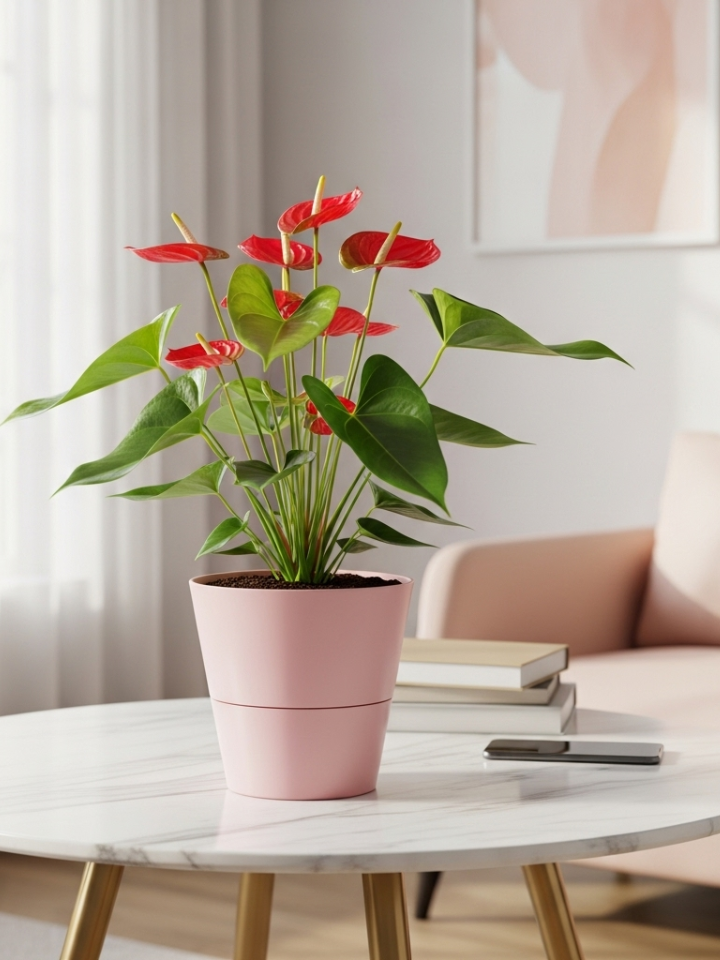
The showy red part is not a petal. It is a spathe, a modified leaf, and it is what gives the plant its waxy, corrugated, lacquered look. Rising from the centre is the spadix, a slim cream-to-yellow spike that carries the true, tiny flowers. Spathes stay colourful for many weeks, and in good light a healthy plant keeps sending up new ones through the warm months. When a spathe finally fades to green, snip the stalk at the base and the plant moves on to the next.
The foliage earns its place even between blooms. Leaves are dark, leathery and heart-shaped, carried on upright stalks in a tidy clump, so the plant looks finished from the day it arrives. Growth is slow and steady, which is why it stays a neat shape on a table for years. It is one of the better indoor flowering plants in India for people who want colour indoors without a garden.
Where it looks and grows best
Give it a spot one to two metres from an east-facing window, or a bright north-facing one, and it will reward you. A living room console, dining sideboard or bright corner is where it looks most at home, and it is one of the more striking choices for plant decoration in the living room. It also holds its own at a reception counter or on a well-lit shelf among indoor office plants. Because the red blooms read as warm and celebratory, it doubles as one of those plants that make lasting gifts for a housewarming, a wedding or Diwali.
A word on low light. This plant will not die in a dim room, but it will stop flowering, and the leaves stretch and darken. If the red bloom is the reason, you are buying it, choose a bright, indirect position and accept nothing dimmer.
Product Specifications
- Plant name — Anthurium Red Plant
- Botanical name — Anthurium andraeanum (hybrid)
- Also known as — Red anthurium, flamingo flower, tailflower
- Plant family — Araceae (arum family)
- Origin — Rainforests of Colombia and Ecuador; sold plants are cultivated hybrids
- Plant type — Evergreen tropical flowering perennial
- Flower — Glossy red, heart-shaped spathe with a cream-to-yellow spadix; blooms last for many weeks
- Foliage — Dark green, leathery, heart-shaped leaves on upright stalks
- Growth habit — Compact, upright clump
- Growth rate — Slow to moderate
- Suitable placement — Living room, dining area, reception desk, bright shelf or console, one to two metres from an east- or north-facing window
- Light requirement — Bright, indirect light; tolerates medium light with fewer blooms. No direct afternoon sun
- Water requirement — Moderate. When the top 2–3 cm of mix is dry; about every 4–6 days in summer
- Soil requirement — Airy, well-draining mix of cocopeat, coco chips or bark, and perlite
- Humidity — Prefers humid air; manages in ordinary indoor conditions
- Temperature — About 18–30 °C ideal. Protect from anything below about 15 °C
- Fertiliser — Balanced or bloom-boosting liquid feed at half strength, about monthly in the growing season
- Difficulty level — Easy to moderate
- Suitable environment — Warm, bright, humid indoor spaces, sheltered from direct sun and cold draughts
- Pet safety — Not pet-safe. ASPCA-listed as toxic to cats and dog
- Propagation — Division of the clump at repotting
Care guide
- Light — Bright, indirect light produces the most blooms. Morning sun through an east window is fine; strong afternoon sun through west or south glass scorches the spathe and leaf edges.
- Water — Water thoroughly when the top 2–3 cm of the mix feels dry, then let the excess drain. Empty the saucer each time. Standing water is the most common way this plant is lost.
- Soil — Airy and free-draining. A blend of cocopeat, coco chips or orchid bark, and perlite suits it; heavy garden soil suffocates the roots.
- Humidity — Prefers humid air. Ordinary indoor conditions are workable; grouping pots or a pebble tray helps through the dry weeks of February and March.
- Temperature — Most comfortable between about 18 °C and 30 °C. Below about 15 °C the growth stalls and leaves can blacken at the edges.
- Feeding — A balanced liquid feed at half strength roughly once a month from March to September, or a bloom-boosting feed at the same strength. Nothing over winter.
- Water quality — Salts in hard tap water show up as brown leaf tips. Stored, filtered or rain water is kinder.
- Leaf care — Wipe the leaves with a soft, damp cloth every few weeks. It keeps the gloss and lets you spot pests early. Skip leaf-shine sprays.
- Repotting — Every two years or so, one size up, in spring. It flowers happily when slightly snug. Do not bury the pale aerial roots that sometimes appear at the base of the stem.
- Flowers — Cut a spent spathe at its base. New ones follow in good light.
Growing it through the Bengal year
These notes are written for the conditions this plant meets in Bengal, and they come from the same team that ships flowering plants from a Kolkata nursery across India.
Monsoon, June to September. The warm, saturated air is close to what this plant grew up in, and it often blooms well now. The danger is rot. A pot standing in humid air holds water for days longer than it looks, and the damage starts under the soil while the foliage still seems fine. Water by touch rather than by calendar, keep the pot off open balconies during long rain, and make sure the drainage holes are never blocked. For the wider seasonal picture, this guide to month-by-month plant care for Kolkata flats runs through the whole year.
Summer, March to May. Water more often as the heat builds, and watch the light rather than the thermometer. By April, afternoon sun through west or south glass is strong enough to bleach a red spathe to papery brown within a day, and that damage does not grow out. Keep the pot well back from those windows and out of hot, still air.
Winter, late November to February. Kolkata winters are mild, but a few cold nights in December and January can still be enough to mark a tropical plant. Keep it indoors, away from open windows and air-conditioner draughts, cut watering to roughly every eight to twelve days, and stop feeding. Growth slows and blooming may pause until March. That is normal.
Common problems and quick fixes
- Yellow lower leaves — Usually overwatering, occasionally simple age. One old leaf yellowing now and then is normal. If several go yellow together, let the top few centimetres of mix dry out before watering again and check the drainage.
- Brown, crisp leaf tips — Dry air, hard water or too much fertiliser. Switch to stored or filtered water, feed at half strength, and trim the tip with clean scissors.
- No new flowers — Almost always too little light. Move it somewhere brighter, out of direct sun, and feed monthly through the warm season. A very young plant may need a season to settle.
- Red spathe fading to green — The bloom is simply ageing. Cut the stalk at the base once it looks tired.
- Brown, papery patches on leaves or spathe — Sun scorch. Move it out of direct sun; the damaged tissue will not recover.
- Black leaf edges in winter — Cold damage. Move it somewhere warmer and trim the marked leaves once new growth appears.
- Wilting although the mix is wet — Root rot. Stop watering, ease the plant out, trim soft brown roots and repot in fresh, airy mix.
- White cottony clusters or sticky, curled new growth — Mealybugs or aphids. Dab with cotton dipped in rubbing alcohol, then spray diluted neem oil weekly for three weeks.
- Drooping for a week or two after delivery — Transit stress, and the most common question we get. Keep it in bright, indirect light, water lightly and leave it alone for two to three weeks.
Is the Anthurium Red safe for pets?
No. The ASPCA lists Anthurium as toxic to cats and dogs. The leaves, stems and spathe hold insoluble calcium oxalate crystals, which cause mouth pain, drooling and vomiting if chewed. It is rarely life-threatening, but it is genuinely unpleasant, and the sap can irritate sensitive skin, so wear gloves when you repot. If you share the home with an animal that samples plants, choose something confirmed non-toxic instead: a feathery areca palm or a cat-safe spider plant copes with much the same light, and our range of houseplants that are safe around pets has more.
Feng shui, Vastu and the "lucky plant" label
The red anthurium is widely gifted across India and East Asia as a symbol of warmth, hospitality and love, and its heart-shaped spathe is the reason. Vastu guides usually suggest the north-east, east or living-room corner for a flowering plant like this, and our wider selection of good luck indoor plants follows the same convention. Worth being straight about it: these placements are modern practice rather than classical scripture. They matter to many households and we are glad to note them, but the better reason to own this plant is that it is handsome and keeps flowering.
A straight answer on air purification
This plant appears on many air-purifying lists because the 1989 NASA study included Anthurium andraeanum, tested in small sealed chambers. In a real room the effect is negligible: Cummings and Waring calculated in 2019 that you would need somewhere between 10 and 1,000 plants per square metre to match the air exchange that opening a window already provides. Grow it for the blooms. If you want the evidence laid out properly, this explainer on what the research says about houseplants and indoor air covers it.















There are no reviews yet.