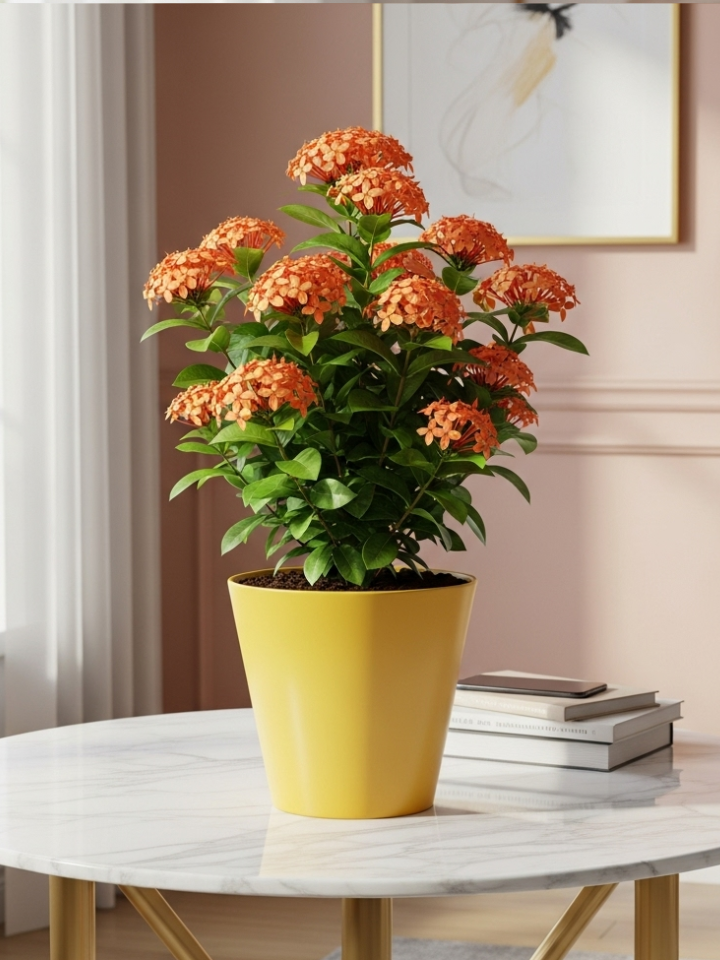
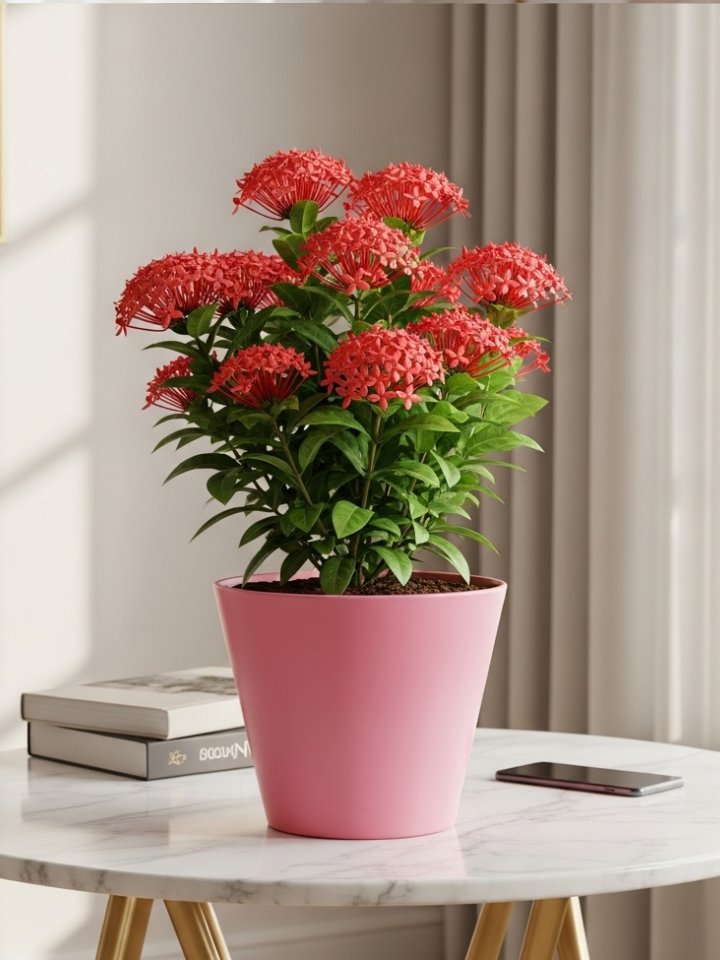
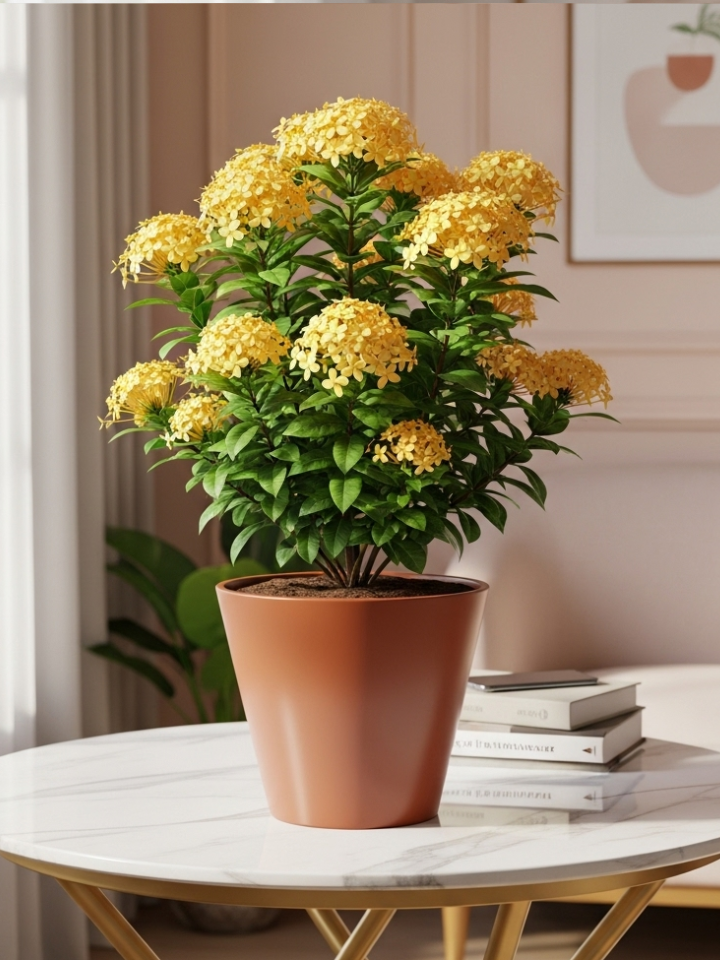
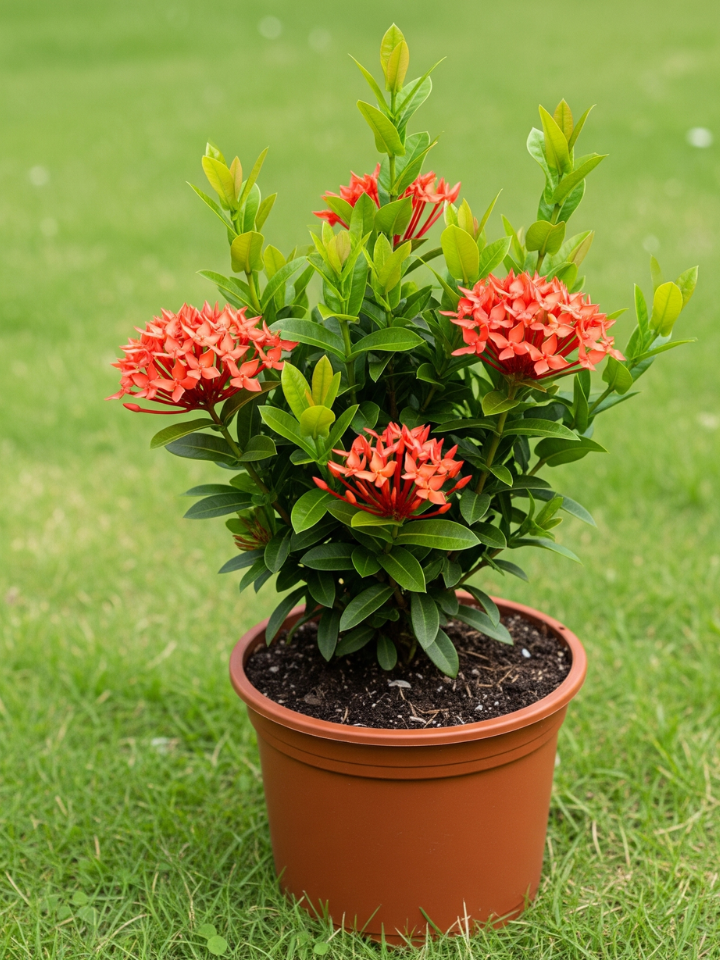
Ixora coccinea belongs to Rubiaceae, the coffee family, and grows wild across southern India and Sri Lanka. In English it is called Flame of the Woods or Jungle Geranium, which tells you what it looks like in full bloom. Each cluster is a rounded dome of a hundred or more slender tubular florets, each opening into four neat petals, packed so tightly the head reads as a single blazing pom-pom.
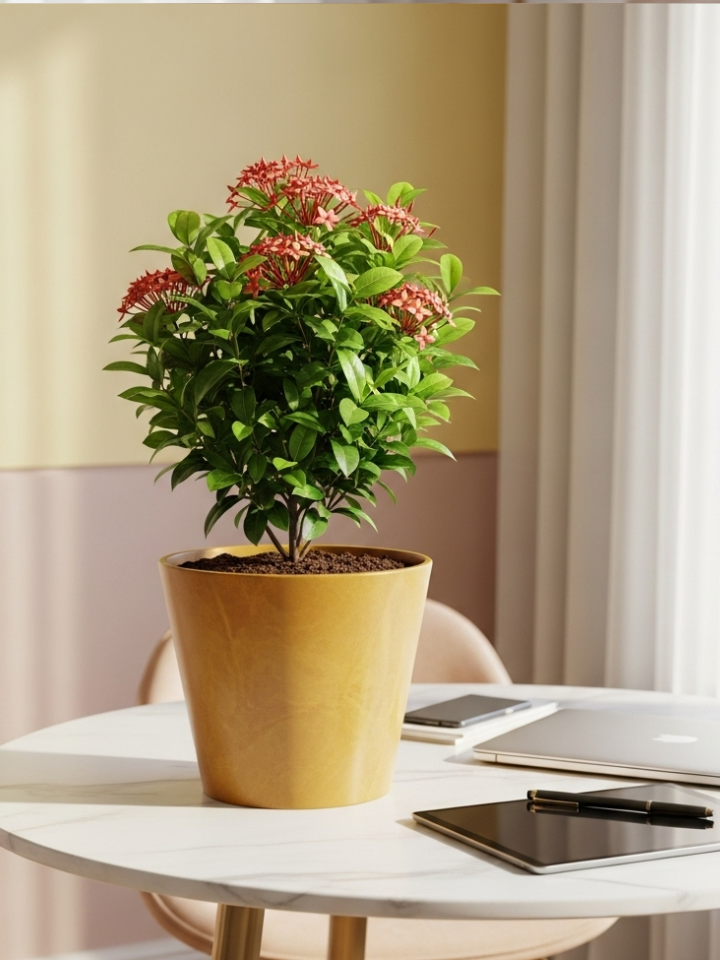
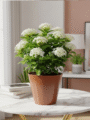
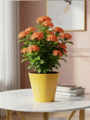
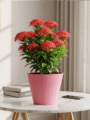
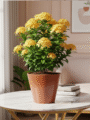
Colour ranges from scarlet through orange and yellow to pink and white, and the classic Rugmini is a fiery red. The leaves are oval, leathery and a deep polished green, held in opposite pairs, so even between flushes the shrub looks tidy and full. New growth often comes in bronze.
It is also a plant that gives back to a garden. The nectar draws butterflies and sunbirds to a balcony rail, and in many Bengali and Hindu households the red blooms are picked fresh for daily worship. A dwarf form stays compact enough for a large pot, which is why it has become one of the dependable choices for a sunny terrace.
Where it looks and grows best
Sun decides everything. A south- or west-facing balcony, a rooftop, a gateway or the front of a courtyard all suit it, and a row of three pots along a railing makes a hedge of colour within a season. If you are choosing plants for a home balcony that stay green and flower for months, this is one of the few that does both. On an open roof it sits comfortably among plants for a rooftop terrace, and it is one of the most reliable summer blooming shrubs for pots when other flowers give up in May heat.
It is not an indoor plant. A windowsill with two hours of light will keep it alive for a few weeks, then the flowers stop and the leaves thin. Give it the outdoors, or a sun-drenched grille.
Product Specifications
- Plant name: Ixora (Rugmini) Plant
- Botanical name: Ixora coccinea
- Also known as: Rugmini, Rangan, Flame of the Woods, Jungle Geranium, Jungle Flame, West Indian Jasmine
- Plant family: Rubiaceae
- Origin: Southern India and Sri Lanka
- Plant type: Evergreen flowering shrub
- Foliage: Glossy, leathery, oval leaves in opposite pairs; new growth often bronze
- Flowers: Dome-shaped clusters of tubular florets with four petals
- Flowering season in India: Through most of the year in warm regions, heaviest March to October
- Growth habit: Compact, bushy, upright to rounded; responds well to pruning
- Suitable placement: Sunny balcony, terrace, rooftop, courtyard, garden bed or gateway; outdoors
- Light requirement: Direct sun, four to six hours
- Water requirement: Moderate and even; not waterlogged
- Soil requirement: Acidic (pH about 5.5–6.5), humus-rich, well drained
- Temperature: 20–35 °C ideal; shed leaves below about 10 °C
- Fertiliser: Monthly balanced feed in the growing season; potash-rich during budding
- Difficulty level: Easy to moderate
- Suitable environment: Warm, humid, sunny; well suited to Bengal and coastal India
- Attracts: Butterflies and sunbirds
- Pet and child safety: ASPCA lists Ixora coccinea as non-toxic to dogs and cats
- Propagation: Semi-hardwood cuttings, air layering; slow to root
Care guide
- Light: Four to six hours of direct sun is the target. It tolerates part shade but flowers less. Bengal's summer sun needs no shading, provided the pot never dries out.
- Water: Water when the top inch is dry. That means about every second day in peak summer, twice a week in spring and autumn, and once a week in winter. Rain does most of the work in the monsoon, so check the pot before adding more.
- Soil: Acidic, humus-rich and well drained, with a pH near 5.5 to 6.5. A good mix is garden soil, compost or leaf mould, and cocopeat in equal parts, with a handful of coarse sand. Ordinary alkaline potting soil is the usual reason for yellow leaves.
- Feeding: A balanced liquid feed once a month in the growing season, switching to a potash-rich one when buds form. Feeds sold for azaleas or acid-loving plants suit it well. A little compost on top every second month helps.
- Pruning: Trim lightly after each flush, cutting spent clusters back to the next pair of leaves. Pinching soft tips in spring builds a bushier plant with more flowering points. Hard pruning is rarely needed.
- Repotting: Every two years, in spring, into a pot one size larger with drainage holes. It dislikes disturbance, so keep the root ball intact.
- Temperature: Happiest between 20 and 35 °C. Growth slows in a Bengal winter, and below about 10 °C it sheds leaves.
Growing Rugmini through the Bengal year
The shrub itself is easy. The seasons are where people slip, so here is what we see at our own nursery.
Summer, March to June. The best months. Full sun, generous watering and a monthly feed give heavy flushes of bloom. Mulch the pot with dry leaves or coco chips to hold moisture through May, when small pots dry by lunchtime.
Monsoon, June to September. Rainwater is naturally soft and slightly acidic, which this plant likes, and it usually flowers strongly. The danger is a pot that never drains. Tilt saucers, lift the pot onto bricks, and skip watering entirely on rainy days. Long grey weeks cut sunlight and slow flowering, which is normal. Our note on plants that grow in rainy season covers what else thrives then.
Winter, November to February. Growth slows and flowers thin out, but it stays green in most of Bengal. Water less, stop feeding by December, and keep it in the sunniest corner. A cold, wet night is worse than cold alone.
These notes come from growing the plant ourselves, and the range for anyone who wants to buy plants online in Kolkata sits with our nursery there.
Common problems and quick fixes
- Yellow leaves with green veins. Iron deficiency caused by alkaline soil or hard water. Feed with chelated iron, switch to an acid-loving fertiliser, and water with rainwater or filtered water when you can.
- Leaves yellowing evenly and dropping. Overwatering or poor drainage. Let the top inch dry, check the drainage holes, and lift the pot off standing water.
- Buds forming, then dropping. Stress: moving the plant, a sudden dry spell or a chill. Settle it in its final spot and keep watering steady through the flush.
- Healthy leaves, no flowers. Too little sun or too much nitrogen. Move it into direct light and switch to a potash-rich feed.
- Brown, crispy leaf edges. Underwatering or heat stress in a small pot. Water deeply, mulch, and consider a larger pot.
- Sticky leaves and white cottony clusters. Mealybugs or scale. Wipe with cotton dipped in rubbing alcohol, then spray diluted neem oil weekly for three weeks.
- Sooty black film on leaves. A mould growing on insect honeydew. Treat the pests, then wash the leaves with mild soapy water.
Is Rugmini safe for cats and dogs?
Yes, for Ixora coccinea. The ASPCA lists it under the names Iron Tree and Flame of the Woods as non-toxic to dogs and cats. That makes it a comfortable choice for a balcony or courtyard shared with animals. Nothing here is a reason to encourage a pet to chew it: eating any large amount of plant can upset a stomach, and cultivated hybrids are not always individually tested. If a pet does eat a lot of it, call your vet.
Meaning, gifting and Vastu
This shrub carries genuine cultural weight. Red Rangan flowers are a familiar offering in Bengali puja, and many families keep a plant at the entrance for that reason. In Vastu practice flowering shrubs are generally kept in the east or north-east, in open light. That is modern convention more than scripture, so the honest rule is to put it where the sun is. If you are collecting vastu plants for home with tradition in mind, this is one to pair with tulsi at a bright doorway.

































There are no reviews yet.