Epipremnum aureum — still widely sold under its old name Scindapsus aureus — is the vine that India calls money plant and the rest of the world calls golden pothos. Same species, two trade names, and a great deal of confusion between them.
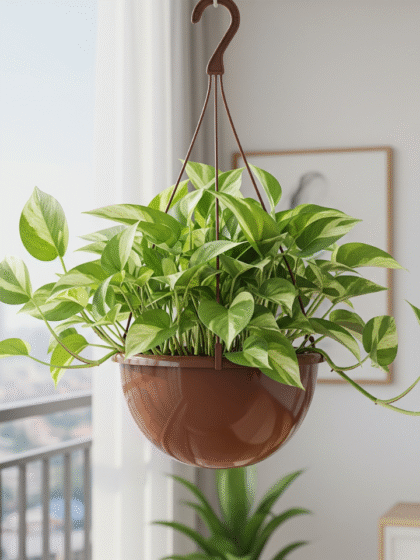
The leaves are the reason to buy it. Each one is heart-shaped, thick and waxy, and marbled in two greens with irregular streaks of buttery gold, so no two are patterned alike. Young leaves are small and neat; give the vine something to climb and the leaves grow noticeably larger, which is a quirk of the species most buyers never discover because they let it trail instead.
It grows quickly. A well-lit plant puts out a new leaf every ten days or so through the warm months and will drape a metre down a bookshelf inside a year. Cut it back whenever it runs long — it branches from just below the cut, and every trimmed piece roots in a glass of water, which is how one plant becomes six.
| Light | Bright indirect. Copes with moderate light, but the gold fades in a dim corner |
| Water | Every 5–7 days once the top layer of soil is dry. Much less in monsoon and winter |
| Pets | Not pet-safe — toxic to cats and dogs if chewed |
| Difficulty | Very easy — one of the best first plants you can buy |
Where to put it
A few feet back from an east or north window is ideal. It does equally well on top of a cupboard, along a curtain rod, on a bathroom shelf where the humidity suits it, or on an office desk under steady overhead light. Avoid harsh afternoon sun through glass, which bleaches the variegation and scorches the leaf edges.
Money plant, golden pothos, money tree — which is this?
Three different plants share these names, and buyers regularly order the wrong one.
| Sold as | Actually is | What it looks like |
| Money plant / golden pothos | Epipremnum aureum | This plant. A trailing vine with heart-shaped green-and-gold leaves |
| Chinese money plant | Pilea peperomioides | An upright plant with flat, round, coin-like leaves on thin stalks |
| Money tree | Pachira aquatica | A small tree with a braided trunk and palm-like leaf fans |
So yes — golden pothos and the golden money plant are the same thing. If you have seen both names on two different listings, you have seen one species twice.
Product specifications
| Specification | Detail |
| Plant name | Money Plant (Golden) |
| Botanical name | Epipremnum aureum (syn. Scindapsus aureus) |
| Also known as | Golden pothos, devil’s ivy, ceylon creeper, hunter’s robe, money plant |
| Plant type | Evergreen perennial climber; trailing and vining |
| Suitable placement | Shelf, cupboard top, hanging planter, office desk, bathroom, bedroom, balcony under cover, water vase |
| Light requirement | Bright indirect light. Tolerates moderate and low light with reduced variegation. No direct afternoon sun |
| Water requirement | Moderate. Every 5–7 days once the top layer of soil is dry; every 10–14 days in winter, less again through the monsoon |
| Soil requirement | Loose and free-draining. Supplied in a blend of soil, coco peat and coco chips |
| Growth habit | Fast-growing climber; trails when unsupported, climbs with larger leaves when given a pole |
| Grows in water | Yes — cuttings root and live indefinitely in a vase |
| Temperature range | Comfortable between 18 °C and 30 °C; tolerates up to about 35 °C in shade |
| Difficulty level | Very easy — beginner-friendly |
| Suitable environment | Warm, humid, indoors or a shaded balcony. Not frost-hardy |
| Pet safety | Not safe — ASPCA-listed as toxic to cats and dogs |
| Air-purifier category | Listed among the species tested in NASA’s 1989 chamber study. See the honest note below |
| Propagation | Stem cuttings in water or soil; roots in 2–3 weeks |
| Lifespan | Many years, and effectively indefinite through cuttings |
Care guide
| Light | Bright, indirect. A few feet from an east or north window is the sweet spot. It survives further into a room, but the gold marbling thins and the leaves come out smaller and plainer |
| Water | Soak until it drains from the base, then wait for the top inch to dry — roughly every 5–7 days in warm weather, every 10–14 days in winter. It shows thirst clearly by drooping and recovers within hours |
| Soil | Loose and quick-draining. Ordinary potting mix opened up with coco peat, coco chips or coarse sand |
| Feeding | A balanced liquid feed at half strength once a month from March to September. Nothing in winter |
| Repotting | Every one to two years, one pot size up. It grows fast enough that roots circle the pot sooner than most houseplants |
| Pruning | Trim any vine that runs bare or long. Cut just after a leaf node and it branches from that point, which is the whole trick to a full, bushy plant rather than three long strings |
| Training | Tie it to a moss pole or coir stick and the leaves grow markedly larger, because the plant reads climbing as maturity. Left to trail, it stays small-leaved |
| Propagation | Take a cutting with two or three leaves and at least one node, strip the lowest leaf, and stand it in water or push it into damp mix. Roots appear in two to three weeks |
Growing it through the Bengal year
Monsoon, June to September. Growth is at its best — the humidity is exactly what this vine wants — but the watering can become the enemy. Air that stays saturated for weeks means a pot holds water far longer than it looks, and stems rot at soil level while the leaves still appear fine. Stop watering to any schedule between June and September; check the soil with a finger and expect the answer to be no more often than once a fortnight. Keep it out of driving rain and somewhere with moving air rather than a still corner.
Summer, March to May. Fast, thirsty months. Water every four or five days in the heat and pull it back from any window that takes hard afternoon sun — a May afternoon behind glass bleaches the gold and crisps the leaf margins within a week.
Winter, late November to February. Growth slows to almost nothing. Every ten to fourteen days is plenty. Kolkata winters are mild enough that no protection is needed, but a plant watered on its August rhythm through December is the one that fails.
Common problems
| Symptom | Cause | What to do |
| Leaves turning yellow, starting at the base | Overwatering — by far the commonest failure | Stop watering and let the mix dry right through. If stems feel soft at soil level, take healthy cuttings and restart |
| Brown, crisp leaf tips and edges | Dry air, harsh sun, or salt build-up from tap water | Move it out of direct sun. Flush the pot thoroughly with water every few months |
| Long bare vines with widely spaced leaves | Too little light | Move it brighter and cut the stretched growth back to a node. It rebranches within weeks |
| New leaves losing their gold and coming out plain green | Not enough light — the plant drops variegation to make more chlorophyll | Brighter position, and prune the all-green sections out before they take over |
| Black, mushy stems near the soil | Root rot, almost always monsoon-related | Take cuttings from the healthy upper vine and root them fresh. The parent rarely recovers |
| Leaves small and pale | Underfeeding, or a plant that has outgrown its pot | Feed monthly through the warm months and repot one size up |
| Sticky residue, fine webbing or white specks | Mealybug or spider mite | Wipe the leaves down, then spray with diluted neem oil weekly for three weeks |
| A few leaves dropping in the first week | Transit stress | Normal. Keep it bright, water sparingly, and expect it to settle within two to three weeks |
Is it safe for pets?
No. The ASPCA lists Epipremnum aureum as toxic to cats and dogs. The leaves and stems contain insoluble calcium oxalate crystals, which cause immediate mouth and throat irritation, drooling, pawing at the mouth and vomiting if an animal chews them. It is very rarely dangerous, but it is genuinely unpleasant, and it applies to the water in the vase as well as the plant.
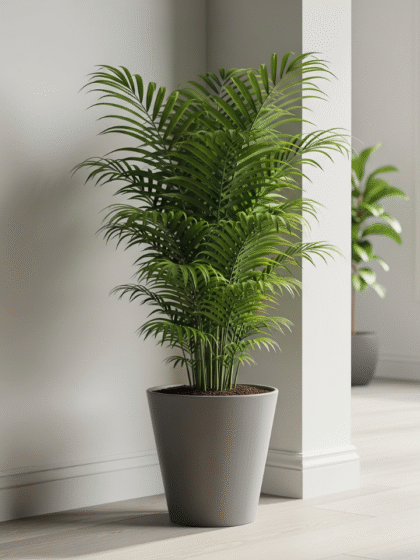
A hanging basket or a high shelf solves it for most households, since the trouble only starts if an animal can reach the foliage. If your cat treats every plant as a salad, browse the pet-friendly range instead — the Areca Palm covers much the same decorating job and is not on the toxic list.
About the air-purifying claim
This product sits in our air purifier plants category, so it is worth being straight about what that means.
Epipremnum aureum was one of the species in NASA’s 1989 sealed-chamber study, where it removed measurable amounts of benzene and formaldehyde from the air. That study used a small airtight chamber, not a home. Later analysis has shown that matching its results in a real room would take an implausible number of plants, and that ordinary ventilation does far more. A money plant is a lovely thing to own; it is not an air filter. We would rather say so than sell you a claim that does not hold. Our longer piece on which indoor plants actually purify air goes through the evidence.
Growing it in water
This is one of the few houseplants that lives happily in a vase for years, and it is why so many Indian homes have one on the kitchen counter.
Take a cutting 15–20 cm long with two or three leaves, making sure at least one node — the small brown bump where a leaf meets the stem — sits below the waterline. Strip any leaf that would be submerged, since a rotting leaf fouls the water fast. Use a clear jar so you can watch the roots, change the water every five to seven days, and rinse the roots when you do.
Two honest caveats. Water-grown plants stay smaller and their leaves never reach the size of a soil-grown, pole-climbing plant, because plain water carries almost no nutrients — a drop of dilute liquid feed once a month helps. And a cutting rooted in water for months builds soft water roots that struggle when moved into soil, so move it across early if soil is where you want it to end up.
Vastu, Feng Shui and placement
In Vastu practice this vine is usually placed in the south-east, the direction associated with wealth and governed by Venus, and kept away from the north-east corner. Feng Shui reaches the same conclusion by a different route, reading the round, upward-curling leaves as a symbol of accumulating prosperity. Common guidance in both is to let it climb rather than hang down, to keep the foliage green and trimmed rather than yellowing, and not to place it directly outside the main door.
Worth saying plainly: these plant-specific placements are modern convention rather than classical scripture, and the association is cultural rather than demonstrable. They matter to a great many households and we are glad to note them. They are also not the reason this is a good buy — it is a handsome, fast, forgiving plant whatever you make of the tradition. Browse the Vastu plants collection if that is what you are shopping for.





































There are no reviews yet.