Calathea makoyana comes from the rainforest floor of eastern Brazil, where it grows in the dim, wet layer beneath the canopy. Botanists moved it into the genus Goeppertia in 2012, so you will see it labelled Goeppertia makoyana in newer references; the trade still calls it Calathea, and so does everyone selling it. It belongs to Marantaceae, the arrowroot family, which makes it a close relative of the prayer plant and the rattlesnake plant.
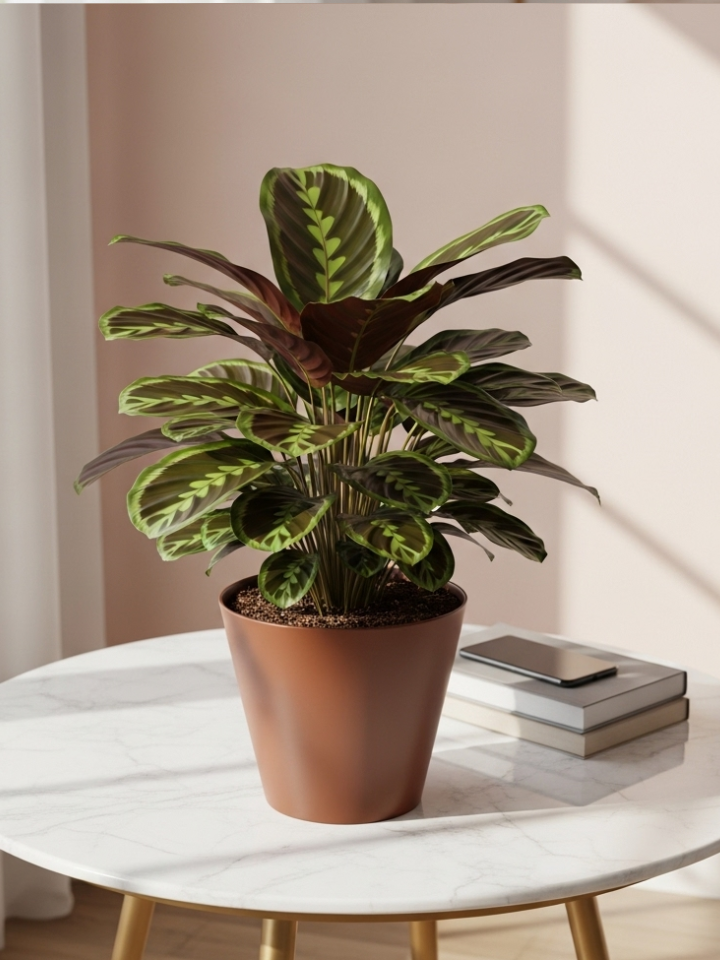
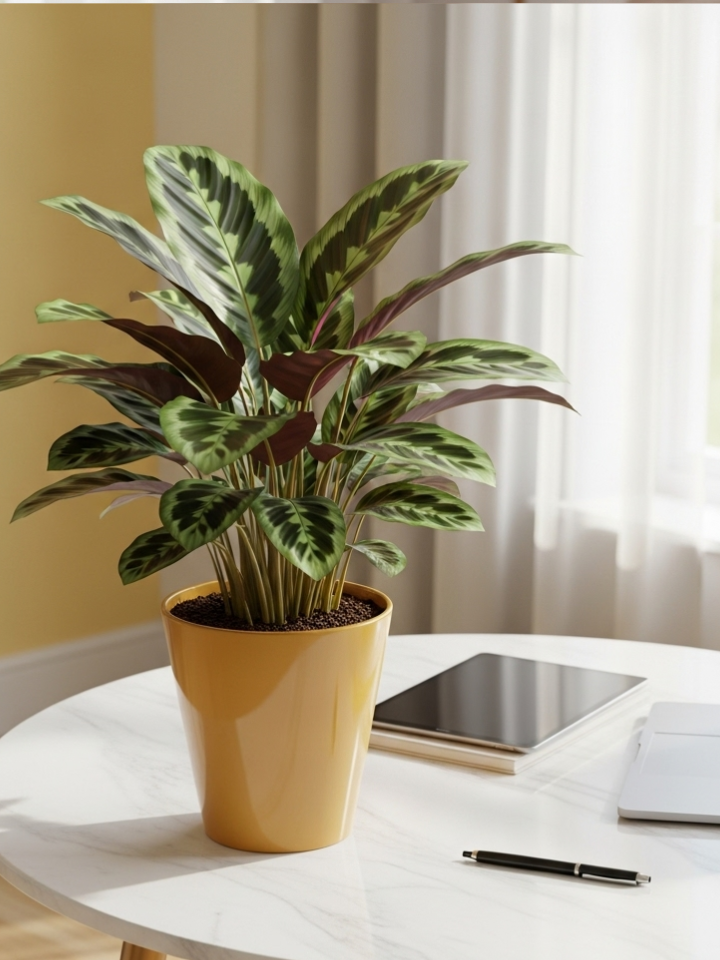
The markings are the reason to own it. Each oval leaf is a thin, papery pale green, and along the midrib runs a series of dark green ovals and fine lines that read as a feather — or, held up to a window, as the tracery of a stained-glass window, which is where the older English name cathedral windows comes from. The underside carries all of it again in deep wine-purple, so a leaf catching light from behind shows two patterns at once. Long slender stalks lift the foliage into a loose, upright clump rather than a dense bush, and every leaf sits at a slightly different angle. No two plants are marked alike.
It is grown for foliage alone. Indoors it rarely flowers, and the small white blooms it occasionally produces are insignificant next to the leaves. Growth is steady through the warm months and stops entirely in winter. Every plant we list is raised at our own nurseries rather than bought in and resold, which is the short answer to why we began selling live plants online in the first place.
The evening movement
Marantaceae plants are called prayer plants for a reason. Each leaf sits on a small swollen joint at the top of its stalk, the pulvinus, which stiffens and relaxes with the light. Through the day the leaves lie open and flat; as the room darkens they lift and fold upward, closing like a pair of hands, and by morning they are flat again. You can watch it happen over an evening.
This is worth knowing when you buy, because it is the single most common reason people think something is wrong. Leaves standing upright at nine at night are a healthy plant doing what it evolved to do. Leaves standing upright at noon are a different matter — that usually means thirst or dry air.
Where it looks and grows best
Think of the conditions it evolved in and place it accordingly: warm, humid, shaded. A bathroom with a window is close to perfect, and it is one of the few genuinely reliable best plants for a bathroom in an Indian flat. Beyond that, a shelf or side table set back from the light, a shaded corner where nothing else will colour up, or a bedside table where the leaf movement is close enough to notice — it sits comfortably among the best plants for bedroom shelves for exactly that reason. In a larger room it works as a low, patterned note at the front of a group rather than as a specimen, which is how most people use it as a plant for a living room corner.
Two places to avoid. Directly in front of glass, where a few hours of afternoon sun will bleach the pattern to beige and the damage will not grow out. And directly in the path of an air-conditioner, which dries the leaf edges faster than anything else in an Indian home. A desk in an air-conditioned office is the one common placement this plant does not forgive, so if that is what you are shopping for, a tougher species from our tabletop plants for an office range will serve you better.
. Product Specifications
- Plant name — Peacock Plant
- Botanical name — Calathea makoyana, reclassified as Goeppertia makoyana
- Also known as — Cathedral windows, peacock leaf plant, calathea peacock plant, prayer plant (family name)
- Plant family — Marantaceae (arrowroot family)
- Origin — Rainforest floor of eastern Brazil
- Plant type — Evergreen tropical foliage perennial, rhizomatous
- Foliage — Thin oval leaves, pale green with dark feather-like markings along the midrib, deep purple underneath, on long slender stalks
- Growth habit — Upright, loose clump from a central rosette
- Growth rate — Moderate in warm months; dormant in winter
- Suitable placement — Bathroom with a window, bedside table, shaded shelf, low group planting in a living room, away from direct sun and air-conditioning
- Light requirement — Bright indirect to shaded. No direct sun
- Water requirement — Regular. Keep the mix evenly moist, never waterlogged; filtered, stored or rainwater preferred
- Soil requirement — Light, airy, moisture-retentive cocopeat-based mix with perlite
- Humidity — 60% or above preferred; the main care requirement
- Temperature — 18–28 °C ideal. Protect from draughts and anything below about 15 °C; not frost-hardy
- Fertiliser — Balanced liquid feed at quarter to half strength, monthly from March to September
- Flowers — Rarely indoors; grown entirely for foliage
- Leaf movement — Folds upward at night and reopens by morning (nyctinasty)
- Difficulty level — Moderate. Not recommended as a first plant
- Suitable environment — Warm, humid, shaded indoor spaces
- Pet safety — Pet-safe. ASPCA-listed as non-toxic to cats, dogs and horses
- Propagation — Division of the rhizome clump at repotting
Care guide
- Light — Bright, filtered, indirect. It handles genuine shade better than almost anything else with a pattern this strong, and it handles direct sun worse than almost anything. North- and east-facing rooms suit it.
- Water — Keep the mix evenly moist, like a wrung-out cloth, and never let it sit in a full saucer. Roughly every 4–6 days in summer and every 8–10 in winter, though the finger test beats the calendar every time. This species does not forgive either drought or waterlogging.
- Water quality — The detail most sellers leave out. Fluoride, chlorine and dissolved salts in hard municipal water collect in the leaf margins and burn them brown. Rainwater or RO water is ideal; tap water left standing uncovered overnight is a reasonable compromise, and flushing the pot through with plain water every couple of months clears built-up salts.
- Humidity — Wants 60% or more. In a humid Bengal summer that is free; in a heated, air-conditioned or February-dry room it is not. Stand the pot on a tray of wet pebbles, group it with other plants, or keep it in the bathroom. Misting helps briefly and is no substitute.
- Soil — Light, airy and moisture-retentive: the cocopeat-based mix it arrives in is right. When you repot, cocopeat with perlite and a little compost works well. Heavy garden soil holds water in a way the roots dislike.
- Temperature — Happiest between 18 °C and 28 °C. Cold draughts and anything under about 15 °C mark the leaves.
- Feeding — A balanced liquid feed at quarter to half strength once a month from March to September. It is a light feeder and excess fertiliser shows up as burnt edges, which look exactly like the damage hard water causes.
- Leaf care — Wipe gently with a soft damp cloth. The leaves are thin and tear more easily than a rubber plant's, so support each one with a hand underneath. Skip leaf-shine sprays entirely.
- Repotting — Every two years in spring, one size up. The roots are fine and shallow, so a wide, shallow pot suits it better than a deep one.
- Propagation — Division only, at repotting. Separate the clump where it naturally parts, keeping roots and at least one shoot on each piece. It does not root from a leaf or a stem cutting, and seed is not practical at home.
Growing it through the Bengal year
These notes come from raising Calathea at our own plant nursery in Kolkata.
Monsoon, June to September. This is the easiest stretch of the year, and the reason this plant is a better bet in Kolkata than in Delhi or Pune. Weeks of saturated air give it exactly the humidity it wants, and it puts out most of its new leaves now. Two cautions: keep the pot off an open balcony during heavy rain, because a mix that stays waterlogged for days will rot the fine roots, and check the undersides for spider mites once the rain breaks. Our guide to which plants handle Kolkata's humidity puts the rest of the calendar in context.
Summer, March to May. Hot is fine; dry and bright is not. The danger is an air-conditioned room, where the humidity drops to a level this plant reads as a desert, and afternoon sun through west-facing glass, which bleaches. Water more often, move the pot away from the vent, and stand it on wet pebbles through May.
Winter, late November to February. Growth stops. Cut watering back to roughly once a week to ten days and stop feeding altogether. The real problem in a Bengal winter is not cold but the dry spell that follows it — through late January and February the air thins out and brown edges appear on plants that were perfect in October. That is a humidity problem, not a watering one, and drenching the pot in response is how people rot a Calathea in winter.
Common problems and quick fixes
- Brown, crisp leaf edges — The signature complaint, and almost always dry air or hard water. Raise humidity, switch to filtered or stored water, and flush the pot through. Trim the brown margin with clean scissors following the leaf shape; it will not turn green again.
- Leaves curling inward during the day — Thirst or low humidity. Check the mix, water if it is dry, and move the plant away from any vent or fan.
- Leaves upright at midday — Same causes as curling. Upright leaves at night are normal and healthy.
- Faded, washed-out pattern — Too much light. Move it out of direct sun; new leaves will come through properly marked.
- Yellowing lower leaves with a soft base — Overwatering. Let the top of the mix dry, empty the saucer, and check the roots if it continues.
- Fine webbing and pale speckling — Spider mites, the commonest pest on this species and worst in dry months. Rinse both leaf surfaces, raise humidity and spray diluted neem oil weekly for three weeks.
- Whole plant collapsed and the mix sour-smelling — Root rot. Unpot, cut away the soft roots, repot in fresh airy mix and water sparingly until it recovers.
- Limp for a week or two after delivery — Transit stress. Stand it in bright shade, water lightly, leave it alone. It settles in two to three weeks.
Is this Calathea safe for cats and dogs?
Yes. The ASPCA lists Calathea as non-toxic to cats, dogs and horses, and this species is among the safest patterned plants you can keep in a home with animals. A cat that chews the foliage may still get an upset stomach — any plant material can do that — but there is no toxin here, and no calcium oxalate of the kind that makes a peace lily or an aglaonema so unpleasant.
That makes it a genuine member of our range of indoor plants safe for cats, alongside a pet-safe spider plant and an areca palm for the living room, both of which are also ASPCA-confirmed. One thing to keep straight: the peacock flower (Caesalpinia pulcherrima), a garden shrub sold under a similar name, is a different plant entirely and is not safe around animals.
A straight answer on air purification
This species turns up on air-purifying lists because it is a broad-leaved tropical foliage plant, not because it was ever tested. NASA's 1989 Clean Air Study covered a specific set of species and no Calathea was among them, and in a real room the effect is negligible in any case: Cummings and Waring calculated in 2019 that you would need somewhere between 10 and 1,000 plants per square metre to match the air exchange an open window already provides. If you want the evidence set out properly, our explainer on whether houseplants actually clean indoor air covers it. Buy this one for the leaves.
Is it a beginner plant?
No, and it is worth saying so before you add it to the cart. It will not tolerate the neglect a snake plant shrugs off, and its two real demands — humid air and water that is not heavily chlorinated — are the two things people are least likely to think about. If this is your first houseplant, start with something from our easy houseplants for beginners guide and come back to this one in six months. If you already keep plants, have somewhere humid to put it and are willing to store water overnight, it is one of the most rewarding leaves in the catalogue.



































There are no reviews yet.