N'Joy is a named cultivar of Epipremnum aureum, the species Indian homes know as money plant and the rest of the world calls pothos or devil's ivy. It also has a homegrown story. N'Joy was discovered in the early 2000s at a commercial nursery in Mumbai as a natural mutation of the 'Marble Queen' pothos. It was then propagated over many generations to make the pattern stable and patented in 2009. It is one of the few houseplants now grown around the world that began in India.
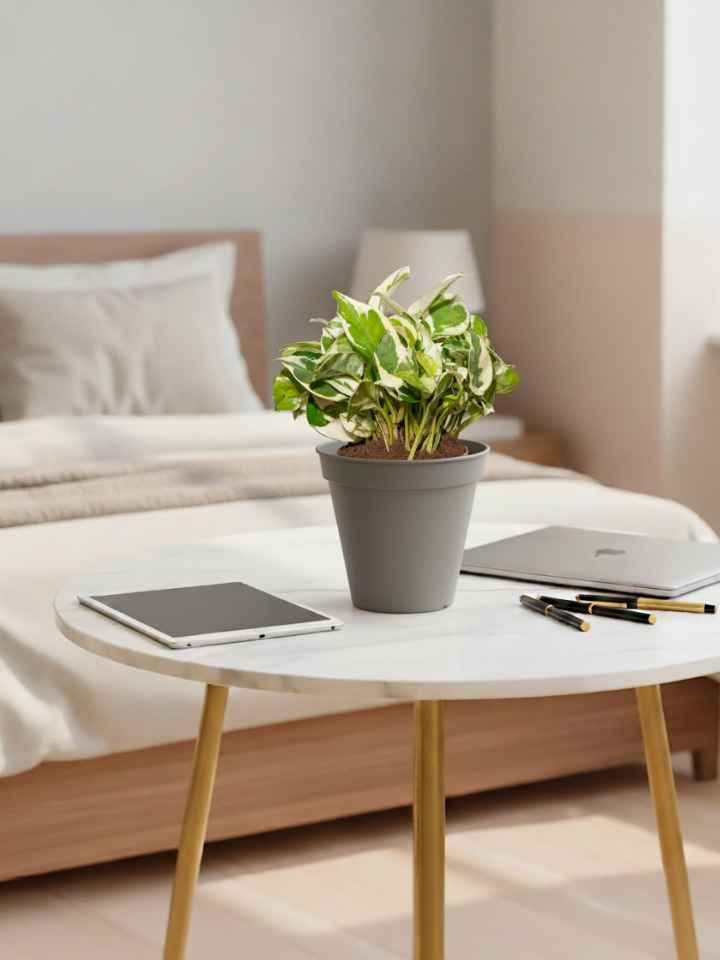
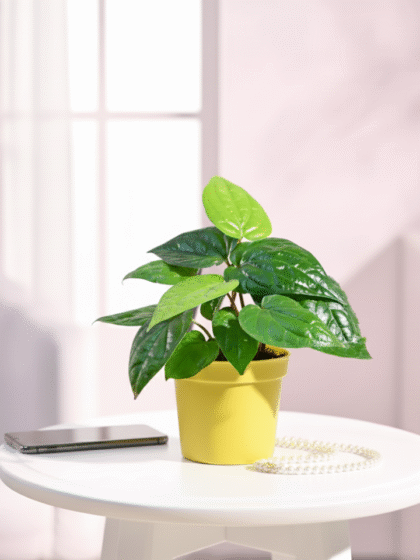
The leaf pattern is what sets it apart. Most variegated money plants are streaked, marbled or speckled. N'Joy leaves are instead divided into clean blocks of colour: a deep green section edged or patched with near-pure white, and only the odd fleck. The leaves are smaller and a little thinner than the golden type, often more spade-shaped than round, with a faint texture you notice up close. The leaf nodes sit close together along each stem, so the plant looks full and dense rather than stringy.
That density comes at the cost of speed. This cultivar grows noticeably slower than other money plants, adding roughly 15–30 cm of vine a year in a typical home and a little more in very good light. In a small flat or on a work desk, that is an advantage. It holds its shape for months and rarely needs trimming.
| Light | Bright indirect. In a dim spot the white fades and new leaves shrink. Keep it out of harsh afternoon sun |
| Water | About every 6–8 days in warm weather, once the top 2–3 cm of soil is dry. Much less in monsoon and winter |
| Pets | Not pet-safe. Toxic to cats and dogs if chewed |
| Difficulty | Easy, with one condition: it needs good light |
Where it looks and grows best
Choose the brightest spot you have that avoids direct sun. Good options are one or two metres back from an east- or north-facing window, a well-lit office desk, a bedroom shelf that gets steady daylight, or a bookcase in the living room. A bathroom with a window works well too, because the plant enjoys humidity. Its short trails spill neatly from a small hanging planter or from a pot on a covered, shaded balcony.
Because it stays compact, it is one of the few trailing plants that can sit on a desk without taking it over. What it cannot do is thrive in a dark corner. There it keeps living but stops looking like N'Joy, as the white patches shrink and new leaves come out smaller. For a spot with only moderate light, the faster, tougher Money Plant (Golden) is the better choice.
N'Joy, Variegated, Golden or Pearls and Jade — how to tell them apart
| Sold as | Leaf pattern | Leaves and habit | Growth | Light |
| Money Plant N'Joy (this plant) | Crisp, separate blocks of white and green; very few speckles | Small, often spade-shaped; close-set and bushy | Slow | Bright indirect |
| Money Plant Variegated | Green marbled and flecked with cream | Medium, heart-shaped | Moderate | Bright indirect |
| Money Plant (Golden) | Green streaked with yellow gold | Larger, heart-shaped; long vines | Fast | Moderate to bright indirect |
| Pearls and Jade (not stocked) | White and green patches, with fine green-grey speckling inside the white | Small and compact | Slow | Bright indirect |
All four are Epipremnum aureum. N'Joy and Pearls and Jade both descend from 'Marble Queen', which is why they are so often mixed up. The quickest test is the speckling: Pearls and Jade have it all through the white, while N'Joy's white is mostly clean. The "Chinese money plant" (Pilea peperomioides) is an unrelated plant with round, coin-like leaves that simply shares the nickname.
| Specification | Detail |
| Plant name | Money Plant N'Joy |
| Botanical name | Epipremnum aureum 'N'Joy' (older synonym Scindapsus aureus; some growers label it Epipremnum pinnatum 'N'Joy') |
| Plant family | Araceae (aroid family) |
| Also known as | N'Joy pothos, Pothos N'Joy, Devil's Ivy N'Joy, white variegated money plant |
| Origin of cultivar | Discovered in Mumbai, India, as a natural sport of 'Marble Queen' pothos; patented in 2009 |
| Plant type | Evergreen perennial vine; trailing or climbing |
| Foliage | Small, spade- to heart-shaped leaves with crisp, separate white and green sections. Pattern varies from leaf to leaf |
| Suitable placement | Office desk, bookshelf, bedside table, living room, bathroom with a window, small hanging planter, covered and shaded balcony |
| Light requirement | Bright indirect light. Tolerates moderate light but loses variegation. Avoid direct afternoon sun |
| Water requirement | Low to moderate. Water when the top 2–3 cm of soil is dry: about every 6–8 days in summer, every 12–15 days in winter, less in monsoon |
| Soil requirement | Loose, well-draining potting mix. Supplied in premium organic potting mix [CONFIRM blend] |
| Growth habit | Compact and bushy, with short gaps between leaf nodes. Trails when left alone, climbs with support |
| Growth rate | Slow — roughly 15–30 cm of vine a year indoors |
| Temperature | Most comfortable at 18–30 °C. Keep away from cold draughts and temperatures below about 15 °C |
| Humidity | Average to high |
| Difficulty level | Easy and beginner-friendly, provided it gets good light |
| Suitable environment | Indoors, or a covered balcony out of direct sun. Not suited to open sun or frost |
| Grows in water | Yes, stem cuttings root and grow in a jar of water |
| Propagation | Stem cuttings with at least one node, in water or soil. Roots in about 3–5 weeks |
| Pet safety | Not pet-safe. ASPCA lists it as toxic to cats and dogs |
Care guide
| Care | What to do |
| Light | Bright, indirect light for most of the day. More light, short of direct sun, means more white. Direct afternoon sun through glass scorches the white sections first |
| Water | Water thoroughly until it runs from the drainage hole, then let the top 2–3 cm of soil dry before the next drink. Small leaves and slow growth mean it uses less water than the golden type, so err on the dry side |
| Soil | A loose, airy, free-draining mix. Potting soil lightened with cocopeat and coco chips or coarse sand suits it. Never let the pot stand in water |
| Feeding | A balanced liquid fertiliser at half strength once a month from March to September. None in winter. Over-feeding produces greener growth, not more white |
| Repotting | Only every two years or so, and just one pot size up. Its root system is modest, and an oversized pot stays wet and invites rot |
| Pruning | Trim any long stem just above a leaf node to keep it bushy. Remove shoots that come up entirely green before they outgrow the rest |
| Growing in water | Stem cuttings with a node root in a jar of clean water in about three to five weeks, a little slower than other money plants. Change the water weekly |
Keeping N'Joy white
Light is the one thing that decides how this plant looks. White tissue has almost no chlorophyll, so when light runs short the plant makes more green to feed itself. New leaves come out plainer and smaller, and occasionally a whole shoot turns solid green. Green growth is more vigorous, so if you leave it alone it slowly takes over. Cut that stem back to a leaf with good variegation and move the pot somewhere brighter.
The opposite also happens. Now and then a leaf emerges almost entirely white. It looks striking but cannot feed the plant, and it often browns early. That is normal, not a disease. When you take cuttings, choose stems with a balanced mix of white and green. They root faster and grow more strongly than mostly-white ones.
Growing it through the Bengal year
Monsoon (June to September). The humidity suits it, but this is when most N'Joy plants are lost. A slow grower with a small root ball drinks very little, and in saturated air the soil can stay wet for a fortnight. Roots then rot while the leaves still look fine. Water only when the top of the soil is dry to the touch, which may mean once in 10–14 days or less. Keep it out of blowing rain and empty any saucer after watering.
Summer (March to May). Growth picks up and so does thirst, so water every five to seven days in the peak heat. The white patches are the first to burn, so pull the plant back from any west- or south-facing window by April. A May afternoon behind glass can brown the white edges within days.
Winter (late November to February). Growth nearly stops. Water every 12–15 days and skip fertiliser until March. Bengal winters need no special protection, but keep the pot off a cold window ledge on the chilliest January nights.
Common problems and quick fixes
| Symptom | Likely cause | What to do |
| Yellow leaves low on the stem | Overwatering, especially in monsoon | Let the soil dry right through before watering again. Check that the pot drains freely |
| Brown, crisp edges on the white sections | Direct sun, very dry air or uneven watering. White tissue is the most delicate part | Move it into bright but indirect light, water more evenly, and trim badly marked leaves |
| New leaves smaller and greener | Too little light | Move it somewhere brighter and cut out any fully green shoots |
| Almost no new growth for weeks | Normal in winter; otherwise low light | Nothing in winter. At other times, give it more light. This cultivar is slow by nature |
| Black, soft stems at the soil line | Root rot from soggy soil | Take cuttings from healthy upper stems and root them in fresh mix or water |
| Sticky residue, webbing or white cottony specks | Mealybug or spider mite | Wipe the leaves, then spray diluted neem oil weekly for three weeks |
| A few leaves drop in the first week | Transit stress | Normal. Keep it bright, water lightly, and let it settle for two to three weeks |
Is Money Plant N'Joy safe for pets?
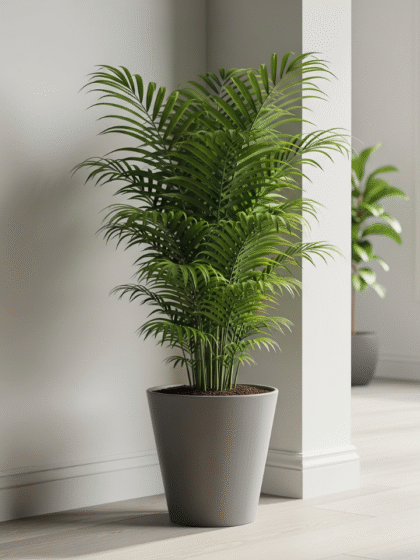
No. The ASPCA lists Epipremnum aureum as toxic to cats and dogs. The leaves and stems contain insoluble calcium oxalate crystals, which cause mouth irritation, drooling, pawing at the mouth and vomiting if chewed. It is rarely serious, but it is unpleasant for the animal. A high shelf or hanging planter solves this in most homes. If you have a pet that nibbles everything green, browse our pet-friendly plants instead. The Areca Palm fills a similar decorative role and is not on the ASPCA's toxic list.
A straight answer on air purification
This plant is listed in our air purifier plants collection, so here is what that means. Epipremnum aureum was one of the species in NASA's 1989 study, where it removed measurable amounts of benzene and formaldehyde from a small sealed chamber. A home is not a sealed chamber. Later research found you would need an impractical number of plants to match that effect in a real room, and ordinary ventilation does far more. Many people do find tending a plant calming, and that is a fine reason to own one. We just don't sell it as an air filter or a health product. Our guide to which indoor plants actually purify the air goes through the evidence.
Vastu and placement
In Vastu practice, the money plant is traditionally kept in the south-east, the direction associated with wealth, and away from the north-east. The usual advice is to let the vine grow upward rather than hang down, and to keep the foliage healthy and trimmed. N'Joy's compact size makes that easy even on a small table or desk corner. These placements are cultural tradition rather than something that can be demonstrated, and we share them respectfully because they matter to many households. Browse our Vastu plants if that is what you are shopping for.

































There are no reviews yet.