

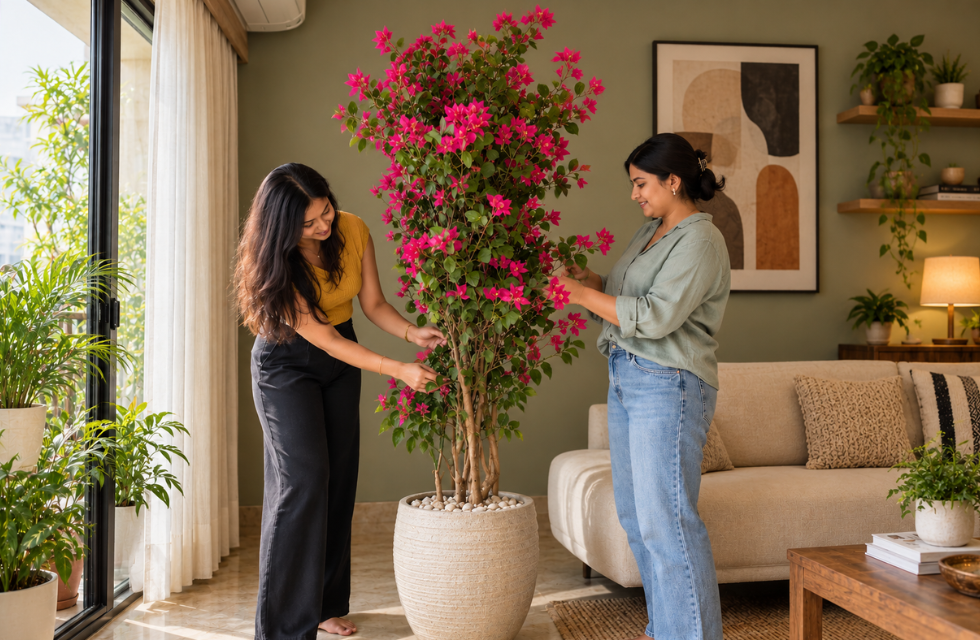
Few plants put on a show quite like a bougainvillea in full colour. One healthy shrub can cover a terrace railing in magenta, flame orange or white for weeks at a stretch, survive a scorching May afternoon without complaint, and ask for very little in return. Yet the most common message nurseries hear about it is the same every year: “My plant is green and growing, but it has stopped flowering.”
Learning how to care for a bougainvillea plant comes down to three things: sunlight, a slightly tough watering routine and pruning at the right moment. Get those right and the plant does the rest. This guide explains each one in plain language, then covers soil, pots, feeding, pests, propagation and the way care changes from a Delhi winter to a Mumbai monsoon.
Quick answer: To care for a bougainvillea, give it at least six hours of direct sun, plant it in fast-draining soil in a pot with a large drainage hole, and water deeply only when the top 5–7 cm of soil is dry. Feed lightly with a low-nitrogen, potash-rich fertiliser during the growing season, prune right after each flush of colour, and keep it slightly on the dry side to encourage blooms. Too much water, shade or nitrogen gives you leaves instead of flowers.
Key takeaways
- Full sun is the single biggest factor; in shade the plant lives but rarely blooms.
- Mild dryness between waterings triggers flowering, while constantly moist soil pushes leafy growth and invites root rot.
- Colour forms on new shoots, so prune straight after a flush and pinch soft tips to multiply flowering points.
- A snug, well-drained pot often flowers better than a large, roomy one.
- Leaf and bract drop after rain, cold or a move is normal and usually temporary.
What is a bougainvillea plant?
A bougainvillea is a thorny, woody climbing shrub from South America whose famous “flowers” are actually colourful modified leaves called bracts. Each cluster holds three papery bracts wrapped around three tiny cream-white tubular flowers, which is why the colour lasts for weeks rather than days.
The plant belongs to the four o’clock family, Nyctaginaceae. Three species matter in gardens: Bougainvillea glabra, B. spectabilis and B. peruviana. Most plants sold in India are hybrids of these, often grouped as B. × buttiana. The name honours the French navigator Louis Antoine de Bougainville, whose 18th-century expedition first recorded it in Brazil.
Across India it carries many local names. Bengali gardeners call it baganbilas, many Hindi speakers know it as kagaz ka phool (the paper flower), and in English it is simply the paper flower plant. Whatever the name, the growth habit is the same. Long arching canes carry hooked thorns that let the plant scramble over walls, gates and pergolas. Regular trimming turns it into a compact shrub, a hedge, a small standard tree or even a bonsai.
Two habits surprise new growers. First, the plant blooms in flushes: a burst of colour, a pause while it drops bracts and grows new shoots, then another burst. Second, it is semi-deciduous, so a cold snap, a sudden move or a heavy downpour can make it shed leaves, after which it refills within a few weeks.
What does a bougainvillea need to grow well?
A bougainvillea needs strong sun, warmth, fast drainage and restraint with water and fertiliser. It is a tough, low-input plant that responds badly to pampering.
Here is a bougainvillea plant care summary you can pin to the fridge:
- Light: Six hours or more of direct sun daily; eight or more for the heaviest flowering.
- Water: Deep soaking, then let the top 5–7 cm of soil dry before the next drink.
- Soil: Loose, gritty, free-draining mix with a pH between roughly 5.5 and 7.
- Temperature: Happiest between about 20°C and 38°C; leaves suffer below about 5°C and frost damages stems.
- Feeding: Light and potash-rich during active growth; very little nitrogen.
- Pruning: After each flush of colour, plus tip-pinching of new shoots.
- Pot: At least 30 cm (12 inches) wide and deep, with a generous drainage hole.
- Difficulty: Easy, once it has sun and is not overwatered.
The sections below explain why each of these matters and how to adjust them through the Indian year.
How much sunlight does a bougainvillea need?
A bougainvillea needs a minimum of six hours of direct, unfiltered sunlight every day, and it flowers most heavily with eight hours or more. Below about four hours, growth turns long, thin and leafy, and colour becomes sparse or stops altogether.
Sunlight is the fuel for bract production. The University of Florida’s IFAS Extension notes that the plant will grow in shade but rarely blooms without full sun, and that matches what Indian growers see on north-facing balconies. Colour intensity also depends on light: magenta and red bracts look deeper in strong sun and wash out in partial shade.
Best spots at home
- An open rooftop or terrace with sun from late morning onwards.
- A south- or west-facing balcony railing.
- A boundary wall, compound gate or pergola in an open yard.
- A sunny driveway edge where the reflected heat suits it.
Spots that rarely work
- North-facing balconies and covered verandas.
- Indoor rooms, even beside a bright window.
- Narrow light wells between buildings where sun lasts only an hour or two.
If your balcony gets only three or four hours of light, choose a plant that tolerates it rather than fighting the conditions. Bougainvillea suits the sunniest corner you have; a shaded ledge is better given to ferns, pothos or other foliage plants.
How often should you water a bougainvillea?
Water a bougainvillea deeply, then wait until the top 5–7 cm of soil feels dry before watering again. For a potted plant in Indian summer that usually means every two to three days; in winter, about once a week; during the monsoon, only when the mix has genuinely dried out.
This is the part of care that most people get wrong, because the plant behaves differently from typical flowering shrubs. In its native habitat it grows through wet and dry seasons, and the dry spells are what tell it to flower. Constantly moist soil sends a different message: grow leaves. IFAS advises gardeners whose plants will not bloom to check that they are not giving more water than the plant needs, and even to try neglecting it a little instead of babying it.
How to check before you water
- Push a finger into the soil up to the second knuckle, roughly 5 cm.
- If it feels cool and damp, wait another day and check again.
- If it feels dry and crumbly, water slowly until it runs freely from the drainage hole.
- Empty the saucer within 15 minutes so the roots never sit in water.
Typical watering rhythm for potted plants
- Summer (March to May): every two to three days for pots under 35 cm; every three to five days for large tubs. On days above 40°C, a small pot may need water daily.
- Monsoon (June to September): often nothing for days at a stretch. Water only after a dry spell, and tip out any pooled water.
- Post-monsoon (October to November): every four to five days, depending on sunshine.
- Winter (December to February): roughly once a week, less in North India when nights are cold.
Plants in the ground
Once established, which takes about a year, a bougainvillea planted in open soil needs watering only during long dry spells. In most of peninsular India, rain covers its needs from June to September, and a deep soak every seven to ten days is plenty in summer.
A slight wilt at midday in May is not an emergency; the leaves usually perk up by evening. A plant that stays limp in the cool of the morning, or wilts while the soil is still wet, is telling a different story, covered in the troubleshooting section further down.
What is the best soil for bougainvillea?
The best soil for bougainvillea is a loose, gritty, fast-draining mix that holds a little moisture but never stays soggy. A slightly acidic to neutral pH of about 5.5 to 7 keeps nutrients available and prevents yellowing.
Heavy clay or pure garden soil packs down in pots and holds water for days, which is the most direct route to root rot. Pure cocopeat is too light and dries unevenly. A balanced blend avoids both problems.
A simple potting mix for Indian conditions
- 40% good garden soil or red soil
- 25% coarse river sand, brick chips or perlite for drainage
- 25% well-rotted compost or vermicompost
- 10% cocopeat to hold a little moisture
Mix in a handful of neem cake per large pot to discourage soil grubs. Skip any fresh cow dung or mustard cake at planting time; both release a burst of nitrogen that pushes leaves at the expense of bracts.
If your local water and soil are hard and alkaline, as they are in parts of Rajasthan, Gujarat and the Deccan plateau, watch for pale new leaves with green veins. That pattern, called chlorosis, usually means iron is locked up by high pH. Adding more compost, using rainwater where possible and an occasional chelated micronutrient feed generally sort it out.
How do you grow a bougainvillea in a pot?
Grow a potted bougainvillea in a sturdy container at least 30 cm wide and deep, with a large drainage hole, filled with a gritty mix and placed in full sun. Keep it slightly root-bound, because a snug pot encourages flowering, and move up only one size at a time.
Growing bougainvillea in pots is how most Indian city gardeners keep this plant, and it has real advantages. You control the soil, you can move the pot under shelter in heavy rain or cold, and pruning keeps it to a manageable 1–2 metres.
Choosing the right pot
- Size: Begin with 30–35 cm (12–14 inches) for a young plant. A mature shrub is happy in 40–50 cm (16–20 inches) for years.
- Material: Terracotta and cement pots stay cooler in summer and their weight stops a top-heavy shrub from tipping in the wind. Plastic works if it is thick, light-coloured and placed where it will not bake.
- Drainage: One wide hole is better than several tiny ones. Cover it with a shard of broken pot or mesh, not a thick layer of gravel.
- Shape: Choose a pot that is roughly as deep as it is wide. Very shallow bowls suit only bonsai.
Step-by-step: moving a nursery plant into a bigger pot
A newly bought plant usually arrives in a nursery bag or a small pot. Repot it once it has settled for a week or two in its new spot.
- Water the day before so the root ball holds together.
- Prepare the new pot with the drainage cover and a few centimetres of fresh mix at the base.
- Cut the nursery bag away rather than pulling the plant out. Bougainvillea has a fine, brittle root system, and IFAS publications point out that root disturbance can set it back badly.
- Lower the root ball in whole, keeping its top at the same level it sat before. Do not tease or loosen the roots.
- Fill the gaps around the sides with mix, firming gently with your fingers.
- Water once thoroughly and place the pot in bright shade for three or four days before moving it into full sun.
- Hold back fertiliser for about three weeks while new roots form.
Some leaf drop in the first fortnight is normal and not a sign of failure. Repot again only when roots circle the pot and water runs straight through, typically every two to three years. Late February to March, before the main heat, is the best window in most regions.
Which fertiliser is best for bougainvillea flowering?
The best fertiliser for a flowering bougainvillea is one low in nitrogen and higher in potassium and phosphorus, applied lightly during active growth. Too much nitrogen gives lush green leaves and very few bracts, a point every extension service that studies the plant makes repeatedly.
A bougainvillea is a modest feeder. Clemson University’s Home and Garden Information Center suggests a general-purpose fertiliser at half the recommended rate during the growing months, and that restraint is the right instinct for Indian pots too.
A practical feeding plan
- After a hard prune or at the start of the season: mix two handfuls of vermicompost into the top layer of soil and give one dose of a balanced water-soluble feed such as 19:19:19 at half the label strength. This supports new shoots.
- Once new shoots are 10–15 cm long: switch to a bloom formula that is high in potash, for example a water-soluble 0:52:34 or 13:0:45, at the label dose every two to three weeks until colour appears.
- During a full flush: feed once a month at most; the plant is busy flowering.
- During the monsoon and the coldest winter weeks: stop feeding. Growth is slow and the roots cannot use it.
Organic options
- Vermicompost or well-rotted compost twice a year gives gentle, balanced nutrition.
- Bone meal adds slow-release phosphorus; a tablespoon per large pot each season is enough.
- Banana peel compost adds a little potassium over time, though it works far too slowly to replace a bloom feed.
- Wood ash supplies potash but raises pH, so use only a pinch, and never in alkaline soil.
- Mustard cake and fresh manure are nitrogen-heavy. They suit leafy vegetables, not a plant you want in colour.
Signs of nutrient trouble
- Browning or scorched edges on older leaves often point to a potassium shortage, according to University of Florida extension notes.
- Yellow new leaves with green veins point to iron or manganese lock-up in alkaline soil.
- Yellowing between the veins of older leaves can mean low magnesium. A teaspoon of Epsom salt in a litre of water, given once, can help, but only use it when this specific symptom appears.
- Dark, oversized leaves and no colour almost always mean too much nitrogen.
Always water the pot lightly before applying liquid fertiliser. Feeding bone-dry roots can scorch them.
How and when should you prune bougainvillea?
Prune a bougainvillea right after a flush of colour finishes, because the next set of bracts forms on fresh new growth. Cut back by about a third, remove dead or crossing canes, then pinch the tips of new shoots to make the plant bushier and more floriferous.
Pruning is not optional for this plant. Left alone, it throws long bare canes with colour only at the far ends. A regular trim keeps it compact, multiplies flowering tips and lets light reach the centre.
When to prune in India
- Main shaping cut: straight after the biggest flush ends. In most of India that falls between late May and early July, as the rains arrive. IFAS lists the start of the rainy season as one of the best times to prune.
- Light tidy-up: in late September or early October after the monsoon, so that new shoots have time to set colour for the winter and spring flush.
- Avoid: heavy cutting in the six to eight weeks before you expect colour. That removes the very shoots that would have flowered.
How to prune, step by step
- Protect yourself with thick gloves, full sleeves and eye protection. The thorns are long and hooked, and the sap can irritate skin.
- Use clean, sharp secateurs wiped with alcohol or a dilute bleach solution.
- Remove the dead wood first: brown, brittle canes and any that rub against each other.
- Shorten healthy canes by about one third, cutting just above a leaf node or a bud facing outward.
- Thin the centre by removing one or two old canes at the base if the shrub is dense.
- Pinch new shoots when they reach 15–20 cm, nipping off the top 2–3 cm. Repeat two or three times. Each pinch creates two or more branches, and each branch tip can carry colour.
Hard pruning an overgrown plant
An old, leggy shrub can be cut back to 30–60 cm of framework at the start of the rains. It will look bare for a few weeks, then sprout vigorously. Expect to skip one flowering cycle while it rebuilds, and feed lightly once new growth appears.
Shaping ideas
- Bush: regular tip-pinching and trimming to a rounded outline, the easiest form for pots.
- Standard or small tree: train a single strong stem up a stake, remove side shoots below the chosen height and let a head of branches form on top.
- Climber: tie two to four main canes to wires or a trellis and prune side shoots back to a few buds after each flush.
- Bonsai: a thick-stemmed plant in a shallow pot, pruned hard and often; bougainvillea is one of the more forgiving flowering bonsai subjects.
How do you train a bougainvillea on a wall, gate or trellis?
Train a bougainvillea by tying its strongest canes loosely to a sturdy support with soft ties, guiding them in the direction you want, and pruning side shoots after each flush. It is a scrambler rather than a true climber, so it needs to be tied in until its thorns hook on.
A support that lasts
- Stretch galvanised wires 30–45 cm apart across a wall, held 5–8 cm away from the surface on eye bolts so air can move behind the plant.
- Over a gate, use a metal arch or two tall bamboo poles joined at the top.
- On a terrace railing, simply weave or tie canes along the top rail.
Training tips
- Choose two to four strong canes as the framework and remove weaker ones at the base.
- Tie with soft jute, cloth strips or plant-tie tape, never thin wire that will cut in as the cane thickens.
- Bend some canes horizontally along the support. Horizontal stems tend to push out more side shoots, and side shoots are where the colour forms.
- Every few months, check ties and loosen any that are tightening.
Grown this way, the plant shares the role of flowering climbers for a sunny wall or arch, only with far more drought tolerance than most of them.
Why is my bougainvillea not flowering?
A bougainvillea usually stops flowering because it gets too little sun, too much water, too much nitrogen, or was pruned just before it was ready to bloom. Fixing the cause typically brings colour back within six to ten weeks.
Work through these causes in order, starting with the most common.
- Not enough direct sun. Under four to five hours, the plant cannot build bracts. Move the pot to the sunniest spot you have, or prune back any tree or awning that has grown over it.
- Too much water. A plant kept constantly moist puts its energy into leaves. Let the top few centimetres dry out between waterings and check that the drainage hole is clear.
- Too much nitrogen. Lawn fertiliser runoff, fresh manure, mustard cake or a balanced feed used too often all push foliage. Switch to a high-potash feed for the next month.
- Pruned at the wrong time. Cutting off new shoots just before a flush removes the flowering points. Wait for the next cycle and prune only after the colour ends.
- Pot too large. A small plant in a huge container spends a season or two filling it with roots. Mildly restricted roots, as several growers note, tend to encourage blooming.
- The plant is too young. A rooted cutting may take one to two years to flower freely; a nursery plant usually blooms within its first full season.
- Recent stress. Repotting, a long journey, a sudden move or a cold spell can pause flowering for a few weeks while the plant recovers.
- Day length. Many cultivars set buds more readily as nights lengthen, which is one reason heavy colour often arrives from late autumn into spring rather than in the longest days of June.
How can you make a bougainvillea flower more?
To make a bougainvillea flower more, give it maximum sun, let the soil dry a little more between waterings for two to three weeks after new shoots form, switch to a high-potash feed and pinch shoot tips to create more branches. This mild, controlled stress mimics the dry season that triggers blooming in the wild.
A six-week bloom plan
- Week 1: prune lightly after the last flush and move the pot to full sun.
- Weeks 2–3: water normally and give one half-strength balanced feed to grow new shoots.
- Week 3: pinch the soft tips of new shoots once they reach 15–20 cm.
- Weeks 4–5: stretch the gap between waterings until the leaves look very slightly soft at midday, then water deeply. Never let the plant wilt hard or stay wilted overnight.
- Weeks 4–6: feed with a high-potash bloom formula every two weeks.
- Week 6 onwards: colour buds should appear on the new tips. Return to a normal watering rhythm once bracts open, so the display lasts.
Two cautions keep this method safe. Do not use it on a plant that is newly repotted, recovering from pests or growing in very hot, shallow containers, because it can tip a stressed plant into serious decline. And remember that water stress works only alongside full sun; drying out a plant in shade simply weakens it.
How do you care for a bougainvillea through the Indian seasons?
Care for a bougainvillea changes with each Indian season: water and feed more in summer, protect it from waterlogging in the monsoon, prune and restart feeding after the rains, and water sparingly in winter while guarding against cold in the north.
Summer (March to May)
This is the plant’s comfort zone. Full sun and dry heat suit it perfectly, and many plants are in heavy colour through March and April. Water deeply every two to three days in pots, feed with a bloom formula every two to three weeks, and mulch the soil surface with dry leaves or cocopeat to cut evaporation. On a scorching west-facing terrace, a light pot is better shifted against a wall that blocks some afternoon glare, or set inside a larger outer pot for insulation. Grouping it with other heat-tough flowering shrubs, such as the summer flowers that keep blooming as the mercury climbs, makes watering easier and raises humidity around the pots.
Monsoon (June to September)
Heavy rain is the hardest season for a potted bougainvillea. Bracts shatter, soil stays wet and fungal leaf spot appears. Do the main pruning as the rains begin, stop feeding, and water only when the mix has dried. Raise pots on bricks or pot feet so they drain freely, empty saucers after every shower, and shift small pots under an eave during the heaviest weeks. Yellow, dropping leaves in July almost always mean too much water rather than too little. The same habits help the rest of the garden, as our guide to caring for terrace pots through a heavy rainy season explains.
Post-monsoon (October to November)
Once the rains ease, do a light shaping trim, refresh the top 3–4 cm of soil with compost, and restart a potash-rich feed. Shortening days and dry air bring a fresh round of buds in many regions, especially in the south and east.
Winter (December to February)
In mild climates, winter and early spring can be the best flowering window of the year. Water about once a week and feed lightly only if the plant is actively flowering. In North India, cold nights slow growth and can strip leaves; cut watering further and give no fertiliser until February. Our wider seasonal guide to India’s outdoor gardening year shows how bougainvillea fits alongside other plants through these months.
How does bougainvillea care change across India?
Bougainvillea grows well across almost all of India below the high hills, but each region needs a slightly different routine. The main differences are winter cold in the north, monsoon intensity on the coasts and in the east, and soil alkalinity on the dry plateaus.
North India: Delhi, Punjab, Haryana, Uttar Pradesh, Rajasthan
Summers reach 45°C and the plant loves them, provided pots are watered deeply. The challenge is winter, when nights fall to 2–6°C and frost touches some areas in December and January. Move pots against a south-facing wall, cover them with an old bedsheet or jute sack on frosty nights, and cut watering to once every 10–12 days. Leaf drop in January is normal; new growth returns in February. Main colour usually arrives from late February to May, with a second round in October and November.
West and the Deccan: Mumbai, Pune, Hyderabad, Bengaluru
The dry plateau climate of Pune, Hyderabad and Bengaluru is close to ideal, and well-placed plants colour for much of the year; bougainvillea is a familiar sight along Bengaluru road dividers for good reason. Watch for chlorosis in alkaline, hard-water areas and add compost generously. Mumbai’s long, intense monsoon calls for raised pots, shelter for small containers and an early pruning before the first heavy showers.
South and the coasts: Chennai, Kerala, Goa, coastal Andhra and Karnataka
Warm, humid conditions suit growth but encourage fungal leaf spot. Space pots for airflow, water at the base rather than over the leaves, and remove spotted leaves promptly. The plant tolerates salty sea breezes better than most flowering shrubs, which makes it valuable for coastal balconies. Heavy colour often comes in the drier months from December to April.
East: Kolkata, West Bengal, Odisha, Assam
Humid summers, a heavy June-to-September monsoon and short, mild winters define the routine. Baganbilas is a terrace favourite across Bengal, and the main show usually runs from November to April, with a lighter flush after the rains. The monsoon is the danger season: waterlogged pots and rotting roots cause more losses here than heat ever does. If you garden in the Kolkata region, notes on how sun-hungry shrubs are raised on Bengal rooftops at a nursery near Kolkata show the same rhythm in practice.
Hill regions
Bougainvillea grows outdoors only in the lower, frost-free hills. Above that, keep it in a pot that can spend winter in the brightest, warmest room, accept that it will be semi-dormant, and move it back outside once nights stay above about 10°C.
What are the common bougainvillea problems and how do you fix them?
The most common bougainvillea problems are leaf drop, yellowing leaves, bract drop and chewed or sticky leaves. Most come down to overwatering, sudden changes in conditions or a handful of easy-to-treat pests.
Leaves dropping suddenly
Normal after a move, a long journey, repotting, a cold night or heavy rain. Keep the plant in its new spot, water only when dry and wait. Fresh leaves usually appear within two to four weeks. Constant leaf drop with wet soil points to root problems instead.
Yellow leaves
- Older leaves yellowing and falling, soil wet: overwatering. Let the pot dry and check drainage.
- New leaves pale with green veins: iron lock-up in alkaline soil. Add compost and a chelated micronutrient feed.
- A few yellow leaves after a flush: natural shedding, nothing to fix.
Bracts falling off
Rain, wind and the end of a natural cycle all cause bract drop. Colour is never permanent on this plant. Trim spent tips and the next round follows in four to eight weeks.
Sudden wilting while the soil is wet
This usually signals root rot. Slide the plant out, cut away black or mushy roots with clean scissors, repot into fresh, grittier mix and withhold water for five to seven days. Catching it early is the only reliable cure.
Chewed, ragged leaves
The bougainvillea looper, a small green caterpillar that feeds at night, is the usual culprit. Look under leaves in the evening and pick them off. For a heavy attack, spray a Bacillus thuringiensis (Bt) product, a biological control that targets caterpillars, following the label.
Sticky leaves, curled tips or white fluff
Aphids gather on soft new growth, mealybugs hide as white cottony clumps in leaf joints, and whitefly rise in a cloud when you brush the plant. Wash them off with a firm spray of water, then apply neem oil: about 5 ml of cold-pressed neem oil and a few drops of liquid soap per litre of water, sprayed in the evening every seven days for three weeks.
Brown or purple spots on leaves
Fungal leaf spot appears in humid, wet weather. Remove affected leaves, improve airflow, avoid overhead watering and, if it spreads, use a copper-based fungicide as directed on the label.
Long, bare stems with leaves only at the tips
Too little light or no pruning. Move the plant into full sun and cut back by a third after the next flush.
How do you propagate bougainvillea from cuttings?
Propagate bougainvillea by taking 15–20 cm semi-hardwood cuttings, pencil-thick, from last season’s growth, dipping the base in rooting hormone and planting them in a gritty, barely moist mix in warm, bright shade. Roots typically form in four to eight weeks.
Step by step
- Choose the right season: February to April, or June to July in warm regions, when the plant is actively growing.
- Select the wood: firm but not woody-brown stems, roughly the thickness of a pencil, without flowers.
- Cut cleanly: take 15–20 cm sections, with the lower cut just below a node, angled slightly.
- Strip the leaves: remove all but two or three at the top, and cut those in half to reduce water loss.
- Apply rooting hormone: dip the base in an IBA-based rooting powder or gel. This noticeably improves success with this slow-rooting plant.
- Plant: insert the bottom third into a mix of equal parts coarse sand and cocopeat in a small pot.
- Keep warm and lightly moist: place in bright shade at 25–30°C. A clear plastic bag over the pot, opened daily, holds humidity.
- Check for roots: after four weeks, a gentle tug that meets resistance means roots have formed. Move the young plant into regular potting mix after eight to ten weeks.
Air layering for faster results
For a bigger plant quickly, remove a 2 cm ring of bark from a healthy cane, dust it with rooting hormone, wrap it in moist sphagnum moss or cocopeat and seal it in plastic. Roots appear in six to eight weeks, after which the rooted section is cut free and potted. Multi-coloured plants sold in nurseries are often two or more varieties grafted together or planted in one pot; cuttings from such plants carry only the colour of the branch they came from.
Which bougainvillea varieties grow well in India?
Almost every bougainvillea variety sold in India grows well in a sunny spot, so the real choice is about colour, size and thorniness. Compact and dwarf types suit balconies and small pots, while vigorous types are best for walls, gates and large terraces.
By colour
- Magenta and purple: the classic, toughest and most free-flowering group, close to the original species.
- Red and crimson: striking on white walls, and often slightly less vigorous.
- Orange, apricot and salmon: bracts frequently change shade as they age, giving a two-tone effect on one plant.
- White: cool-looking in summer and lovely by moonlight, though bracts show rain marks quickly.
- Yellow and gold: usually slower growing and a little more sensitive to cold.
- Bicolour types: varieties such as ‘Mary Palmer’ carry white and magenta bracts on the same plant.
By habit
- Dwarf and compact cultivars stay small with light pruning and suit 30 cm pots and railing planters.
- Upright or bushy types such as ‘Torch Glow’ grow more like a shrub than a climber.
- Variegated forms like ‘Thimma’ offer cream-edged leaves even when not in colour, though they need a little more care and sun.
- Double-bracted types look like small rosettes and hold their colour longer, but tend to drop spent bracts less cleanly.
A note on thorns
No bougainvillea is truly thornless, although B. glabra types are generally less thorny than B. spectabilis. If children or pets share the space, choose a compact variety and site it where people do not brush past.
Can you grow a bougainvillea indoors?
A bougainvillea cannot be grown as a long-term indoor plant in most Indian homes, because it needs several hours of direct sun every day to stay healthy and flower. Indoors it becomes weak and leggy and stops blooming within weeks.
A flowering plant can visit a sunny south-facing window or an enclosed sunroom for a few days during a celebration, but it should go back outside soon after. In cold hill towns, the brightest indoor window is a winter shelter, not a permanent home. It also does not purify indoor air in any meaningful way; research reviewing decades of studies, including Cummings and Waring’s 2019 analysis, found that houseplants make little practical difference to air quality in a normal room. Grow it for colour and resilience, outdoors in the sun.
Is bougainvillea safe for pets and children?
Bougainvillea is not listed as toxic to dogs or cats on the ASPCA’s plant database, so serious poisoning is not expected, but it is not a hazard-free plant. Its long, hooked thorns can cause painful punctures, and its sap can irritate skin and mouths in sensitive people and animals.
Chewing a lot of leaves or bracts may cause mild stomach upset, which the ASPCA notes can happen with almost any plant material. The bigger, more practical risks are physical: thorn scratches, eye injuries during pruning and splinters from dropped canes. Wear gloves and eye protection while working on the plant, keep pots away from play areas and narrow walkways, and sweep up pruned canes promptly. If your cat likes to chew foliage, a plant like a spider plant, one of the few houseplants the ASPCA confirms as safe for cats and dogs, is a better choice for a reachable indoor shelf.
Where should you place a bougainvillea at home?
Place a bougainvillea where it gets the most direct sun on your property: an open terrace, a south- or west-facing balcony railing, a boundary wall or a gate arch. Keep it away from doorways, paths and seating areas where its thorns can catch people.
Good homes for it
- Terraces: it shrugs off wind and glare that flatten softer plants, which is why it sits naturally among rooftop plants that cope with fierce sun and wind.
- Balconies: trained along the railing, it suits balconies that catch strong afternoon sun, as long as the pot is heavy enough not to tip.
- Boundary walls and gates: its dense, thorny growth makes a colourful barrier as well as a show.
- Garden beds: as a hedge or a single specimen shrub among other outdoor shrubs that want blazing sun all day.
Good companions
Pair it with plants that share its love of sun and dislike of wet feet. The adenium, a desert rose that thrives on the same dry-between-drinks routine, makes a natural partner on a hot terrace. A red hibiscus, the classic jaba of Indian courtyards, adds bold blooms at eye level, though it wants a little more water. For fragrance, a champa shrub with its scented summer flowers suits the same sunny corner. More ideas sit in our list of sun-loving plants for Indian gardens, from flowers to fruit.
A note on Vastu
Vastu practitioners hold differing views on thorny plants. A common position places them along the boundary or terrace edge, often to the south or west, rather than beside the main entrance or inside living spaces. Classical texts do not single out bougainvillea, so treat placement guidance as a matter of tradition and personal preference. The reasoning behind outdoor placement is explained in our guide to arranging garden plants around the home according to Vastu.
What does a month-by-month bougainvillea care calendar look like?
A month-by-month calendar helps you prune, feed and water at the moments that matter. Timings below suit most of peninsular and eastern India; in the north, shift winter tasks a few weeks later and expect a firmer winter pause.
- January: water once a week or less; no fertiliser in cold regions. Enjoy winter colour in the south and east.
- February: start feeding as growth resumes. Best month to repot or take cuttings.
- March: peak flowering begins in many regions. Feed with a bloom formula every two to three weeks and step up watering.
- April: heavy colour and high heat. Water deeply every two to three days in pots and mulch the surface.
- May: keep watering through the hottest weeks. Trim spent tips as the flush fades.
- June: main pruning as the rains begin. Raise pots on feet and stop feeding.
- July: water only after dry spells. Watch for fungal leaf spot and caterpillars.
- August: pinch new shoots to build a bushy frame. Shelter small pots from the heaviest downpours.
- September: a light shaping trim late in the month as the rains ease.
- October: refresh the topsoil with compost and restart a potash-rich feed.
- November: buds form as days shorten; reduce watering slightly as temperatures drop.
- December: first winter colour in mild regions. Protect pots from frost in the north.
What mistakes should you avoid when caring for a bougainvillea?
The costliest mistakes are overwatering, planting in shade, overfeeding with nitrogen and pruning at the wrong time. Each one produces a green, healthy-looking plant that simply refuses to flower.
- Watering on a fixed daily schedule. Check the soil first; the plant prefers to dry slightly.
- Choosing a shaded spot because the plant “looks tough.” It is tough, but it will not flower without sun.
- Using a pot without a drainage hole, or leaving it in a water-filled saucer.
- Feeding with leafy-growth fertilisers like urea, mustard cake or fresh manure.
- Disturbing the roots when repotting, which can set the plant back for months.
- Pruning just before a flush instead of straight after one.
- Moving the pot often. Frequent changes of position cause leaf and bract drop.
- Expecting year-round colour. Healthy plants bloom in cycles, with rest periods in between.
- Handling it bare-handed. Gloves and long sleeves save a great deal of pain.
Frequently asked questions
Water a potted bougainvillea when the top 5–7 cm of soil feels dry, which is usually every two to three days in summer, about once a week in winter and only after dry spells in the monsoon. Always water deeply until it drains, then empty the saucer.
Yellow leaves on a bougainvillea most often mean the soil is staying too wet. Let the pot dry out between waterings and check the drainage hole. Pale new leaves with green veins instead suggest an iron shortage caused by alkaline soil, which compost and a chelated micronutrient feed can correct.
Bract drop is part of the plant’s natural cycle, and rain, wind or a sudden move speeds it up. Trim the spent tips, keep the plant in full sun with slightly dry soil, and a new round of colour should follow in four to eight weeks.
Yes. A bougainvillea needs at least six hours of direct sun daily and blooms best with eight or more. In partial shade it survives but produces mostly leaves.
A low-nitrogen, high-potash fertiliser works best. A water-soluble bloom feed such as 0:52:34 or 13:0:45 every two to three weeks during active growth, plus vermicompost twice a year, keeps the plant flowering without pushing excess leaves.
Prune straight after a flush of colour ends. In most of India that means a main cut between late May and early July, and a light trim in late September or early October. Avoid heavy cuts in the two months before you expect flowers.
Yes, if the balcony gets six or more hours of direct sun. Choose a compact variety and a pot at least 30 cm wide with good drainage, and keep the plant to shape with regular pinching and pruning.
A healthy nursery plant usually flowers within its first full growing season once it is in full sun. Plants grown from cuttings can take one to two years before they bloom freely.
Bougainvillea is not on the ASPCA’s list of plants toxic to dogs and cats, and serious poisoning is not expected. Its sharp thorns and irritating sap are the real hazards, so wear gloves when handling it and keep it away from play areas.
Yes. Take a 15–20 cm semi-hardwood cutting, dip the base in rooting hormone and plant it in a sand and cocopeat mix in warm, bright shade. Roots usually form in four to eight weeks.
Established plants in the ground usually survive North Indian winters with some leaf loss, but potted plants need protection. Move pots against a south-facing wall, cover them on frosty nights and water sparingly until February.
A well-cared-for bougainvillea can live for decades. Regular pruning, good drainage and repotting every few years keep potted plants productive for a very long time.
Ready to add a splash of paper-flower colour?
If your terrace or balcony gets real sun, a bougainvillea is one of the most rewarding plants you can grow. A nursery-raised bougainvillea, pruned and packed for the journey, is a good place to start, and the wider range of colourful bloomers to pick from for every Indian season can fill the spaces around it. Every plant is grown and dispatched by a nursery-direct garden store that ships live plants nationwide, with home delivery to cities and towns across the country.