‘Pixie’ is the dwarf cultivar of Syngonium podophyllum, the arrowhead vine, and it is also sold under the name ‘Nana’. Everything about it is a scaled-down version of the familiar plant: the leaves are a fraction of the size, and the gaps between nodes along the stem are so short that the plant builds a dense, multi-stemmed clump instead of reaching outward.
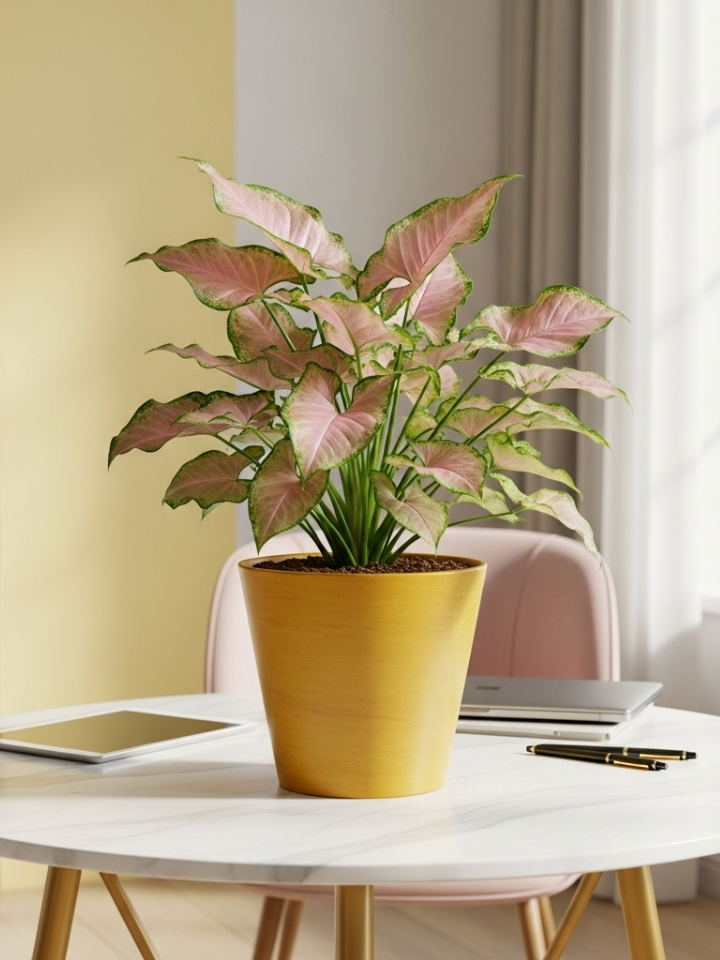
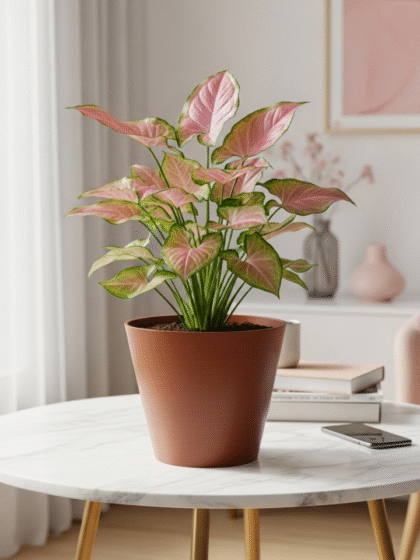
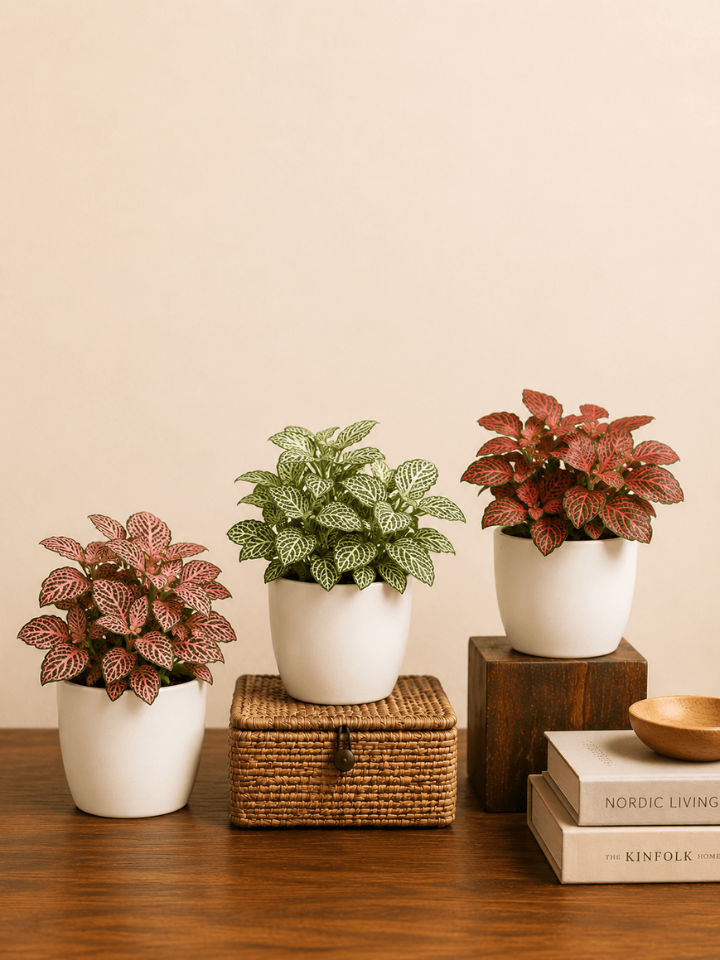
The leaf is the reason to own it. Each blade is a small, softly matte spearhead with two short lobes at the base, and the colouring runs inward — a creamy-white to pale-green field in the centre, ringed by a distinctly darker green margin that follows the leaf’s outline. New leaves unfurl palest and firm up over the following weeks. On a healthy plant with a dozen or more leaves, the effect is closer to a patterned bouquet than a vine.
It will stay small, and that is the point. A standard arrowhead vine outgrows a shelf within two seasons. This one holds at roughly 15–20 cm across for years, and even with a support to climb it tends to stop somewhere near 60 cm rather than heading for the ceiling. Growth is steady rather than fast. If you have bought a Syngonium before and lost the shape of it, this is the version that stays where you put it.
| Light | Bright indirect. The pale centres depend on it — see the note below |
| Water | When the top inch dries — roughly every 4–5 days. A 4-inch pot dries faster than you expect |
| Pets | Not pet-safe — ASPCA-listed as toxic to cats and dogs |
| Difficulty | Easy — forgiving, but wants more light than most people give it |
Where to put it
A metre or two back from an east or north window is ideal. It is genuinely well suited to a work desk under steady overhead light, a bathroom shelf where the humidity does it good, a bedside table, or a shallow bowl planted with two or three together for fullness. It is also one of the better terrarium plants in the catalogue — the small leaf, the slow habit and its liking for humid, still air are exactly what a closed glass container provides. Keep it off a west-facing sill in April and May.
Keeping the white centres white
This is the question that decides whether someone is happy with this plant six months from now, so it is worth being precise.
The pale centre of each leaf holds little or no chlorophyll. It contributes almost nothing to feeding the plant, which means the green margin has to do all the work — and that is why a variegated variety like this one needs better light than a plain green arrowhead, and grows more slowly even when it gets it.
In bright indirect light the plant can afford the pale tissue, and new leaves come out with generous cream centres. In a dim corner it cannot, and it responds by producing leaves with progressively more green. This is an economy measure rather than a disease. Move it brighter and the next flush comes back marked.
Three things worth knowing before you buy:
- Direct sun does not brighten the variegation — it burns it. Pale tissue has no pigment shielding it, so it scorches faster than a green leaf would, and it shows the damage as dry, papery patches that never recover.
- The pattern varies leaf to leaf, and always will. Some leaves come out nearly all cream, others mostly green with a pale flash along the midrib. That variation is normal on a single plant and is not a fault in the one you receive.
- Cuttings do not always keep the pattern. Propagation works easily, but a cutting taken from a strongly green stem tends to produce green growth. Take material from the best-marked stems if the colouring matters to you.
Product specifications
| Specification | Detail |
| Plant name | Syngonium Pixie White Plant |
| Botanical name | Syngonium podophyllum ‘Pixie’ |
| Also known as | Syngonium ‘Nana’, dwarf arrowhead vine, mini arrowhead plant, white syngonium, goosefoot plant |
| Plant family | Araceae (the arum family — the same family as Monstera and money plant) |
| Plant type | Evergreen perennial; dwarf cultivar. Clump-forming when young, slowly trailing or climbing with age |
| Suitable placement | Work desk, study table, shelf, bedside table, bathroom, living room, north or east windowsill, shaded balcony, terrarium, dish or bowl planter |
| Light requirement | Bright indirect light for the strongest cream marking. Tolerates moderate light with more green in the new leaves. No direct afternoon sun |
| Water requirement | Moderate. Roughly every 4–5 days once the top inch is dry; every 10–12 days in winter, and far less through the monsoon |
| Soil requirement | Light, airy and free-draining. Supplied established in a nutrient-rich nursery mix |
| Growth habit | Compact, multi-stemmed clump with short internodes. Very slowly lengthens with age; can be given a small support but does not climb vigorously |
| Growth rate | Slow to moderate — slower than plain green Syngonium, because the pale leaf tissue does not photosynthesise |
| Foliage | Small arrowhead leaves with short basal lobes; creamy-white to pale-green centre with a darker green margin. Pattern varies leaf to leaf and with light |
| Humidity | Prefers 50–60% or higher. Thrives through the Indian monsoon; may brown at the tips in dry winter air or under an AC vent |
| Temperature range | Comfortable between 18 °C and 30 °C. Keep above 15 °C. Not frost-hardy |
| Grows in water | Yes, for cuttings and for the medium term. Long-term growth is stronger in soil |
| Terrarium suitable | Yes — one of the better choices for a closed terrarium or glass bowl, given the small leaf and slow habit |
| Difficulty level | Easy — suitable as a first or second houseplant |
| Suitable environment | Warm, humid, indoors or a shaded balcony |
| Pet safety | Not safe — ASPCA-listed as toxic to cats, dogs and horses |
| Propagation | Stem cuttings with a node, or division of the clump. Roots in 2–3 weeks |
| Lifespan | Several years, and effectively indefinite through cuttings and division |
Care guide
| Light | Bright, indirect. Two metres from an east or north window is the sweet spot. It survives further in, but each new leaf comes out greener than the last |
| Water | Water until it drains, then wait for the top inch to dry — roughly every 4–5 days in warm weather, every 10–12 days in winter. A 4-inch pot holds little soil, so check it more often than you would a large plant |
| Soil | Light and quick-draining. Ordinary potting mix opened up with coco peat and a handful of coco chips or coarse sand |
| Humidity | Group it with other plants, stand the pot on a pebble tray, or keep it in a bathroom. Do not sit it directly under an air conditioner |
| Feeding | A balanced liquid feed at half strength once a month from March to September. Nothing through winter — and go light, because forced growth on a dwarf variety comes out leggy |
| Repotting | Every 12–18 months, one size up at most. It looks and grows better slightly snug than in a large pot |
| Pruning | Little needed. Snip any stem that runs longer than the rest, and remove yellowing lower leaves. Every trimmed piece is a free cutting |
| Propagation | Take a short cutting with at least one node, or lift and split the clump at repotting. Root in water or damp mix; two to three weeks |
Growing it through the Bengal year
Monsoon, June to September. The best months of its year, and the ones that need the least from you. Air this humid is close to what the plant evolved in, and the leaves fill out faster now than at any other time. The whole risk is the watering can. Soil in a small pot sitting in saturated air stays wet for a week longer than it looks, and stems rot at soil level while the foliage still appears fine. Stop watering to a schedule between June and September, check with a finger, and keep it somewhere with moving air rather than a still corner.
Summer, March to May. The season where a 4-inch pot works against you. There is not much soil in it, and in Bengal’s dry pre-monsoon heat it can go from moist to bone dry in three days — faster than the fortnightly rhythm most people apply to indoor plants. Check every second or third day through April and May. Also watch the afternoon sun: an hour behind west-facing glass in May will bleach the pale leaf centres, and that damage does not grow out.
Winter, late November to February. Growth almost stops and watering drops to every ten to twelve days. Cold is not the problem here — dry air is. Crisp brown edges appear first on the plants nearest a heater or an AC vent, and on this variety they show more plainly than they would on a plain green plant, because the damage sits against pale tissue. A pebble tray or a weekly misting usually settles it. Spider mites also arrive in the dry season, so check the leaf undersides in January.
Common problems
| Symptom | Cause | What to do |
| New leaves coming out mostly green | Not enough light — the commonest complaint on any variegated plant | Move it brighter, out of direct sun. The next flush recolours; existing leaves will not change |
| Dry, papery pale patches | Sun scorch. Pale tissue burns faster than green | Move it out of direct sun. Damaged tissue does not recover; trim the worst leaves |
| Brown, crisp leaf edges and tips | Dry air, an AC or heater vent, or salt build-up from tap water | Raise humidity, move it away from the vent, and flush the pot thoroughly every few months |
| Yellow leaves, soft at the base | Overwatering — especially during the monsoon | Stop watering, let the mix dry right through, and check the pot drains freely |
| Whole plant wilting suddenly in summer | The 4-inch pot has dried out completely | Water thoroughly until it drains. It usually recovers within hours |
| Very slow growth | Normal for this cultivar, and slower still in low light | Nothing, if the plant looks healthy. Brighter light speeds it up; feeding harder does not |
| A stem running long and bare | Ordinary ageing, or low light | Snip it back to a node. It branches from below the cut, and the cutting roots easily |
| Fine webbing on leaf undersides | Spider mites — most likely in the dry winter months | Rinse the leaves, then spray diluted neem oil weekly for three weeks |
| A few leaves drooping in the first week | Transit stress | Normal. Keep it bright, water sparingly, and expect it to settle within two to three weeks |
Is it safe for pets?
No. The ASPCA lists Syngonium podophyllum as toxic to cats, dogs and horses, and that applies to this cultivar as much as to the full-size plant. The leaves and stems contain insoluble calcium oxalate crystals, which cause immediate mouth and throat irritation, drooling, pawing at the mouth and vomiting if an animal chews them. It is rarely dangerous and usually resolves on its own, but it is genuinely unpleasant, and the sap can irritate sensitive skin when you take cuttings.
Its size is an advantage here — a small plant is easy to keep out of reach on a high shelf or inside a closed terrarium. If your cat treats every plant as a salad, browse the pet-friendly range instead.
About the air-purifying claim
This product sits in our air purifier plants range, so it is worth saying what that does and does not mean.
Syngonium podophyllum was among the species tested in NASA’s 1989 sealed-chamber experiments, where it removed measurable formaldehyde from the air. That was a small airtight chamber, not a room. Later analysis found that reproducing the effect in an ordinary home would take an implausible number of plants, and that opening a window does far more. A plant this size clears even less air than the full-grown version tested. It is a lovely thing to own; it is not an air filter, and we would rather tell you that than sell you a claim that does not hold. Our longer piece on which indoor plants actually purify air goes through the evidence.
Vastu, Feng Shui and the “good luck” association
The arrowhead vine is widely sold across India as a good-luck plant. In Feng Shui the five-lobed mature leaf is read as representing the five elements, and the plant is associated with balance and steady growth; the usual placement guidance is the east or south-east of a room, in soft rather than harsh light, with yellowing leaves trimmed away.
Two honest notes. This is cultural convention rather than classical scripture, and the association is a tradition rather than anything demonstrable. And the dwarf cultivar rarely produces the lobed mature leaf that the five-element reading refers to — it keeps its simple arrowhead shape almost indefinitely. That matters to nobody’s luck, but if the symbolism is the reason you are buying, the standard-size varieties in the Vastu plants collection fit the tradition more literally.

















There are no reviews yet.