Start with what it is, because almost nobody selling it will tell you. The Brazilian Wood Plant is Dracaena fragrans — a tropical foliage plant from the forest understorey of central and eastern Africa, not from Brazil, and no relation to the brazilwood timber tree that gave the country its name. “Brazilian lucky wood” is a nursery trade name that travelled through South-East Asian growers into Indian homes, and it stuck because it describes the look of the thing: a length of bare, knotted wood that turns green.
That is genuinely how it works, and it is the reason to own one. The cane is a section of mature stem, cut and rooted, carrying dormant buds sleeping under the bark. Given warmth and light, those buds break through and open into rosettes of long, arching, strap-shaped leaves — deep glossy green, faintly ribbed, often 20 to 30 cm long on an established shoot. A single cane may push one crown or three, and each new one changes the plant’s shape entirely. Few houseplants give you something visibly new to look at this often.
It stands up by itself. The woody stem is rigid and needs no stake, moss pole or trellis, which makes it one of the tidiest tall plants you can keep in a small flat. A young cane sits comfortably on a desk or shelf; over several years, with the crown allowed to build, the same plant becomes a floor-standing specimen of around 90 to 150 cm indoors. Growth is slow and unhurried — a few new leaves through the warm months is a good year’s work, and that steadiness is exactly what people mean when they call it a low-maintenance plant.
Soil or water, your choice
The cane roots readily in both, which is unusual and useful. In a vase of plain water it becomes a clean, minimal desk piece with no soil to spill and no watering to remember beyond a fortnightly change. In soil it grows faster, holds its leaves longer and ultimately gets taller. Neither is wrong; the section further down sets out the honest trade-off.
Where to put it
A metre or two back from an east- or north-facing window is the sweet spot. It suits a study desk, a reception counter, a bedside table, a bookshelf, the corner of a living room, or a covered balcony out of direct sun. It handles the steady, windowless fluorescent light of an office better than most plants of its size, which is why it is one of the more sensible desk plants we sell, and it holds its colour through a Kolkata winter without complaint.
Is the Brazilian Wood Plant actually lucky?
It is the question the name invites, so here is a straight answer.
In Feng Shui and in the Indian Vastu tradition as it is practised today, upright woody plants with rising, sword-shaped foliage are associated with growth, resilience and steady prosperity, and this one is usually placed in the east, south-east or north-east of a room, away from the head of a bed. Households that buy it as a housewarming, Diwali or new-office gift are buying that meaning, and it is a lovely thing to give.
Being straight about it: the association is modern convention rather than classical scripture. Dracaena fragrans is an African plant that reached India through the nursery trade in living memory — it has no Sanskrit name, and the placement guidance given for it is the general direction advised for healthy green foliage rather than anything specific to this species. If the tradition matters to you, the plants it actually names are gathered in our Vastu plants collection.
What we can stand behind without qualification: it is a handsome, upright, forgiving plant that looks after itself, and a cut piece of wood sprouting new green leaves is about as direct a symbol of renewal as a gift can be.
Product specifications
| Specification | Detail |
| Plant name | Brazilian Wood Plant |
| Botanical name | Dracaena fragrans |
| Also known as | Brazilian lucky wood, lucky wood plant, corn plant (the gold-striped ‘Massangeana’ form), cornstalk dracaena, happy plant |
| Plant family | Asparagaceae |
| Plant type | Evergreen perennial foliage plant, grown as a rooted woody cane |
| Origin | Tropical Africa — the forest understorey of Cameroon, Uganda, Tanzania and neighbouring regions. Not native to Brazil |
| Suitable placement | Study desk, work desk, reception counter, bedside table, bookshelf, living room corner, hallway, covered balcony, shaded veranda |
| Light requirement | Bright indirect light. Tolerates low light and office tube lighting with slower growth. No direct afternoon sun |
| Water requirement | Moderate. In soil, every 7–10 days once the top inch is dry, and every 2–3 weeks in winter. In water, change it every 10–14 days |
| Soil requirement | Loose, nutrient-rich and free-draining — potting soil opened up with coco peat and perlite or coarse sand. Supplied established in a pre-nourished nursery mix |
| Growth habit | Upright, self-supporting single or multi-headed cane. Does not climb or trail, and needs no stake |
| Growth rate | Slow |
| Foliage | Long, arching, strap-shaped glossy green leaves in rosettes at the crown, typically 20–30 cm on established growth |
| Grows in water | Yes — the cane lives indefinitely in a vase of clean water. Growth is stronger in soil |
| Humidity | Comfortable at normal indoor humidity; happier above 50%. Dislikes a direct air-conditioner draught |
| Temperature range | 18 °C to 28 °C is ideal. Keep above 12 °C. Not frost-hardy |
| Water sensitivity | Sensitive to fluoride and salts in tap water, which show as brown leaf tips. Filtered or stood water is better |
| Air purifying | Sits in our air purifier range; Dracaena fragrans was among the species in NASA’s 1989 chamber study. See the honest note below |
| Difficulty level | Very easy — suitable for beginners |
| Suitable environment | Warm indoor spaces, offices, shaded balconies and covered verandas |
| Pet safety | Not safe — ASPCA-listed as toxic to cats and dogs |
| Propagation | Stem and top cuttings, rooted in water or damp mix |
| Lifespan | Many years; decades in good conditions |
Care guide
| Light | Bright, indirect. A metre or two from an east or north window is ideal. It survives further in and under office lighting; growth simply slows and the crowns space out. Direct afternoon sun bleaches and scorches the leaves |
| Water | In soil, water until it runs from the drainage hole, then wait for the top inch to dry — roughly every 7–10 days in warm weather, every 2–3 weeks in winter. Never leave the pot standing in a filled saucer. In a vase, keep 4–5 cm of the cane submerged and change the water every 10–14 days |
| Water quality | This is the one fussy thing about a Dracaena. Fluoride and dissolved salts in tap water collect at the leaf tips and burn them brown. Filtered water, or tap water left standing overnight, makes a visible difference within a few months |
| Soil | Loose and quick-draining — potting mix opened up with coco peat and a generous handful of perlite or coarse sand. Heavy garden soil holds water around the base of the cane and is the commonest cause of failure |
| Humidity | Normal indoor humidity is fine. It appreciates a pebble tray or an occasional misting in the dry months, and dislikes sitting directly under an air conditioner |
| Feeding | A balanced liquid feed at half strength once every six to eight weeks from March to September. Nothing through winter. A cane in plain water needs a few drops of hydroponic feed at each change, or it will slowly run down |
| Repotting | Every two to three years, one size up. It flowers and shoots more readily when slightly snug, so resist a large pot |
| Pruning | Remove yellowed lower leaves at the base with clean scissors. If a crown grows leggy, cut the stem back cleanly — new buds break below the cut, and the piece you removed roots as a new plant |
| Cleaning | Wipe the leaves with a soft damp cloth every two or three weeks. These leaves are broad and glossy, and dust dulls them faster than people expect |
| Propagation | Cut a healthy section of cane with at least two dormant nodes, let the cut ends dry for a day, then stand it upright in damp mix or a few centimetres of water. Roots follow in four to six weeks |
Growing it through the Bengal year
Monsoon, June to September. The one season that genuinely threatens this plant. Air that stays saturated for weeks keeps a small pot wet ten days after a watering, and rot starts inside the base of the cane where nothing shows until the wood softens. Stop watering to a schedule entirely between June and September, check with a finger every time, and keep it where air moves rather than in a still corner. Canes standing in water are safer through these months than potted ones, provided the water is actually changed.
Summer, March to May. Comfortable months and the season of fastest growth, with two things to watch. Pre-monsoon light through a west window will scorch these broad leaves in a single afternoon, and the damage does not heal — a metre back from the glass solves it. And a plant that has spent April under an air conditioner will show dry brown edges by May; move it out of the airflow rather than misting harder.
Winter, late November to February. Growth stops almost entirely and watering drops to every two or three weeks. Kolkata’s cool season poses no threat to this plant, but a cold draught from an open window at night does, and dry indoor air is when spider mites arrive. Check the undersides of the leaves in January — fine speckling and a dull, dusty look are the first signs, well before you see any webbing.
Common problems
| Symptom | Cause | What to do |
| Brown, crisp leaf tips | Fluoride and salts in tap water — by far the commonest complaint on this plant | Switch to filtered or stood water, and flush the pot through every few months. Trim the tips at an angle with clean scissors |
| Lower leaves yellowing and dropping | Normal ageing at the base of a crown, or overwatering if it is widespread | A few at a time is natural — remove them. If many go at once, let the mix dry right through and check the drainage |
| Cane soft or spongy at the base | Rot from standing water or dense soil, worst in the monsoon | Cut back to firm, pale wood, let the cut dry a day, and re-root the healthy section. The soft part will not recover |
| No shoots on a bare cane | Too cold, too dark, or simply not yet | Give it warmth and bright indirect light and be patient. Dormant buds can take six to ten weeks to break |
| Leaves pale or bleached | Direct sun | Move it back from the glass. Bleached tissue does not recover; trim the worst leaves |
| Growth stretched, crowns thin and sparse | Not enough light | Move it brighter, out of direct sun. Growth thickens up over a season |
| Fine speckling, dull leaves, faint webbing | Spider mites, most likely in dry winter air | Wipe both leaf surfaces, then spray with diluted neem oil weekly for three weeks |
| White cottony specks where leaf meets stem | Mealybugs | Dab them off with a cotton bud dipped in diluted neem oil and repeat weekly until clear |
| Water in the vase going cloudy or smelling | Not changed often enough, or a submerged leaf rotting | Change it, rinse the roots, and keep every leaf above the waterline |
| A shoot drooping in the first week | Transit stress | Normal. Keep it bright, water sparingly, and expect it to settle within two to three weeks |
Is it safe for pets?
No. The ASPCA lists Dracaena fragrans as toxic to cats and dogs. The leaves contain saponins, and an animal that chews them may drool, vomit, lose appetite or become unsteady; cats sometimes also show dilated pupils. It is rarely life-threatening and most cases settle on their own, but it is not a plant for a home with an animal that samples foliage.
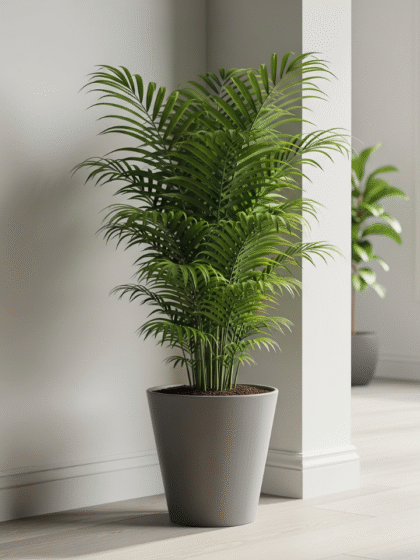
If you have a curious pet and want the same upright, low-light-tolerant look, the Bamboo Palm and the Areca Palm are both ASPCA non-toxic and cope with very similar conditions, and the full pet-friendly plant range is worth a browse before you decide.
About the air-purifying claim
This product sits in our air purifier plants range, so it is worth being precise about what that means.
Dracaena fragrans genuinely was one of the species tested in NASA’s 1989 sealed-chamber experiments, and it did remove measurable quantities of formaldehyde and benzene from that chamber. What later analysis of the same research showed is that reproducing the effect in an ordinary room would need an implausible number of plants — dozens per room — and that opening a window achieves far more in a minute than a shelf of foliage does in a day.
So: this plant does, very slightly, what all green leaves do, and it has better laboratory credentials than most. It is not an air filter, and we would rather say so than sell a claim that does not survive scrutiny. Our longer piece on which indoor plants actually purify air goes through the evidence properly.
Soil or water — which should you choose?
Both work, and the right answer depends on what you want from the plant.
Water suits display. A cane in a clear vase is clean, modern and effectively maintenance-free — change the water every ten to fourteen days, keep the leaves above the waterline, and add a few drops of hydroponic feed each time. Nothing spills, nothing needs repotting, and it is the form most people choose for a desk or a reception counter. The trade-off is that growth is slower, leaves are somewhat smaller, and without feeding the plant gradually runs down over a couple of years.
Soil suits the long game. A potted cane grows faster, carries bigger and darker leaves, produces more crowns, and is the only route to the tall, full-grown specimen people search for. It asks a little more of you: free-draining mix, restraint in the monsoon, and a feed every six to eight weeks in the growing season.
You can move a water-grown cane into soil at any time. Do it in the warm months, keep the mix evenly damp for the first fortnight while the roots adapt, and expect a short pause before growth resumes.
A note on the striped form
You may see this plant sold elsewhere as the corn plant, with a broad gold or cream stripe running down the centre of each leaf. That is Dracaena fragrans ‘Massangeana’ — the same species in a variegated cultivar, not a different plant. Care is identical, with one difference: the striped form needs brighter light to hold its colour and grows more slowly in a dim corner, where it tends to revert towards plain green.
The plain green form sold here holds its colour in far lower light, which is exactly why it suits Indian flats and offices.




































There are no reviews yet.