Aglaonema is a genus of tropical foliage plants from the forest floors of tropical Asia, known in English as the Chinese evergreen. It belongs to Araceae, the arum family, which makes it a cousin of the peace lily and the money plant. The wild species are green or silver-marked; every strongly coloured form on sale today is a modern hybrid, bred largely in Thailand from the 1980s onward, and this one reaches India under the trade names Siam Aurora and Red Siam.
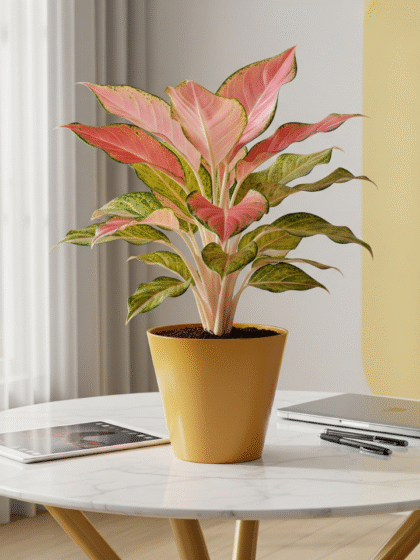
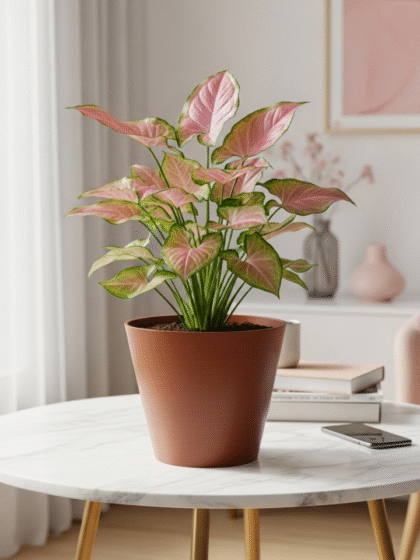
The foliage does all the work. Each leaf is thick, leathery and softly glossy, elliptic with a drawn-out tip, and it lengthens as the plant matures. The midrib runs a clear scarlet through the centre, the margin carries a fine band of the same shade, and between them the green is brushed and flecked with wine and coral. Leaf stalks are flushed pink right down to the soil. No two leaves are marked alike, and the balance of colour to green shifts from one plant to the next — which is why the photograph on a listing can only ever be a guide.
Leaves rise from short central stems in a tidy, upright clump, unfurling from the middle a few at a time. Growth is slow: a handful of new leaves across a warm season is a good year. That unhurried pace is exactly why it keeps its shape on a side table for years without pruning, and why it is worth buying at the size you want rather than waiting for it to fill out. Mature specimens occasionally push up a small cream spathe, rather like a miniature peace lily bloom, sometimes followed by berries that ripen scarlet. Many growers snip the flower off so the plant puts its energy back into leaves. Every plant we list is raised at our own nurseries rather than bought in and resold, which is the short version of why we began selling house plants online.
Where it looks and grows best
Treat it as a colour accent for rooms that never see direct sun. A position one to two metres from an east- or north-facing window is close to ideal. It looks settled on a console, a bookshelf, a bedside table or a reception counter, which is why it sits among our indoor plants for the drawing room, and the 4-inch pot it ships in is sized for a monitor shelf, making it one of the more forgiving small plants for an office desk. Because it arrives looking finished and asks so little of whoever receives it, it also works as one of the easier indoor plant gifts to hand over at a housewarming.
A word on low light. This genus has earned its reputation for coping with dim rooms, and this variety will survive in the sort of corner covered by our indoor plants that grow in shade. The catch is colour. Pigmented areas of a leaf carry less chlorophyll, so in weak light the plant produces new leaves with more green and less crimson simply to feed itself. Leaves already open will not change back. If the colour is the reason, you are buying it, give it bright, indirect light and accept nothing dimmer.
Product Specifications
- Plant name — Aglaonema Red Plant
- Botanical name — Aglaonema hybrid, of the Aglaonema commutatum group
- Also known as — Siam Aurora, Red Siam, red Chinese evergreen
- Plant family — Araceae (arum family)
- Origin — Genus native to tropical Asia; the coloured forms are cultivated hybrids, largely Thai-bred
- Plant type — Evergreen tropical foliage perennial
- Foliage — Thick, glossy, elliptic leaves; green brushed with wine and coral, with a scarlet midrib and margin, on pink-flushed stalks
- Growth habit — Upright, bushy clump from short central stems
- Growth rate — Slow
- Suitable placement — Living room, office desk, bedside table, bookshelf, console or reception area, one to two metres from an east- or north-facing window
- Light requirement — Bright, indirect light; tolerates medium light with duller colour. No direct sun
- Water requirement — Moderate. When the top 2–3 cm of soil is dry; about every 7–10 days in summer
- Soil requirement — Well-draining cocopeat-based mix, lightened with perlite
- Humidity — 60–80% preferred; manages in ordinary indoor air
- Temperature — 18–30 °C ideal. Protect from anything below about 15 °C; not frost-hardy
- Fertiliser — Balanced liquid feed at half strength every two to three months in the growing season
- Flowers — Occasional small cream spathe on mature plants; grown for its foliage
- Difficulty level — Easy
- Suitable environment — Warm indoor spaces, sheltered from direct sun and cold draughts
- Pet safety — Not pet-safe. ASPCA-listed as toxic to cats, dogs and horses
- Propagation — Division of the clump; stem cuttings in water or soil
Care guide
- Light — Bright, indirect light for the deepest colour. Tolerates medium light with slower growth and a plainer leaf. Keep it out of direct sun, which bleaches and scorches within days.
- Water — Soak thoroughly when the top 2–3 cm of soil feels dry, then let the excess drain away. Roughly every 7–10 days in summer and every 12–15 days in winter. Empty the saucer each time; standing water is the commonest way this plant is lost.
- Soil — Airy and free-draining. The cocopeat-based mix it arrives in suits it well; when you repot, use garden soil lightened with cocopeat and perlite, plus a little compost. Heavy soil that stays wet invites root rot.
- Humidity — Prefers humid air and manages perfectly well in an ordinary room. Keep it clear of air-conditioner vents, and group it with other pots through the dry weeks of February and March.
- Temperature — Most comfortable between 18 °C and 30 °C. Below about 15 °C the leaves may yellow or develop dark, water-soaked patches.
- Feeding — A balanced liquid fertiliser at half strength every two to three months from March to September. Nothing over winter.
- Leaf care — Wipe the leaves with a soft, damp cloth every few weeks. It keeps the gloss, lets light in, and gives you an early look at pests. Skip leaf-shine sprays.
- Repotting — Every two to three years, one size up, in spring or early monsoon. It is content slightly snug in its pot.
- Propagation — Divide an established clump at repotting, keeping roots on each section, or root a stem cutting in water or moist mix. Expect roots within a few weeks.
- Flowers — Occasional cream spathes on mature plants. Removing them is optional. Any berries that follow are toxic, so keep them away from children and animals.
Growing it through the Bengal year
Monsoon, June to September. The plant enjoys the warm, saturated air and puts out most of its new growth now. The danger is rot. A pot standing in humid air holds water for days longer than it appears to, and the damage starts below the soil while the foliage still looks fine. Stop watering to a schedule, check with a finger instead, and move the pot off an open balcony during long spells of rain. A stem that turns soft and brown at soil level is the warning sign, and by then you are racing it. If you want the wider picture, our guide to how houseplants cope with Kolkata's monsoon runs through the whole calendar.
Summer, March to May. Water more often as the heat builds, and watch the light rather than the thermometer. By April, afternoon sun through west- or south-facing glass is strong enough to bleach a crimson patch to papery beige in an afternoon, and that damage does not grow out. Keep the pot well back from those windows.
Winter, late November to February. Bengal winters are mild, but a night beside an open window or on a balcony can still drop cold enough to mark a tropical plant. Bring it indoors, keep it away from draughts, cut watering back to roughly once a fortnight and stop feeding altogether. Growth pauses until March. That pause is normal and not a sign that anything has gone wrong.
Common problems and quick fixes
- Yellow lower leaves with soft stems — Overwatering, or cold. One old leaf yellowing now and then is simply age. Let the top few centimetres dry before watering again, move the plant away from draughts, and remove spent leaves at the base.
- New leaves coming through green, colour fading — Too little light. Move it somewhere brighter but still indirect. Fresh growth will recolour; the leaves already open will not.
- Beige or papery patches — Sun scorch. Shift it out of direct sun and trim badly marked leaves.
- Brown, crisp tips or edges — Dry air, an air-conditioner draught, erratic watering or salt build-up. Water consistently, move it away from vents, and flush the pot through with plain water every few months.
- Leaves curling inward — Thirst or chill. Check the soil, water thoroughly if it is dry, and keep the plant above 15 °C.
- Dark, water-soaked patches in winter — Cold damage. Move it somewhere warmer and trim the affected leaves once new growth appears.
- White cottony clusters in the leaf joints — Mealybugs. Dab them off with cotton dipped in rubbing alcohol, then spray diluted neem oil weekly for three weeks.
- Fine webbing and speckled leaves — Spider mites, mostly in the dry months. Rinse the foliage, raise humidity and spray diluted neem oil.
- Drooping for a week or two after delivery — Transit stress, and the most common question we get. Keep it in bright, indirect light, water lightly and leave it alone for two to three weeks. It settles on its own.
Is the Aglaonema Red safe for pets?
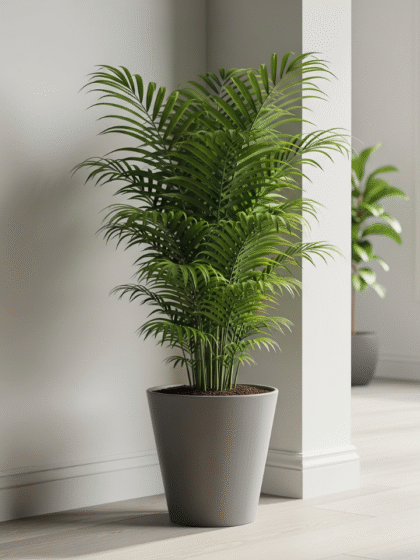
No. The ASPCA lists Aglaonema (Chinese evergreen) as toxic to cats, dogs and horses. The leaves and stems hold insoluble calcium oxalate crystals, which cause mouth pain, swelling, drooling and vomiting if chewed. It is rarely serious, but it is genuinely unpleasant, and the sap can irritate sensitive skin — wear gloves when you divide the plant. A high shelf keeps it out of reach of most cats, though not all. If you would rather have something confirmed non-toxic to cats and dogs, a hanging spider plant or a pet-safe areca palm will cope with much the same light.
Feng shui, Vastu and the "lucky plant" label
Coloured Aglaonemas are widely sold across India and East Asia as good-luck plants, and the crimson forms are popular gifts at Diwali, weddings and housewarmings, where the colour reads as auspicious. Vastu guides usually suggest the north, east or north-east of a room for indoor foliage, and our wider range of plants for positive energy follows the same convention. Worth being straight about it: these plant-specific placements are modern practice rather than classical scripture. They matter to many households and we are glad to note them, but the better reason to own this one is that it is handsome and hard to kill.
A straight answer on air purification
This plant appears on most air-purifying lists because NASA's 1989 Clean Air Study included a green Aglaonema species that removed benzene and formaldehyde inside small sealed chambers. The coloured hybrids were never tested, and in a real room the effect is negligible: Cummings and Waring calculated in 2019 that you would need somewhere between 10 and 1,000 plants per square metre to match the air exchange that opening a window already provides. Grow it for the foliage. If you want the evidence laid out properly, our explainer on what NASA's clean-air study really found covers.







































There are no reviews yet.