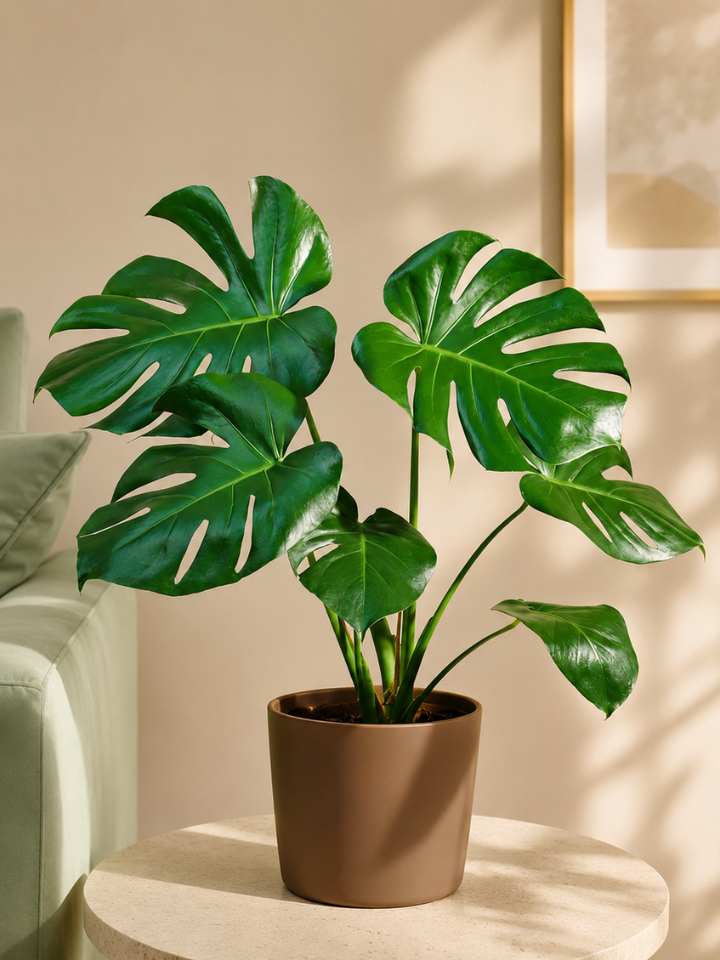
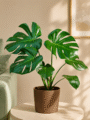
Few houseplants have captured the modern imagination quite like the Monstera deliciosa. Its enormous, glossy leaves — dramatically slashed and perforated with natural holes — have turned this tropical climber into the unofficial mascot of contemporary interior design. Walk into a stylish café, scroll through a décor feed, or step into a plant-lover's living room, and you are almost guaranteed to spot its unmistakable silhouette. The extra-large (XL) specimen takes that presence and amplifies it, delivering mature, deeply fenestrated foliage that instantly anchors a room.
But behind the Instagram fame is a genuinely remarkable botanical story. This is a plant that begins life on the shadowed floor of Central American rainforests and hauls itself skyward toward the light, clinging to tree trunks with thick aerial roots. It produces an edible fruit in the wild, carries centuries of cultural meaning, and — despite its exotic looks — is forgiving enough for a first-time grower to keep thriving for decades. This guide brings together horticultural science, hands-on care experience, and honest, myth-busting information so you can understand exactly what you are bringing home.
What Is the Monstera Deliciosa?
The Monstera deliciosa is a large-leaved, evergreen tropical vine belonging to the arum family (Araceae), the same botanical family as the Peace Lily and Philodendron. In its native habitat it is a hemiepiphyte — a plant that germinates on the ground, then climbs a host tree, sending down aerial roots as it ascends. Its most famous feature is the set of naturally developing holes and splits in the leaves, known botanically as fenestrations. A young plant produces solid, heart-shaped leaves; as it matures and receives more light, each new leaf emerges larger and more elaborately cut.
Why Is It Called the Swiss Cheese Plant?
The nickname is delightfully literal. The mature leaves develop rounded holes and deep edge-splits that resemble the holes in a wedge of Swiss cheese. Scientists have long debated why the plant evolved this way. The leading theories suggest fenestration lets scarce rainforest light filter down to lower leaves, allows the leaf to capture sunflecks across a wider area with less tissue to build, and helps the broad leaf survive tropical downpours and gusts by letting wind and water pass through rather than tearing the leaf apart. Whatever the exact driver, the result is one of the most recognisable leaf shapes in the plant kingdom.
Why Has It Become One of the Most Popular Indoor Plants?
Three forces converged to make this plant a household name. First, its architectural leaves photograph beautifully and suit almost any décor style, from minimalist to bohemian. Second, it is genuinely easy to grow — tolerant of average indoor conditions and quick to reward good care with dramatic new growth. Third, a single XL specimen does the decorating work of several smaller plants, filling a corner and creating a lush, resort-like feel. For anyone building a collection of indoor plants with low maintenance, it is frequently the centrepiece everything else is arranged around.
Quick Plant Overview
Here is an at-a-glance snapshot of everything you need to know before reading further:
| Attribute | Details |
| Botanical name | Monstera deliciosa |
| Common names | Swiss Cheese Plant, Split-Leaf Philodendron (misnomer), Mexican Breadfruit, Ceriman, Fruit Salad Plant |
| Family | Araceae (arum family) |
| Plant type | Evergreen tropical climbing vine (hemiepiphyte) |
| Mature size (indoors) | 1.8–3 m tall; leaves up to 45–90 cm wide on established plants |
| Growth rate | Moderate to fast in warm, bright conditions |
| Native region | Rainforests of southern Mexico and Central America |
| Toxicity | Toxic to cats, dogs and humans if chewed or swallowed (calcium oxalate) |
| Light | Bright, indirect light; tolerates medium light |
| Water | When the top 3–5 cm of soil is dry; keep evenly moist, never soggy |
| Indoor suitability | Excellent — a signature statement plant |
| Air quality | Contributes to fresher indoor air alongside good ventilation |
What Makes the Monstera Deliciosa Special?
Plenty of plants have big leaves. What sets this one apart is the combination of scale, self-transformation and adaptability. A new Monstera leaf unfurls tightly rolled, like a scroll, then opens over a day or two to reveal a larger, more fenestrated blade than the one before it. Watching this process is one of the quiet joys of owning the plant — each leaf is a small event.
It is also a plant that visibly responds to how you treat it. Give it a support to climb and better light, and its leaves grow dramatically larger and more perforated, mimicking its mature rainforest form. Leave it to sprawl in low light, and it stays smaller and simpler. Few houseplants offer such a clear, rewarding feedback loop between care and appearance, which is part of why growers find it so engaging over the long term.
History and Origin
The Monstera deliciosa is native to the humid tropical forests stretching from southern Mexico through Panama. It was formally described by Danish botanist Frederik Michael Liebmann in the 1840s. The genus name Monstera is thought to derive from the Latin for "monstrous" or "abnormal," a nod to the strange, hole-riddled leaves that puzzled early European botanists. The species name deliciosa refers to its edible fruit, which — when fully ripe — tastes like a blend of pineapple and banana.
From its native range, the plant travelled the world through the great age of tropical plant collecting in the 19th and 20th centuries. It naturalised in many warm regions and became a greenhouse favourite in cooler climates. Its modern surge as a houseplant, however, is a 21st-century phenomenon driven by design culture and social media, which rediscovered its sculptural appeal for indoor living.
Meaning and Significance of the Monstera Deliciosa
Across cultures, the Monstera has picked up rich symbolism. In many traditions its ever-expanding leaves and long life represent growth, longevity and prosperity. Because a mature plant honours a home for years and keeps producing ever-grander foliage, it is often given as a housewarming gift to wish the new household abundance and steady progress.
In the language of contemporary plant culture it has also come to signify a certain aspirational, nature-connected lifestyle — the desire to bring a slice of the wild tropics into an urban apartment. Its significance, then, is both traditional and modern: an old emblem of thriving life that has been adopted anew as a symbol of calm, style and personal wellbeing.
Monstera Deliciosa as an Ornamental Plant
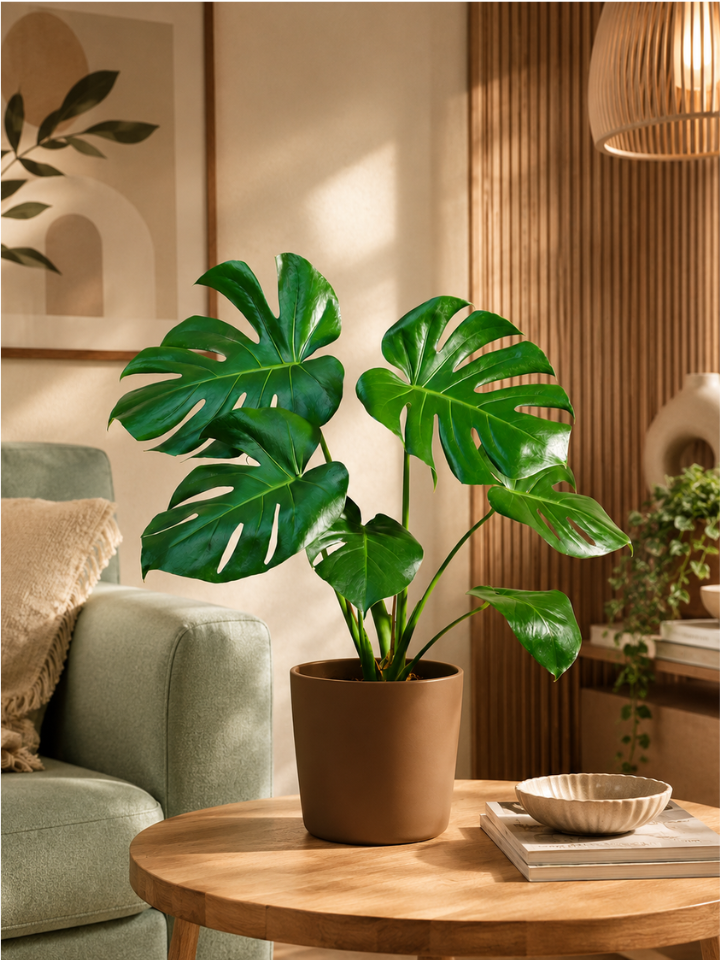
As a purely ornamental specimen, the XL Monstera is hard to beat. Its value lies in three visual qualities: scale (a single plant reads as a piece of living sculpture), texture (the interplay of light and shadow through its fenestrations), and form (the graceful, slightly wild arrangement of leaves on their long stalks). It works as a floor plant beside a sofa, a green backdrop for a reading nook, or a focal point in an otherwise minimal space. Because its foliage is so distinctive, it rarely needs companions to make an impact — one well-grown plant is a complete décor statement.
Monstera Deliciosa Plant Benefits
The appeal of this plant goes well beyond looks. Here is what a healthy specimen genuinely contributes to your home and daily life.
Aesthetic and Interior-Design Benefits
The Monstera's leaves bring instant architectural interest to a room. Designers use it to soften hard modern lines, add height to low furniture arrangements, and introduce organic curves into geometric spaces. Its deep green foliage also acts as a natural colour anchor that makes surrounding tones — whites, woods, terracotta — feel warmer and more considered.
Air Quality Benefits
Like many broad-leaved tropical foliage plants, the Monstera participates in gas exchange, taking in carbon dioxide and releasing oxygen, and its large leaf surface can trap airborne dust. The famous NASA Clean Air Study of 1989 popularised the idea that houseplants remove volatile organic compounds such as formaldehyde and benzene. It is worth being honest here: that study was conducted in small, sealed chambers, and a widely cited 2019 re-analysis by Cummings and Waring concluded that you would need an impractically large number of plants to match a mechanical purifier in a normal, ventilated room. The sensible takeaway is that a Monstera is a welcome contributor to a fresher indoor environment — best appreciated alongside good ventilation rather than as a standalone air-cleaning device. If air quality is your main goal, it is worth exploring the best plants for air purification as a coordinated group.
Mental Wellness and Stress Reduction
A growing body of research on biophilia — our innate affinity for living things — links indoor greenery to lower stress, improved mood and a greater sense of calm. Tending a plant, watching new leaves unfurl, and simply having a large living presence in a room can create a gentle daily anchor. Many owners describe caring for their Monstera as a small, grounding ritual that punctuates a busy schedule.
Productivity and Focus
Studies in office and study settings suggest that the presence of plants can support attention and reduce mental fatigue. Placed within sight of a desk — though not so close that it crowds the workspace — a Monstera offers a restful focal point that lets the eyes and mind reset between tasks.
Humidity Balance
Through transpiration, the plant releases moisture from its leaves into the surrounding air. In dry, air-conditioned rooms this modest humidifying effect can make the environment feel slightly more comfortable, and it pairs naturally with the plant's own preference for humid conditions.
Scientific Facts About the Monstera Deliciosa
Fenestration develops with maturity. Juvenile leaves are entire (unbroken); holes and splits appear only as the plant ages and climbs toward stronger light.
It is a true climber, not a self-supporting shrub. In the wild it can ascend 20 metres or more up host trees using tough aerial roots.
The fruit is edible only when fully ripe. Unripe fruit is loaded with irritating calcium oxalate crystals; ripe fruit is a tropical delicacy sometimes called "fruit salad fruit."
It shows negative phototropism when young. Seedlings famously grow toward darkness ("skototropism") to find a tree trunk to climb, then reverse and grow up toward light.
Aerial roots serve two jobs. Some anchor the plant to its support; others reach the soil to draw up extra water and nutrients.
It belongs to the Araceae family. This shared ancestry with Peace Lily and Philodendron explains the family resemblance — and the shared calcium-oxalate toxicity.
Monstera Deliciosa Care Guide
Good Monstera care is less about intensive effort and more about getting a few fundamentals right and then leaving the plant alone to do its thing. Here is each element explained in practical detail.
Light Requirements
Bright, indirect light is ideal. Think of a spot a metre or two back from a bright window, or beside an east-facing window that gets gentle morning sun. In this light the plant produces large, well-fenestrated leaves at a satisfying pace. It will survive in medium light, but growth slows and new leaves may stay smaller and less split. Avoid prolonged harsh, direct afternoon sun through glass, which can scorch the foliage into pale or brown patches. If your room is dim, rotating the plant a quarter-turn each week helps it grow evenly rather than leaning toward the window.
Watering Schedule
Water when the top 3–5 cm of the potting mix feels dry to the touch. When you do water, do it thoroughly until it runs from the drainage holes, then empty the saucer so the roots never sit in standing water. The single most common cause of a struggling Monstera is overwatering, which starves the roots of oxygen and invites rot. In practice this often means watering roughly once a week in warm months and less in cooler ones — but always let the soil, not the calendar, be your guide.
Soil Requirements
The plant wants a rich but fast-draining, airy mix that mimics the loose forest-floor debris of its native home. A good blend is roughly equal parts quality potting soil, coco coir or peat, and chunky material such as perlite, orchid bark or coarse sand. This holds enough moisture to keep the plant happy while letting excess water escape quickly, which is exactly the balance those thick roots prefer.
Temperature
A comfortable indoor range of about 18–30°C suits it perfectly, which happens to align with the temperature of most Indian homes for much of the year. It dislikes cold; try to keep it above about 12–13°C and away from cold draughts, unheated winter windowsills and the direct blast of air-conditioners.
Humidity
As a rainforest native it enjoys moderate to high humidity, ideally 50–60% or more. In humid regions and during the monsoon it will thrive with no help at all. In dry, air-conditioned rooms you can raise local humidity by grouping plants together, standing the pot on a tray of pebbles and water (with the pot above the waterline), or running a small humidifier nearby. Occasional misting is pleasant but has only a brief effect.
Fertiliser
During the active growing season — roughly spring through the warm monsoon months — feed with a balanced liquid houseplant fertiliser about once every three to four weeks, diluted to the strength recommended on the label. Ease off almost entirely in the cooler, low-light winter period when growth naturally slows. Over-feeding does more harm than under-feeding, causing salt build-up and leaf-tip burn, so err on the gentle side.
Potting Mix and Container
Choose a pot with drainage holes that is only slightly larger than the root ball — an oversized pot holds too much wet soil around the roots. Terracotta breathes and dries faster (helpful for heavy-handed waterers); glazed ceramic and plastic retain moisture longer. Whatever the material, drainage is non-negotiable.
Repotting
A young, vigorous Monstera typically needs repotting every one to two years; a large established XL specimen can go longer. Tell-tale signs it is time include roots circling the surface or escaping the drainage holes, water running straight through, and slowing growth. Move it up just one pot size, refresh the mix, and do it in the growing season so it recovers quickly. Handle the thick roots gently — they resent heavy disturbance.
Pruning
Prune to shape the plant, remove any yellowed or damaged leaves, and control size. Cut just above a node (the bump where leaves and aerial roots emerge) using clean, sharp secateurs. Pruning also encourages bushier growth and gives you cuttings to propagate. Wear gloves and avoid touching your eyes, as the sap is an irritant.
Cleaning the Leaves
Those big leaves are efficient dust collectors, and a layer of dust reduces the light the plant can absorb. Every couple of weeks, wipe each leaf gently with a soft, damp cloth, supporting it from underneath with your other hand. Clean leaves photosynthesise better, look glossier, and let you spot early signs of pests.
Supporting With a Moss Pole
Because it is a natural climber, a Monstera grown with vertical support behaves very differently from one left to sprawl. Training the stems up a moss pole, coir pole or trellis encourages the aerial roots to attach, keeps the plant upright and tidy, and — most rewardingly — prompts larger, more heavily fenestrated "mature-form" leaves. Tie stems loosely to the support as they grow, and keep a moss pole lightly moist so the aerial roots grip it.
How to Plant a Monstera Deliciosa
- Whether you are settling a newly arrived XL plant into a decorative pot or planting up a rooted cutting, the steps are the same:
- Choose the right pot. Pick a container with drainage holes, only slightly larger than the root ball.
- Prepare the mix. Combine potting soil, coir and a chunky aerating agent (perlite or bark) for a light, free-draining medium.
- Add a base layer. Put a few centimetres of mix at the bottom so the plant will sit at the same depth it grew before.
- Position the plant. Centre the root ball, insert a moss pole now if you plan to use one, and backfill around the roots.
- Firm and water. Gently firm the soil, water thoroughly, let it drain, and place the plant in bright, indirect light.
- Give a freshly potted plant a week or two of stable conditions before fertilising, so its roots can settle in without stress.
Can We Grow the Monstera Deliciosa in Water?
This is one of the most searched questions about the plant, so let us answer it directly and fully.
Can we grow the Monstera deliciosa in water?
Yes — a Monstera can live in water, and cuttings root readily in it. A stem cutting with at least one node placed in a clean jar of water will typically sprout roots within a few weeks. Many people keep cuttings in water long-term as an attractive, low-effort display. However, water-grown plants generally grow more slowly and stay smaller than the same plant potted in soil, because water alone offers limited nutrients and oxygen to the roots.
Can we grow it in water like Pothos?
Not quite as effortlessly. Pothos is famously happy to live indefinitely in a vase with minimal fuss. A Monstera can be grown hydroponically too, but it is a larger, hungrier plant, so long-term water culture demands more attention: frequent water changes to keep it fresh and oxygenated, a diluted hydroponic nutrient solution to prevent deficiency, and a clean container to discourage algae and rot. For a small cutting or a decorative accent, water works beautifully. For a full XL specimen that keeps producing those giant fenestrated leaves, soil (or a proper semi-hydro setup) will give far better results.
Water Propagation vs Long-Term Hydroponics — Pros and Cons
| Approach | Pros | Cons |
| Rooting a cutting in water | Simple, visible roots, high success rate, free new plants | Slower once potted; water roots must adapt to soil |
| Long-term water culture | Clean, no soil mess, decorative | Slower growth, nutrient deficiency risk, needs frequent water changes |
| Soil (recommended for XL) | Fastest, largest leaves, most stable | Requires drainage and mindful watering |
Monstera Deliciosa Propagation Guide
Propagation is one of the great pleasures of owning this plant — it multiplies generously. There are four reliable methods.
Stem Cutting
The most popular method. Cut a healthy stem section just below a node so that the cutting includes at least one node and ideally an aerial root. Place it in water or moist propagation mix; roots form in two to four weeks. Once roots are several centimetres long, pot it up. A node is essential — a leaf with no node will not grow into a new plant.
Air Layering
A near-foolproof method for larger plants. Wrap a node (with its aerial root) in damp sphagnum moss, enclose it in plastic to hold moisture, and wait for roots to develop inside the moss before cutting the rooted section free and potting it. Because the stem stays attached to the parent while rooting, the success rate is very high and the new plant establishes quickly.
Division
If your plant has grown into multiple stems from the base, you can divide it during repotting. Ease the root ball apart into sections, making sure each division has healthy roots and at least one growing stem, then pot each separately. This instantly gives you two established plants.
Water Propagation
As described above, nodes rooted in water are an easy, beginner-friendly route. Change the water every few days, keep the jar in bright indirect light, and transplant once a healthy root system has formed.
Is the Monstera Deliciosa a Climber?
Yes — emphatically. Although it is often sold as a bushy pot plant, the Monstera is by nature a vigorous climbing vine. Understanding this changes how you grow it.
Natural growth habit: In the wild it climbs tree trunks toward the canopy light, which is what triggers its leaves to grow ever larger and more fenestrated.
Aerial roots: The thick brown roots emerging from the stem are climbing organs. They grip supports and also gather moisture and nutrients.
Moss-pole support: Giving it something to climb indoors mimics the tree trunk it evolved with, and the plant responds with more impressive, mature-form foliage.
Tree-climbing nature: Left unsupported, it sprawls sideways and stays in its juvenile, less-fenestrated form — attractive, but not the plant's full potential.
Monstera Deliciosa Similar Plants
Several plants are frequently confused with the Monstera deliciosa, some sold under overlapping names. Here is how it compares with its most common lookalikes and relatives.
| Plant | Key difference from Monstera deliciosa |
| Philodendron Selloum (Thaumatophyllum) | Deeply lobed leaves but self-heading (non-climbing) and no true holes; forms a shrubby trunk over time. |
| Rhaphidophora tetrasperma (Mini Monstera) | Looks like a miniature Monstera but is a different genus; smaller, faster, split leaves without the large round holes. |
| "Split-Leaf Philodendron" | A confusing trade name often applied to Monstera itself or to Philodendron selloum — not a distinct correct species name. |
| Epipremnum pinnatum | A climbing aroid that develops fenestrations, but with narrower, more feather-like leaf splits. |
| Syngonium (Arrowhead Vine) | Arrow-shaped juvenile leaves; smaller, faster-trailing, and never develops Monstera-style holes. |
Monstera Deliciosa vs Philodendron
Because both belong to the Araceae family and are often shelved side by side, they get muddled constantly. The clearest distinctions:
| Feature | Monstera deliciosa | Philodendron (typical) |
| Leaf holes | Develops true internal holes (fenestration) with age | Most species split at the edges but lack internal holes |
| Growth form | Large climbing vine with prominent aerial roots | Ranges from trailing vines to self-heading shrubs |
| New leaf | Emerges as a rolled scroll | Often emerges from a protective cataphyll sheath |
| Size indoors | Can become very large (XL statement plant) | Usually more compact, though some climb high |
| Care | Bright indirect light, moderate water | Very similar; both are forgiving aroids |
Can You Get High on a Monstera Deliciosa Plant? (Safety Facts)
Because this question circulates online, it deserves a clear, factual, and responsible answer: No. The Monstera deliciosa is not a psychoactive plant, and it must never be smoked, eaten raw, or consumed in any attempt to alter one's state of mind.
What the plant actually contains
Every part of the living plant — leaves, stems and unripe fruit — is packed with microscopic, needle-shaped crystals of calcium oxalate called raphides. These are a physical irritant. When plant tissue is chewed or crushed, the crystals embed in soft tissue and cause immediate, intense burning of the lips, mouth, tongue and throat, along with swelling, drooling and pain. There is no chemical in the plant that produces a "high" of any kind.
Why it should never be smoked
Burning and inhaling any part of the plant offers no intoxicating effect whatsoever and is genuinely dangerous. Smoke from any houseplant can carry irritant particles and combustion by-products into the lungs and airways, and the calcium oxalate content only adds to the risk of painful irritation. There is no safe or meaningful way to "use" this plant as a drug — the idea is a myth.
Addressing the myths directly
"Can you get high on it?" No. It contains no psychoactive compounds.
"Drug abuse" and "intoxication" claims: These are misinformation. Any "intoxication" reported from the plant is actually oxalate poisoning — a harmful reaction, not a recreational effect.
"Smoking" the plant: Provides no effect and risks respiratory and oral harm. Never attempt it.
If someone has chewed or swallowed part of the plant and is experiencing burning, swelling or difficulty breathing or swallowing, treat it as a medical concern: rinse the mouth, do not induce vomiting, and contact a doctor or poison-control service promptly. This plant is a beautiful ornamental — enjoy it as décor and, in the case of properly ripened fruit only, as an occasional tropical treat. It has no place in any attempt at intoxication.
Is the Monstera Deliciosa Toxic?
Yes, in the practical, everyday sense that matters to households: the calcium oxalate crystals described above make the whole living plant mildly to moderately toxic if chewed or swallowed by people or pets. It is not usually life-threatening, but it is genuinely unpleasant and occasionally serious. Here is what to know for each group.
Children
Keep the plant out of reach of curious toddlers who might bite a leaf. Ingestion causes immediate mouth and throat burning, swelling and distress. Serious poisoning is uncommon because the pain discourages swallowing large amounts, but any exposure warrants rinsing the mouth and seeking medical advice if symptoms are significant.
Pets — Dogs and Cats
The ASPCA lists Monstera deliciosa as toxic to both dogs and cats. A pet that bites the plant may drool heavily, paw at its mouth, vomit, and show oral swelling and difficulty swallowing. Place the plant where pets cannot reach it, and contact your veterinarian if your animal chews it. If you specifically want greenery that is safe around animals, choose genuinely pet-friendly species instead of relying on this one.
First Aid Basics
- Rinse the mouth thoroughly with water or milk to flush out crystals.
- Wipe any sap off skin; wash hands and avoid touching eyes (sap is an irritant).
- Do not induce vomiting.
- Contact a doctor, poison-control line, or veterinarian if swelling, breathing difficulty or persistent symptoms occur.
Monstera Deliciosa for Homes and Offices
Part of the plant's universal appeal is how well it bridges domestic and professional settings. At home it brings a relaxed, tropical warmth; in an office it signals a considered, human-centred environment. Its tolerance of ordinary indoor light and forgiving watering needs make it practical for both — a home corner that gets weekend attention or a reception area tended once a week. In either setting, a single XL plant does the visual heavy lifting while asking very little in return.
Why Interior Designers Love the Monstera Deliciosa
Designers reach for it because it solves several problems at once. It fills vertical and corner space that furniture cannot. Its bold leaf shape reads clearly from across a room, giving a space a defined focal point. Its silhouette photographs beautifully, which matters for hospitality and retail interiors. And because its form is naturally a little wild, it introduces welcome informality into polished, controlled schemes — the organic counterpoint that keeps a designed room from feeling sterile.
Best Places to Keep a Monstera Deliciosa Indoors
- Near a bright window, set back from direct sun — the sweet spot for large, fenestrated leaves.
- A living-room corner beside a sofa or behind an accent chair, where it can spread without being brushed against.
- An entryway or hallway with reasonable light, to create a lush first impression.
- A home-office backdrop within view of the desk for a calming focal point.
- Avoid dark interior corners with no natural light, spots directly above radiators or heaters, and the cold draught of an air-conditioner aimed straight at the leaves.
Feng Shui and Vastu Significance
In Feng Shui, the Monstera's large, rounded, upward-reaching leaves are associated with abundance, positive "wood" energy and the welcoming of good fortune and growth into a space. In the Indian tradition of Vastu Shastra, lush green foliage plants placed thoughtfully are believed to invite positive energy and prosperity, with leafy greens generally favoured in eastern, northern or south-eastern zones and kept clear of cluttered, neglected corners. A healthy, well-tended plant is considered auspicious in both systems — the emphasis is always on vitality, so keeping the plant clean, upright and thriving matters more than any single placement rule.
Monstera Deliciosa for Apartments
Apartment living and this plant are a natural match. It thrives in the bright, indirect light of a typical flat, needs no garden, and delivers a big botanical statement from a single pot — ideal when floor space is limited but you still want impact. Choose an XL specimen for an instant established look, give it a moss pole to grow up rather than out, and it becomes the green heart of a compact home. It sits comfortably alongside the other best indoor plants for apartment living, forming the anchor of a small urban jungle.
Monstera Deliciosa for Living Rooms
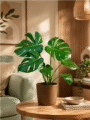
The living room is where this plant truly belongs. Positioned in a corner or beside a seating arrangement, it draws the eye, fills otherwise dead space and gives the room a finished, layered feel. Pair it with a simple ceramic or woven planter to let the foliage star, and keep it a little away from high-traffic paths so its leaves are not constantly knocked. As a centrepiece among your interior plants for living room, it sets the tone that everything else complements.
Common Problems and Solutions
Most Monstera troubles trace back to watering, light or humidity. Use this quick diagnostic table to read the signs and respond.
| Symptom | Likely cause | What to do |
| Yellow leaves | Overwatering (most common); sometimes low light or old age | Let soil dry more between waterings; check drainage; move to brighter spot |
| Brown leaf tips/edges | Low humidity, dry air, or fertiliser salt build-up | Raise humidity; flush soil occasionally; ease off feeding |
| Brown mushy stem/roots; foul smell | Root rot from soggy soil | Unpot, cut away rotten roots, repot in fresh airy mix, water less |
| Leggy growth, small solid leaves | Insufficient light and no support | Move to brighter indirect light; add a moss pole |
| Pests (spider mites, mealybugs, scale) | Dry conditions, new plant contamination | Wipe leaves, treat with insecticidal soap or neem, isolate plant |
| Drooping leaves | Under- or over-watering; check soil first | Water if dry; if wet, let it dry and inspect roots |
| Curling leaves | Underwatering or heat/light stress | Water thoroughly; move away from direct heat and harsh sun |
| No fenestration on new leaves | Young plant or too little light | Be patient; increase light and add a climbing support |
Monstera Deliciosa Seasonal Care Guide
Summer Care
Growth is at its peak, so water more frequently as the mix dries faster, and feed on your regular growing-season schedule. Protect the plant from scorching direct afternoon sun through glass, and keep it away from the drying blast of air-conditioners. This is the ideal season to repot or propagate.
Monsoon Care
High humidity is a gift — the plant loves it and often pushes out its best leaves now. The main watch-outs are overwatering and poor drainage in the damp air, which can trigger rot, plus a greater chance of fungal spots and pests. Water only when the soil is genuinely dry, ensure the pot drains freely, and keep good air circulation around the plant.
Winter Care
Growth slows in cooler, lower-light months. Water noticeably less to avoid waterlogging cold, damp soil, and pause or greatly reduce fertiliser until spring. Move the plant to the brightest available spot, and shield it from cold draughts and unheated windows. Do not be alarmed if it produces little new growth — it is simply resting.
Monstera Deliciosa Care in the Indian Climate
For most of India, the Monstera is remarkably well suited to indoor life. The warm temperatures of much of the year sit squarely in its comfort zone, and the humidity of coastal cities and the monsoon months keeps its foliage lush with little effort. A few region-specific pointers help: in the intense summer heat of the plains, keep it out of direct window sun and maintain watering as soil dries quickly; during the monsoon, prioritise drainage and airflow to prevent rot; and in the cooler northern winter, reduce watering and protect it from chilly draughts. In consistently hot, dry interiors, a pebble tray or nearby humidifier keeps leaf tips from browning. Overall, it is one of the more effortless statement plants an Indian household can grow.














There are no reviews yet.