Few houseplants divide opinion quite like this one. Walk into a plant store and the glossy, fern-like canopy stops you dead — it looks like someone shrank a tropical rainforest tree and put it in a pot. Take it home, move it twice, and within ten days you may be sweeping leaflets off the floor and wondering what you did wrong.
Neither reaction is the whole story. The truth is that Radermachera sinica is not a difficult plant. It is a fussy-about-change plant, which is an entirely different problem and a far easier one to solve once you understand what is actually happening inside those slender stems.
This guide is written for the person who has just brought home an extra-large specimen, or is about to, and wants to get it right the first time. It covers the botany that explains the behaviour, the care routine that actually works in Indian conditions — from Kolkata's sticky monsoon to Delhi's bone-dry January — and honest answers to the questions people genuinely search for, including a few where the internet's confident consensus turns out to be wrong.
We have deliberately avoided the two habits that make most plant articles useless: repeating the same three care tips under different headings, and stating things with more certainty than the evidence supports. Where the science is thin, we say so.
Quick : Bright indirect light near an east window, water when the top 2–3 cm of soil dries, keep it away from air-conditioner vents and doorways, and do not move it around. That single sentence solves roughly 80% of problems people have with this species.
What is a China Doll Plant?
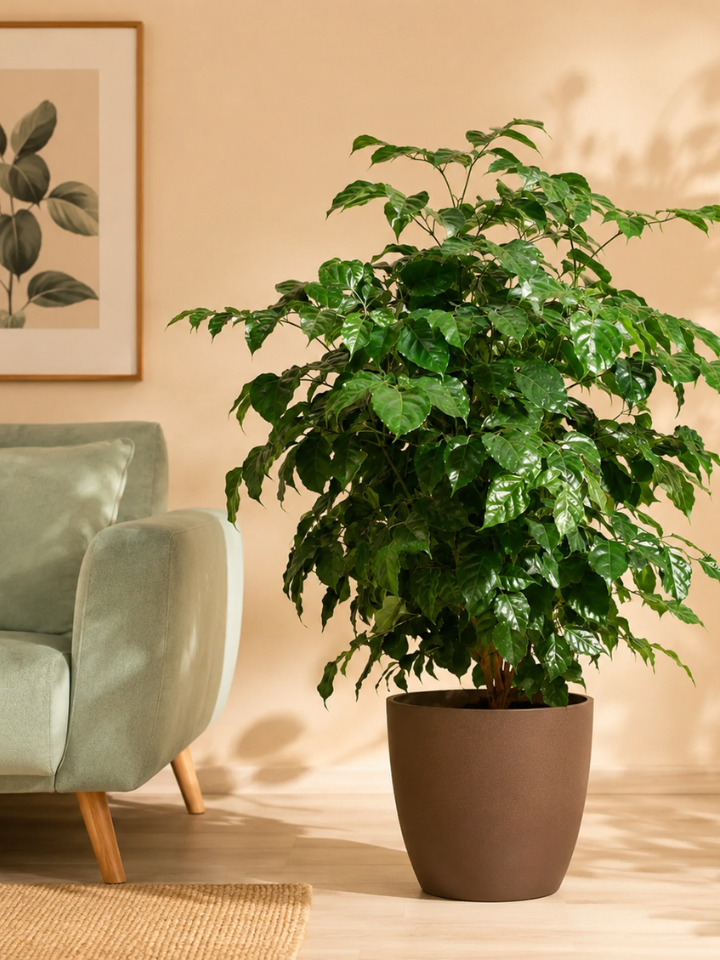
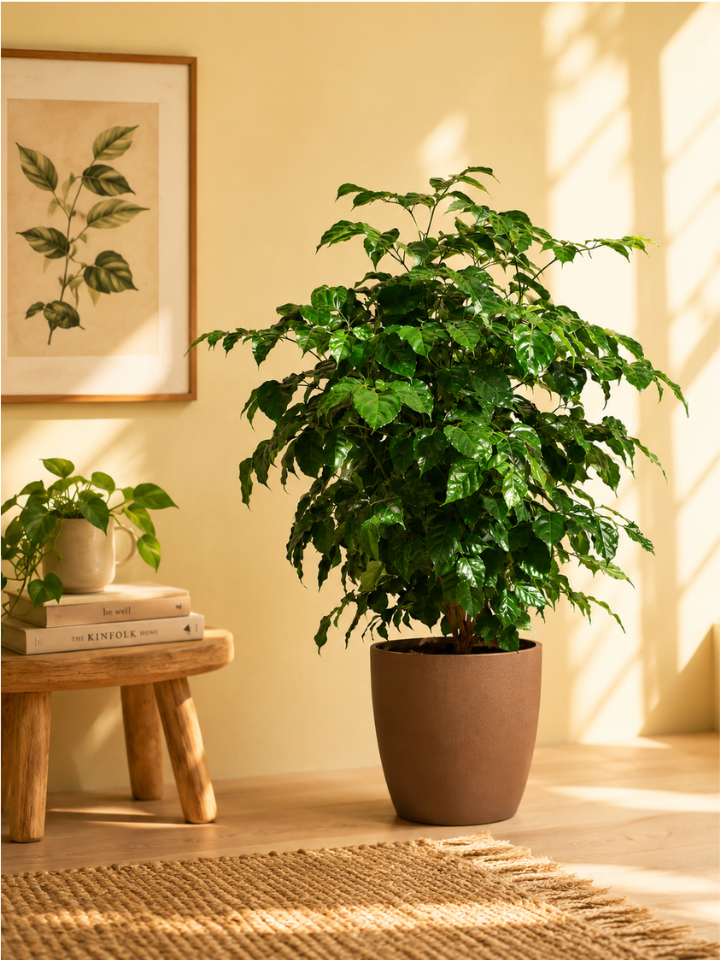
The china doll plant is a fast-growing evergreen tree from the Bignoniaceae family, grown indoors for its finely divided, lacquer-glossy foliage. In its native forests it is a genuine timber-sized tree reaching close to 30 metres. Confined to a container, deprived of a monsoon, and pruned by a human, it settles into a well-behaved indoor specimen of 1.2 to 2 metres — which is exactly what makes the XL size so appealing as a floor plant.
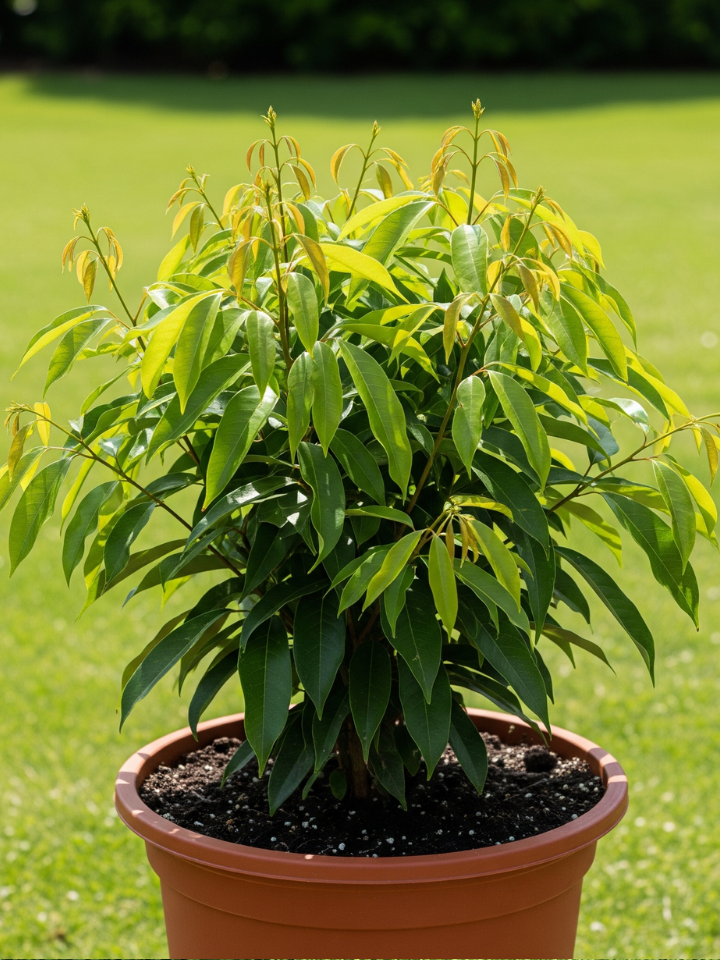
What you notice first is the leaf architecture. Each "leaf" is not a leaf at all in the way most houseplant leaves are. It is a bipinnate compound leaf: a central stalk carrying secondary stalks, each of those carrying paired leaflets. The result is a canopy with the visual texture of a fern but the substance and shine of a ficus. It reads as lush without reading as heavy, which is why interior designers keep reaching for it.
The species is also, unusually, night-blooming in the wild. Mature trees open large trumpet-shaped flowers after dark, release a strong sweet fragrance to attract bats and moths, and drop the spent blooms by mid-morning. This almost never happens indoors — a potted specimen simply does not accumulate the reserves or the light hours required. If you have been promised flowers on an indoor plant, that promise was oversold.
The names, and where they come from
- China Doll — a nursery trade name coined in the 1980s in the United States, referring to the delicate, almost porcelain-fine leaflets rather than to any Chinese cultural association.
- Emerald Tree — a straightforward description of the foliage colour.
- Serpent Tree — from the long, narrow, snake-like seed capsules that hang from mature wild trees, sometimes exceeding 40 cm.
- Asian Bell Tree — properly the name of the dwarf, densely branched cultivars (such as 'Kaprima') selected for compact indoor growth. Most plants sold as china doll today are these selections rather than the wild type.
Scientific Classification
| Rank | Classification |
| Kingdom | Plantae |
| Clade | Angiosperms — Eudicots — Asterids |
| Order | Lamiales |
| Family | Bignoniaceae |
| Genus | Radermachera |
| Species | Radermachera sinica (Hance) Hemsl. |
| Common names | China doll, emerald tree, serpent tree, Asian bell tree |
| Native range | Southern China, Taiwan, northern Vietnam, Laos, north-east India |
| Habit | Evergreen tree; container-grown as an indoor specimen |
| Mature height (wild) | Up to ~30 m |
| Indoor height | 1.2–2 m in a container, indefinitely with pruning |
| Growth rate | Fast — 30–60 cm per season in good conditions |
| Light | Bright indirect |
| USDA hardiness | Zones 10–12 outdoors |
Why the family matters more than you'd think. Bignoniaceae is the jacaranda, tabebuia, tecoma and African tulip tree family. Every one of those is a tree that grows fast, flowers hard, and sheds leaves when stressed. Your indoor specimen is doing exactly what its cousins do on Indian roadsides in April — dropping foliage it cannot currently afford. It is not dying. It is budgeting.
Origin and History
The genus honours Jacob Cornelis Matthieu Radermacher (1741–1783), a Dutch colonial administrator in the East Indies who founded what became the Batavian Society of Arts and Sciences — one of the oldest scientific societies in Asia. He collected plants around Java, and the genus was named for him posthumously. The species epithet sinica simply means "of China."
Botanically, the plant was described by Henry Fletcher Hance and later transferred to Radermachera by William Botting Hemsley. Its natural range runs through the subtropical hill forests of Yunnan, Guangdong, Guangxi and Hainan, across Taiwan, and westward into northern Vietnam, Laos and the north-eastern Indian states. That last point is worth pausing on: this is not a stranger to the Indian subcontinent. It grows wild in forests not far from the Assam–Myanmar frontier.
Its career as a houseplant is recent. Commercial tissue-culture and seed propagation scaled up in Taiwan and the Netherlands during the 1980s, and the plant arrived in Western garden centres with a marketing name and very little accompanying information. That gap — a fast-growing subtropical forest tree sold as a low-maintenance desk plant — is the origin of its reputation for being temperamental. The plant was fine. The instructions were not.
Why Choose a China Doll Plant (XL)?
Size changes what a plant does for a room. A 20 cm specimen on a shelf is a decorative object. A 1.5 metre specimen in a corner is architecture — it changes sightlines, softens a hard edge, and gives a room a sense of depth that no piece of furniture can.
The extra-large format has practical advantages beyond visual impact:
A larger root system is a more forgiving root system. The most common way people lose small specimens is inconsistent watering — small pots swing from soaked to bone-dry in 48 hours. A big pot holds a buffer. You get more margin for error, not less.
Established plants ship better and settle faster. A well-rooted mature specimen has stored reserves. It can afford to shed a few leaflets during acclimatisation and push new growth within three weeks. A young cutting has no such savings account.
You skip the slow years. This species grows fast, but "fast" still means two to three seasons from a rooted cutting to a floor-standing specimen. Buying at size buys back that time.
It fills a specific design gap. Most large indoor plants are either broad-leaved and heavy (rubber plant, fiddle-leaf fig) or architectural and spiky (snake plant, dracaena). Very few give you height with lightness. This one does. It reads as a tree without blocking a room.
If you are assembling a collection of best indoor plants for apartment living, a single large specimen usually does more work than five small ones.
China Doll Plant Benefits
Let us separate what is well established from what is marketing.
Well established
Visual density without visual weight. The bipinnate leaf structure scatters light rather than blocking it. In a small flat, this matters — a large-leaved plant of the same height makes a room feel smaller; this one does not.
Rapid, visible response to good care. Slow plants punish beginners by giving no feedback. Put this species in the right light and you see new growth within weeks. That feedback loop is genuinely useful if you are learning.
Transpiration and local humidity. A large, actively growing specimen moves a meaningful amount of water through its leaves. In an air-conditioned room in Chennai or a heated one in Shimla, that raises local relative humidity slightly in its immediate vicinity. The effect is real but modest — it will not replace a humidifier, and honest sources do not claim otherwise.
Structural forgiveness. It tolerates hard pruning better than almost any other common indoor tree, which means a leggy or damaged plant is recoverable rather than disposable. Few houseplants offer that.
Plausible, but with caveats
Wellbeing and attention restoration. There is a reasonable body of environmental psychology research — Kaplan's attention restoration theory, and subsequent controlled studies on indoor greenery in offices — suggesting that visible plants correlate with lower reported stress and improved task performance. This is a general finding about greenery, not a property unique to this species. Anyone telling you Radermachera specifically reduces cortisol is extrapolating well past the evidence.
Overstated
Air purification. This deserves its own section, below, because the honest answer is more interesting than the marketing one.
China Doll Plant as an Air Purifier
Search "china doll plant air purifier" and you will find dozens of pages confidently listing it among NASA-approved air-cleaning houseplants.
It is not on that list. It never was.
What the NASA study actually said
The 1989 NASA Clean Air Study (Wolverton, Douglas and Bounds) tested a small set of species — around a dozen — inside sealed chambers roughly the size of a large refrigerator, measuring the removal of benzene, formaldehyde and trichloroethylene. Radermachera sinica was not among the species tested. The plants that were tested did remove volatile organic compounds under those conditions. That result is real and has never been retracted.
What the 2019 recalculation added
In 2019, Cummings and Waring published a meta-analysis in the Journal of Exposure Science and Environmental Epidemiology that re-expressed every published chamber study — including NASA's — in terms of clean air delivery rate (CADR), the standard metric used to rate mechanical air purifiers. This allowed a direct comparison with something people already understand: opening a window.
The finding was sobering. The median CADR across all published studies came to roughly 0.023 cubic metres per hour per plant. To match the VOC removal that ordinary building air exchange already provides in a typical room, you would need something on the order of 10 to 1,000 plants per square metre of floor space. Not per room. Per square metre.
The chamber results were not wrong. They were simply never scalable to a living room. A sealed box has no air exchange; your home has doors, windows, gaps and a ceiling fan.
So what is the honest position?
| Claim | Verdict |
| Removes VOCs in a sealed laboratory chamber | Untested for this species; plausible by analogy with related foliage plants |
| Meaningfully cleans the air in a real room | No — the arithmetic does not support it for any houseplant |
| Was part of the NASA Clean Air Study | No |
| Adds oxygen worth measuring | Negligible against a room's air volume and exchange rate |
| Raises local humidity slightly | Yes, modestly, when large and actively growing |
| Improves how a space feels to be in | Well supported for greenery generally |
Buy this plant because a 1.5 metre canopy of glossy foliage transforms a corner. If cleaner indoor air is the actual goal, ventilation and a HEPA unit will outperform any plant collection by orders of magnitude. Then buy the plant anyway, for the reason people have always kept plants.
If you specifically want species that were in the original chamber trials, browse best plants for air purification — just calibrate your expectations with the numbers above.
China Doll Plant and Feng Shui
Here too, a little honesty improves the answer.
Radermachera sinica does not appear in classical feng shui texts. It could not — it entered the ornamental trade in the 1980s, centuries after those texts were written. What has happened is that modern practitioners have assessed it against traditional principles and found that it fits rather well. That is a legitimate exercise; it is just not ancient tradition, and pages that imply otherwise are inventing a lineage.
Assessed on its merits:
Wood element, strongly expressed. Upright growth, vigorous vertical energy, abundant green foliage. In the five-element system this is textbook mù — associated with growth, renewal, and new beginnings.
Rounded leaflets. Feng shui consistently prefers soft, rounded foliage over sharp or spiky forms, which are read as "poison arrows" directing cutting energy at occupants. The oval leaflets of this species are about as far from a poison arrow as foliage gets.
Upward, outward habit. The canopy lifts and opens rather than trailing or drooping, which is read as rising, aspirational energy.
Placement guidance
| Bagua area | Direction | Rationale |
| Family / health (Zhen) | East | Wood element's home direction — the strongest natural fit |
| Wealth / abundance (Xun) | South-east | Wood element also governs here; associated with growth and prosperity |
| Career | North | Water feeds wood; acceptable secondary placement |
| Living room | Any of the above | Shared space benefits most from a large specimen |
| Bedroom | Use judgement | Traditional practice discourages large vigorous plants where you sleep; modern practitioners are split |
| Bathroom / near toilet | Avoid | Considered a drain on the element regardless of species |
And the Vastu view, for Indian homes
Vastu Shastra reaches similar conclusions by a different route. Leafy, non-thorny, non-milky plants are placed in the east or north-east to catch morning light and support the flow of prana. This species qualifies on all three counts: it has no thorns, no milky latex, and abundant soft foliage. Keep the heavy south-west quadrant for solid furniture, keep the centre of the home — the Brahmasthan — open, and place the specimen where the morning sun reaches it.
Which, conveniently, is also where it grows best. When the metaphysics and the horticulture agree, follow both.
China Doll Plant Care Guide
Before the individual variables, understand the single principle that governs this species: it hates change more than it hates any particular condition.
A specimen kept in slightly-too-dim light, watered slightly inconsistently, but left alone, will usually outperform one that receives textbook care in three different locations over a month. Bignoniaceae are pioneer trees. They respond to environmental shifts by dumping foliage and rebuilding it to suit the new conditions — an excellent survival strategy in a forest gap, an alarming one on your living room floor.
So: choose the spot carefully, then commit to it.
China Doll Plant Care at a Glance
| Requirement | Specification |
| Light | 4–6 hours bright indirect daily; 1–1.5 m from an unobstructed east window |
| Water | When top 2–3 cm of medium is dry — roughly every 4–7 days summer, 8–12 days winter |
| Humidity | 50–60% ideal; tolerates 40%; struggles below 35% |
| Soil | Rich, fast-draining, slightly acidic (pH 6.0–6.8) |
| Temperature | 18–27°C ideal; damage below 10°C; stress above 35°C |
| Feeding | Balanced liquid feed at half strength, fortnightly Mar–Oct; pause Nov–Feb |
| Repotting | Every 2 years, or when roots circle the base; spring only |
| Pruning | Any time in active growth; hard renovation in early spring |
| Toxicity | Not listed by ASPCA; no documented toxic principle (see below) |
| Growth rate | Fast — 30–60 cm per season |
| Difficulty | Moderate; easy once settled, unforgiving during transitions |
Ideal Light Requirements
This is where most people go wrong, and the culprit is a single misunderstood word.
"Indirect" does not mean "dim." It means the plant sees plenty of sky but not the sun's disc. A forest-gap tree evolved under exactly that condition: bright, open, diffuse overhead light with the direct beam broken by canopy above.
What to aim for: a position 1 to 1.5 metres from an unobstructed east-facing window, where morning sun falls on the plant for an hour or two and the rest of the day is bright ambient light. A north window in India can work if it is large and unshaded. West windows deliver harsh afternoon glare — set the plant back 2 metres or filter it with a sheer curtain. A south window in Delhi or Jaipur will scorch the foliage in May; keep 2.5 metres of distance or use a blind.
Diagnosing it without a meter: at midday, hold your hand 30 cm above the canopy. A crisp, sharply defined shadow means direct sun — too much. A soft-edged but clearly present shadow is the target. No perceptible shadow means the light is too dim, and the plant will stretch, thin out, and drop its lower leaflets.
Rotate a quarter turn every fortnight. This is the only movement the plant welcomes. It keeps growth even and stops the canopy from leaning into the window.
The relocation rule. Never move an established specimen more than once. If you must relocate it — a house move, a renovation — expect leaf loss and let it happen. Do not respond by watering more, feeding, or moving it again. Every one of those instincts makes it worse. Set it down, water normally, and wait three to four weeks.
Watering Requirements
Two contradictory facts have to be held at once: this species is intolerant of drought and intolerant of waterlogging. The resolution is evenly moist, never saturated — and the only reliable way to hit that is to test rather than schedule.
The method. Push a finger 3 cm into the medium. Dry at that depth means water. Damp means wait. That is the entire technique, and it beats every watering calendar ever written, because a plant in Kolkata in July and the same plant in Delhi in April have completely different requirements.
How to water an XL specimen properly. Take it to the bathroom or balcony if you can. Water slowly around the whole soil surface until it runs freely from the drainage holes, then let it drain for 20 minutes before returning it to its cachepot or saucer. Empty the saucer. Standing water is the fastest route to root rot in a large container.
Partial watering is a specific hazard in big pots. If you tip in half a litre and stop, you moisten the top third and leave the bottom two-thirds dry — while your finger test reports "wet." The roots down there die quietly and you discover it weeks later.
| Season (Indian conditions) | Approximate frequency | What is driving it |
| Summer (Mar–Jun) | Every 4–6 days | Peak transpiration, high evaporation |
| Monsoon (Jul–Sep) | Every 8–12 days | High humidity slows drying; overwatering risk is highest here |
| Post-monsoon (Oct–Nov) | Every 6–8 days | Growth still active, evaporation falling |
| Winter (Dec–Feb) | Every 10–14 days | Reduced metabolism; northern India colder and drier |
| Indoors under AC | Every 5–7 days | Air conditioning dries soil faster than most people expect |
Water quality matters here. Municipal supply in much of India is hard, and borewell water is harder still. Dissolved calcium and magnesium build up in the medium over months, raising pH and locking out iron. If your kettle furs up, so will your pot. Use collected rainwater during monsoon, or leave tap water standing overnight, and flush the pot thoroughly with clean water every two to three months to leach accumulated salts.
Humidity Requirements
Native habitat sits at 60–80% relative humidity. Indian conditions vary enormously — coastal Kolkata, Mumbai and Chennai deliver that for free most of the year, while Delhi in winter and any air-conditioned room anywhere can fall to 25–30%.
Below roughly 35%, leaflet margins turn crisp and brown and spider mites become a live threat.
What works, ranked:
- A pebble tray. A wide shallow tray of pebbles with water below the pebble tops, pot sitting on top and not in the water. Cheap, passive, effective.
- Cluster three or four plants. Their combined transpiration creates a genuinely more humid pocket. The most underrated technique in indoor growing.
- A room humidifier. The only method that reliably holds a target figure. Worth it in a dry-winter city.
- Popular and largely ineffective. It raises humidity for perhaps twenty minutes, and on dense compound foliage it leaves water sitting in leaf axils overnight, which invites fungal leaf spot. If you enjoy misting, mist in the morning only.
The AC vent problem. An air-conditioner outlet does two things simultaneously: it strips moisture and it delivers a cold draught. This species objects to both. Never place a specimen in the direct airflow. The same goes for a doorway to a stairwell, a ceiling fan on high directly overhead, and a window kept open to a north-Indian December.
Best Soil Mix
The requirement is a contradiction to solve: it must hold moisture (the plant hates drying out) while draining fast (the plant hates sitting wet). You solve it with structure, not with a single ingredient.
A mix that works reliably in Indian conditions:
| Component | Proportion | Function |
| Good quality potting soil or garden loam | 40% | Body, mineral nutrition, water holding |
| Well-rotted compost or vermicompost | 20% | Slow nutrient release, microbial life |
| Cocopeat | 20% | Moisture retention without compaction |
| Coarse sand or perlite | 15% | Drainage, air-filled porosity |
| Rice husk, leaf mould or fine bark | 5% | Structure; resists slumping over time |
Target pH is 6.0–6.8 — slightly acidic. If you are using cocopeat, buy the washed, low-EC grade; unwashed coir carries high sodium and potassium that will stall root development.
What to avoid: pure garden soil in a container (it compacts into a brick), builder's sand (too fine — it seals rather than drains), and any mix that is still soggy 48 hours after a thorough soak.
The drainage test. Fill the pot with mix, water thoroughly, wait an hour. Push a finger in. It should feel like a wrung-out sponge — cool and moist, not muddy, no water pooling on the surface. If it is muddy, add another handful of perlite and try again.
Temperature Requirements
| Range | Effect |
| 18–27°C | Optimal — active growth, healthy foliage |
| 27–32°C | Tolerated; water demand rises sharply |
| Above 35°C | Heat stress; growth pauses, leaflets may fold |
| 13–18°C | Growth slows; safe |
| 10–13°C | Stress zone; leaf drop likely |
| Below 10°C | Cold damage; below 5°C, likely fatal |
For most of India, indoor temperatures sit comfortably inside the optimal band year-round. The genuine risks are localised: a north-Indian winter night on an unheated balcony, a Kolkata west-facing room in May, or a specimen parked in a car boot on a summer afternoon.
Draughts are worse than the temperature reading suggests. A stable 15°C is survivable. A room that swings from 26°C to 15°C every time a door opens is not — the plant reads it as instability and responds the way Bignoniaceae always do.
Fertilizer Requirements
A fast-growing tree in a finite container exhausts its medium quickly. But it is also easy to overfeed, and the symptoms of fertiliser burn — brown crisp margins, sudden leaf drop — look almost identical to underwatering, which leads people to water more and compound the problem.
The routine:
- March to October (active growth): balanced liquid feed — NPK 19:19:19 or similar — at half the label rate, every two weeks. Half strength, double frequency. This is gentler on roots than full-strength monthly feeding and matches how the plant actually uses nutrients.
- November to February: stop entirely. The plant is not growing; unused salts accumulate and burn roots.
- Always water first, feed second. Never apply liquid feed to dry medium.
- Organic alternative: vermicompost tea or well-diluted seaweed extract, fortnightly. Slower, more forgiving, and it feeds the soil biology as well as the plant.
Signs you are overfeeding: a white crust on the soil surface, brown crisp leaflet tips despite adequate watering, or a flush of soft, pale, oversized growth that flops. Flush the pot with three pot-volumes of clean water and skip four weeks of feeding.
Signs you are underfeeding: uniformly pale green new growth, leaflets progressively smaller than older ones, and stalled height despite good light.
Repotting Guide
When: every two years, in early spring — February or March in most of India, just as growth resumes. Repotting a stressed or dormant plant is how a recoverable problem becomes a dead plant.
Signs it is due: roots emerging from drainage holes, water running straight through in seconds, the plant drying out every second day, or visible root coiling when you lift it from the pot.
How, step by step:
- Water thoroughly the day before. A hydrated root ball slides out intact; a dry one shatters.
- Choose a pot only 5 cm wider in diameter than the current one. Oversizing is the classic error — excess unrooted medium stays wet and rots roots. Terracotta breathes and is more forgiving than plastic for this species.
- Ease the plant out sideways. Never pull by the trunk on a large specimen; the stem will tear from the root plate.
- Tease apart the outer 2 cm of roots. Trim any that are black, mushy or smell sour. Healthy roots are firm, pale and faintly sweet-smelling.
- Add fresh mix so the plant sits at the same depth as before. Burying the stem collar deeper invites collar rot.
- Backfill, firm gently with your fingers — do not compress — and water in thoroughly.
- Return it to the same spot, in slightly softer light for two weeks, and do not feed for a month.
Expect some leaf drop over the following fortnight. It is normal and it is temporary.
China Doll Plant Pruning Guide
Here is the good news that changes everything about owning this species: it back-buds enthusiastically on old wood. Cut a bare stem and it will sprout new shoots from dormant buds along its length. Very few indoor trees do this — a leggy fiddle-leaf fig or dracaena often stays leggy. This one rebuilds itself.
Which means pruning is not damage control. It is the primary tool for shaping the plant you actually want.
Why prune at all
- Every cut triggers two or more shoots below it. Pruning is how you convert a thin, stretched specimen into a full canopy.
- Height control. Left alone, it will head for the ceiling and go bare at the base.
- A plant that has declined after months of poor light can be cut back hard and rebuilt.
- Thinning the interior reduces fungal problems in humid climates.
When to prune
Light shaping: any time during active growth, March through October.
Hard renovation: early spring only — February or March. The plant needs a full season of light and warmth ahead of it to rebuild.
Never: during winter dormancy, or within a month of repotting, or while the plant is already dropping leaves from some other stress.
How to prune
- Use sharp, clean secateurs. Wipe the blades with isopropyl alcohol between plants. Crushed stems dry back; clean cuts callus.
- Cut just above a node — the point where leaves or buds emerge — leaving 3–5 mm of stem above it. New shoots come from that node, so the node you leave determines the direction of new growth. Choose an outward-facing one to open the canopy.
- Remove the three D's first: dead, damaged, diseased. Then step back and look.
- The one-third rule. Never remove more than a third of the canopy in a single session on a healthy plant. Photosynthetic tissue is how the plant pays for regrowth.
- Pinch, don't cut, for fine work. Pinching out the soft growing tip with your fingernail is the gentlest way to force branching, and it is how you build density in a young canopy.
Hard renovation — for a plant that has gone bare, leggy and hopeless — means cutting stems back to 15–30 cm above the soil in early spring. It looks brutal. It works. Reduce watering substantially while there is little foliage to support (this is the step most people skip, and it is why hard prunes sometimes fail — the plant rots before it resprouts). Do not feed until new shoots are 5 cm long. Expect visible buds within three to five weeks and a rebuilt canopy within a season.
Do not seal the cuts. Pruning paste and sealants trap moisture and pathogens against the wound. A clean cut in open air callouses on its own within days.
China Doll Plant Propagation Methods
Honest expectation-setting first: this species is moderately difficult to propagate at home, and success rates for the usual method sit around 30–50% even for experienced growers. It is a woody tree, not a pothos. Take more cuttings than you need.
Method 1: Stem cuttings (most practical)
Best time: late spring to early summer, when the plant is pushing new growth.
- Select a semi-hardwood shoot — this season's growth that has begun to firm up and lost its soft floppy quality. Fully green softwood rots; fully hard old wood will not root.
- Cut a 10–15 cm section with at least three nodes, slicing just below the lowest node at a slight angle.
- Strip the leaves from the bottom two nodes. Reduce the remaining foliage by half — cut leaflets across the middle. This lowers water loss while the cutting has no roots to replace it.
- Dip the base in rooting hormone. With this species, do not skip it. Powder is fine; IBA gel is better.
- Insert into a sterile, free-draining medium — equal parts cocopeat and perlite, or coarse sand — with the lowest node buried.
- Tent with a clear polythene bag or a cut plastic bottle to hold humidity near 90%. Keep it off the foliage with sticks or a wire hoop.
- Place in bright indirect light, never direct sun. A propagator in direct sun becomes an oven.
- Keep the medium consistently moist. Ventilate for ten minutes daily to prevent mould.
- Bottom heat of 22–25°C markedly improves the strike rate.
Roots in four to eight weeks. Test by tugging very gently — resistance means roots. Pot up only when roots reach 2–3 cm, and keep humidity high for another fortnight while the cutting adjusts.
On water propagation: it works occasionally and fails often. Water roots are structurally different from soil roots — thinner, more brittle, adapted to an environment they will not stay in. Cuttings rooted in water frequently collapse during transfer. If you want to try it, change the water every two days and pot up the moment roots hit 2 cm. Medium is the more reliable route.
Method 2: Air layering (highest success rate)
The technique for a leggy specimen you want to rescue and clone at once.
- Choose a healthy stem section 1–2 cm thick.
- Remove a 2 cm ring of bark all the way around, down to the pale hard wood. This interrupts the phloem so sugars pool above the cut.
- Dust the exposed wood with rooting hormone.
- Pack a fistful of moist sphagnum moss around the wound.
- Wrap in clear polythene, seal both ends with tape or twine, and cover with foil to exclude light.
- Wait six to ten weeks, checking through the polythene for white roots.
- When the moss is full of roots, cut below the layer and pot up.
Higher success rate than cuttings because the layer stays attached to the parent — fed and watered — throughout rooting.
Method 3: Seed
Realistic only if you have access to a flowering tree, which effectively rules out indoor growers. Seed is winged and papery, viability drops fast, and germination takes two to four weeks at 24–27°C in a moist, sterile medium. Interesting to know; not a practical option for most people.
Which method for what
| Situation | Method | Expected success |
| Want a few extra plants, have material to spare | Semi-hardwood cuttings | 30–50% |
| Leggy plant you want to rescue and clone | Air layering | 70–85% |
| Have access to fresh seed | Seed | Variable |
| Want a bonsai starter with an existing trunk | Air layering | Best option by far |
How to Grow China Doll Plant Outside
The short answer for India: yes, in most of the country, in the right position.
The species is hardy in USDA zones 10–12, which covers coastal and peninsular India, Bengal, the Deccan and most of the south. It grows wild in north-east India. The limiting factors here are not cold — they are sun intensity and the monsoon.
Where it works outdoors
| Region | Verdict | Key considerations |
| Kolkata & coastal Bengal | Excellent | Ideal humidity; needs shade from May–June afternoon sun |
| Mumbai, Goa, coastal Maharashtra | Excellent | Humidity ideal; ensure drainage through monsoon |
| Chennai & coastal Tamil Nadu | Good | Bright shade essential; consistent watering |
| Bengaluru & Deccan plateau | Excellent | Near-ideal temperatures year-round |
| Hyderabad, Pune, Nagpur | Good | Deep shade in peak summer; protect from dry heat |
| Delhi NCR, Punjab, Rajasthan | Seasonal only | Move indoors November–February; frost is fatal |
| North-east India | Excellent | Native range conditions |
| Hills above 1,500 m | Container only | Winter minimums fall below tolerance |
Rules for outdoor placement
Bright shade, always. Under a tree canopy, on a covered balcony, on the shaded side of a wall. Full Indian sun will bleach and scorch the foliage inside a week. This is a forest tree, not a hedge plant.
Wind shelter. Those fine compound leaves are efficient at losing water. An exposed high-rise balcony in Mumbai's pre-monsoon winds will desiccate a specimen faster than any amount of heat.
Drainage above all else during monsoon. Standing water for even three days can kill the roots. Raise the pot on feet or bricks. If planting in the ground, choose a mound or a slope, never a hollow.
Acclimatise gradually. Moving a plant from indoors to outdoors is a light increase of several thousand lux. Do it over two to three weeks: an hour of morning shade the first day, extending gradually. Skip this and you get leaf scorch on every exposed surface.
Bring it back before the cold. In north India, indoors by the first week of November. Reverse the acclimatisation over a fortnight, and accept some leaf drop as it adjusts.
China Doll Plant Bonsai Guide
This species is genuinely well suited to bonsai, and for reasons that are specific and worth understanding.
Why it works:
- Fast trunk thickening. Growth vigour that is a nuisance in a houseplant is a gift in bonsai — you build a trunk in years rather than decades.
- Reliable back-budding. Cut anywhere and it responds. This is the single most important trait in a bonsai species and many popular subjects lack it.
- Excellent leaf reduction. Under bonsai discipline — restricted root run, controlled feeding, defoliation — leaflets shrink dramatically. The naturally small leaflets of a compound leaf reduce further to genuinely convincing proportions.
- Naturally interesting bark. Mature specimens develop attractive fissured bark without artificial ageing.
The limitation: it is not frost hardy, so it is an indoor or tropical bonsai, and that shapes both technique and expectations. Treat it as you would a ficus or a schefflera bonsai, not a juniper.
A practical starting sequence
| Stage | Timeline | Actions |
| Trunk development | Years 1–3 | Grow freely in a large container; let it get tall and coarse. Trunk thickness only comes from unrestricted growth. |
| Chop and taper | Year 3, spring | Cut the trunk hard to your intended height. Let the new leader run to build taper. |
| Primary branching | Years 3–5 | Select and wire main branches; remove bar branches and crossings. |
| Ramification | Years 5+ | Repeated clip-and-grow; pinch tips continuously to build fine twigging. |
| Refinement | Ongoing | Partial defoliation in early summer to reduce leaf size; move to a bonsai pot. |
Wiring notes. Young shoots are flexible and wire easily. Older wood is brittle — bend it slowly, over multiple sessions, or use guy wires. Growth is fast enough that wire bites in within two months; check monthly without fail.
Watering a bonsai specimen is a different discipline. Shallow bonsai pots dry out in hours in an Indian summer. Daily checks in the warm months, sometimes twice daily. A bonsai in a proper pot is a plant on life support and it needs the attention that implies.
Feeding: weaker and more frequent than a houseplant — quarter strength weekly during growth. You want steady health, not vigour.
Common Problems and Solutions
Almost every complaint about this species traces back to one of four causes: a change it did not like, water in the wrong quantity, air that is too dry, or light that is too dim. The skill is in telling them apart, because the wrong diagnosis makes things worse — watering a plant that is drowning is the classic fatal error.
Why Are the Leaves Drooping?
china doll plant leaves drooping is the most searched problem for this species, and it has five distinct causes with five different fixes.
Start with a finger test. Everything follows from it.
| Finding | Likely cause | What to do |
| Soil dry 3 cm down, foliage limp, recovers within hours of watering | Underwatering | Water thoroughly until it drains; adjust your interval, not your volume |
| Soil wet, foliage limp, stems soft, sour smell | Overwatering / root rot | Stop watering; check roots; repot into fresh dry mix if they are black and mushy |
| Recently moved, bought, or repotted | Acclimatisation shock | Nothing. Leave it alone for 3–4 weeks. Resist every instinct |
| Near an AC vent, door or fan | Cold draught | Relocate once, then commit |
| Foliage crisp at the edges as well as limp, air very dry | Low humidity | Pebble tray, grouping, or a humidifier |
The counter-intuitive one. A plant drowning in a waterlogged pot looks exactly like a plant dying of thirst. Both wilt. The reason is the same in both cases — the roots are not delivering water — but in one case there is no water and in the other the roots have rotted and can no longer take it up. The finger is the only arbiter. Trust it.
The shock case deserves patience. A newly delivered specimen has just spent days in a dark box. It is now in light it has never seen, humidity it has never experienced, and a pot it may have just been moved into. Drooping and some leaf drop over the following fortnight is not a fault — it is the plant recalibrating. Give it stable light, normal watering and three weeks of being ignored.
Why Does the Plant Have White Spots?
A china doll plant has white spots is a symptom, not a diagnosis. Four different things produce white marks and they need completely different responses. Look closely — a phone camera in macro mode is genuinely useful here.
| What you see | Cause | Treatment |
| Fluffy white cotton-wool blobs in leaf axils and stem joints; sticky residue nearby | Mealybugs | Dab each with a cotton bud soaked in isopropyl alcohol; follow with neem oil spray weekly for 3 weeks |
| Fine white powder dusted over leaf surfaces, like flour | Powdery mildew | Improve airflow; reduce misting; spray potassium bicarbonate or diluted neem |
| Hard chalky flecks or a rim, mostly on older leaves, will not rub off easily | Mineral deposits from hard water | Cosmetic only. Wipe with a cloth dipped in dilute vinegar; switch to rainwater or standing water |
| Tiny pale stipples in a dense pattern, fine webbing under leaflets | Spider mites | Raise humidity immediately; spray neem oil weekly for 3 weeks, covering leaf undersides |
The mealybug distinction matters most. Mealybugs are the single most common serious pest on this species — the dense compound foliage gives them dozens of sheltered leaf axils to hide in. Catch them early and alcohol plus neem clears them. Ignore them for two months and you are dealing with hundreds of insects across a 1.5 metre canopy, at which point a hard prune plus systemic treatment may be the only realistic option.
Spider mites are a dry-air disease. They explode in populations under air conditioning and in a north-Indian winter. The stippling looks like someone dusted the leaf with white pepper. If you fix the humidity, you have removed the conditions they need.
Yellow Leaves and Leaf Drop
Yellowing is a nutrient and water story; leaf drop is a stress story. Read the pattern, not the individual leaf.
| Pattern | Reading | Action |
| Oldest, lowest leaves yellow slowly; a few at a time | Natural senescence | Nothing — this is normal and continuous |
| Widespread yellowing, soil persistently wet | Overwatering | Reduce frequency; check drainage and pot size |
| Yellow between the veins, veins staying green | Iron chlorosis, usually from alkaline water | Flush the pot; apply chelated iron; correct water source |
| Uniformly pale, growth stalled | Underfeeding | Resume half-strength fortnightly feed |
| Sudden mass drop of green leaflets | Shock — light, temperature, draught, relocation | Stabilise conditions; do not intervene further |
| Lower leaves drop, upper growth stretches | Insufficient light | Move once, to brighter indirect light, then leave it |
The most important sentence in this article. Sudden leaf drop after a move is not a disease and it is not your fault. The plant is a Bignoniaceae pioneer tree; shedding foliage to rebalance against new conditions is what its family does. The correct response is to change nothing and wait. People kill this plant by responding — more water, more fertiliser, a new position, a fungicide — when the plant simply needed three weeks.
Pests and Diseases
| Problem | Signs | Management |
| Mealybugs | White cotton masses, honeydew, sooty mould | Alcohol swab + neem oil weekly ×3; inspect axils fortnightly |
| Scale insects | Hard brown limpet-like bumps on stems | Scrape off; horticultural oil; repeat at 10-day intervals |
| Spider mites | Stippling, fine webbing, bronzed foliage | Raise humidity; neem oil; leaf undersides are essential |
| Aphids | Clusters on soft new shoots; distorted growth | Strong water jet; insecticidal soap |
| Fungus gnats | Small flies around the pot | Let the top 3 cm dry between waterings; yellow sticky traps |
| Corynespora / Myrothecium leaf spot | Brown lesions, sometimes with pale centres | Remove affected leaves; improve airflow; stop overhead watering |
| Root rot (Phytophthora, Rhizoctonia) | Wilting despite wet soil; black mushy roots; sour smell | Unpot, cut away rot, repot in fresh dry mix, reduce watering drastically |
Neem oil is the workhorse for Indian growers, and it is worth using it correctly. Dilute at 5 ml per litre with a couple of drops of mild liquid soap as an emulsifier. Spray in the evening, never in sunlight — oil plus direct sun scorches foliage. Cover leaf undersides, where nearly everything hides. Repeat weekly for three weeks to break the pest life cycle; a single application only kills what it touches.
Prevention beats treatment. Inspect new arrivals before they join your collection. Quarantine anything new for two weeks. Keep humidity up and airflow moving. Most of the problems above simply do not start in a well-ventilated plant that is not stressed.
Is a China Doll Plant Poisonous?
This is where nearly every page on the internet, including some large and reputable ones, states something with more confidence than the evidence allows. So here is the careful version.
The honest position: there is no documented toxic principle in Radermachera sinica, and it does not appear on the major veterinary toxicity registers — in either direction.
Unpacking that:
It is not on the ASPCA's toxic plant list. It is also not on their non-toxic list. Absence from the toxic list is not the same thing as a clearance; the register only contains species that have been assessed. Radermachera has not been.
It is not on the Pet Poison Helpline register either, for the same reason.
No toxic compound has been identified. No alkaloid, no glycoside, no saponin, no irritant latex has been described in this species in the peer-reviewed literature. That is genuinely reassuring — it means nobody looking has found anything — but it is different from a formal safety clearance.
The calcium oxalate claim, and why it is probably wrong
You will find many care pages asserting that this plant contains insoluble calcium oxalate raphides — the needle-like crystals that make dieffenbachia, philodendron and monstera irritating.
There is a strong botanical reason to doubt this. Raphides of that kind are characteristic of the Araceae — the aroid family. Radermachera is in Bignoniaceae, which is not known for raphide production and shares none of the aroid chemistry. The claim reads exactly like text copied from an aroid care guide and pasted into a Radermachera page, then copied onward by everyone who came next. We have found no primary source supporting it.
We flag this rather than repeat it, because getting pet safety right matters more than sounding authoritative.
What is actually known
- The Royal Horticultural Society does not list this species among plants harmful to humans or animals.
- Long-standing horticultural references classify it as non-poisonous, while noting that ingesting a large quantity of any plant material can cause vomiting, nausea and appetite loss simply as a mechanical and digestive matter.
- There is no record in the veterinary literature of serious poisoning attributed to this species.
The sensible conclusion
Treat it as low risk but not certified safe. That is the defensible position, and it is the one a good vet would give you.
If your pet or child has eaten part of the plant: rinse the mouth with water, offer a drink, and watch for drooling, vomiting or lethargy. Contact a vet or doctor if symptoms appear or persist. Take a photograph of the plant and, ideally, a leaf sample with you. This advice applies to any houseplant, not just this one.
China Doll Plant and Cats
The china doll plant cats question deserves a direct answer rather than a hedge, so: most vets and horticultural references consider it low-risk for cats, but it has not been formally assessed by the ASPCA, and it is not on their certified non-toxic list.
If you want certainty, this is not the plant that gives it to you.
Practical guidance for cat households:
Cats chew plants for reasons that have nothing to do with hunger. Boredom, texture-seeking, and a genuine instinct to eat grass are the usual drivers. A pot of cat grass or catnip somewhere accessible redirects most of that behaviour more effectively than any deterrent.
Height is your friend, and an XL specimen helps here. A 1.5 metre plant in a heavy pot presents most of its foliage above easy nibbling height. The finely divided leaflets are also less appealing to bat at than the long ribbon leaves that cats find irresistible.
*Watch what is on the plant, not just the plant.* A cat that chews a leaf sprayed with neem oil or a systemic insecticide has ingested something considerably more concerning than the leaf. If you have pets, treat pests with alcohol swabs and physical removal where you can, and keep the plant inaccessible for 48 hours after any spray.
Non-toxic does not mean edible. Even certified-safe species cause vomiting if a cat eats enough. This is true of grass.
If a formal ASPCA clearance is your requirement — and for many households it reasonably is — build the collection from species that have actually been assessed. Areca palm, spider plant, Boston fern and peacock plant are all on the ASPCA non-toxic list and all thrive in Indian conditions. You will find those and others under best cat and dog Friendly Plants.
China Doll Plant vs China Doll Rose Plant
A short section that saves a lot of confusion, because "china doll rose plant" is a genuinely distinct search and people arrive at the wrong pages constantly.
They are unrelated. Not distant cousins — completely different families.
| China Doll Plant | China Doll Rose |
| Botanical name | Radermachera sinica | Rosa cultivar (a miniature rose) |
| Family | Bignoniaceae | Rosaceae |
| Type | Evergreen tree grown as foliage plant | Compact deciduous flowering shrub |
| Grown for | Glossy compound foliage | Small, profuse, pale pink blooms |
| Flowers indoors | Effectively never | Yes, that is the point |
| Light | Bright indirect | Full sun, 6+ hours direct |
| Best position | Indoors, bright corner | Balcony, terrace, garden |
| Thorns | None | Yes |
| Indoor viability | Excellent | Poor — needs direct sun |
The shared name is an accident of nursery marketing. Both got called "china doll" because both are small, delicate and pretty. If you searched for a plant with pink flowers and landed here, you want the miniature rose — an outdoor plant that will sulk and stretch on an indoor windowsill.
Decorating Ideas with China Doll Plant
An XL specimen is not an accessory. It is a piece of the room, and it works best when treated as one.
The empty corner. The classic and best use. Most rooms have a corner where two walls meet and nothing happens. A 1.5 metre canopy softens the junction and gives the eye somewhere to travel. Choose the corner that gets the most ambient light and the least traffic.
Beside a sofa, not behind it. Behind a sofa the canopy is hidden and the plant gets knocked. Beside it, at arm's length from the armrest, it frames the seating and reads as intentional.
Flanking a doorway or a bookshelf. Two matched specimens either side of an architectural feature give a room formality without expense. This works particularly well in high-ceilinged older Kolkata flats.
As a room divider in open-plan spaces. A large specimen in a substantial pot marks the transition between a living and a dining zone without building a wall. The lightness of the foliage is the whole reason this works — a solid-canopy plant would just feel like an obstruction.
In an office reception or a cabin corner. It photographs well, it survives the light levels near a large glazed façade, and it does not shed messily the way a ficus does.
Getting the pot right
The container is half the effect and people underspend on it consistently.
- Height ratio. For a 1.5 metre plant, a pot roughly 35–45 cm tall keeps proportions right. Too small and the plant looks like it is about to tip; too large and the foliage looks stunted.
- Terracotta for the growers among you — it breathes and reduces root rot risk, which matters for this species specifically.
- Ceramic or concrete for weight and stability. An XL plant with a light pot is a hazard around children and pets.
- Cachepot method. Keep the plant in its nursery pot with drainage and drop it inside a decorative outer container. You get the look and you can still water properly. Just remember to empty the outer pot.
- A saucer with feet raises the pot off the floor, protects the surface, and improves airflow at the base.
Underplanting. The bare lower trunk of a mature specimen is an opportunity, not a flaw. A skirt of low foliage at the base — peperomia, a small fern, trailing golden sedum — finishes the composition. Match their water needs to the tree's, or you will be juggling two schedules in one pot.
For more on building coherent plant groupings, see interior plants for living room.
Best Places to Keep a Large China Doll Plant
| Location | Suitability | Why |
| Living room, east-facing corner | Excellent | Ideal light, stable temperature, visible |
| Home office near a window | Excellent | Good light; visible greenery supports focus |
| Bright hallway or landing | Good | Watch for draughts from opening doors |
| Bedroom, near a window | Good | Perfectly safe; no nighttime oxygen concern (see FAQs) |
| Enclosed balcony with bright shade | Excellent | Near-ideal for most Indian cities |
| Office reception, glazed façade | Excellent | Handles the light; presents well |
| Bathroom with a window | Fair | Humidity is welcome; light rarely is |
| North-facing dim corner | Poor | Stretches, thins, drops lower foliage |
| Directly under an AC vent | Avoid | Cold draught plus dry air — the worst combination |
| Beside a frequently opened outer door | Avoid | Temperature swings it cannot tolerate |
| Unshaded south or west window | Avoid | Scorch within days |
| Open terrace, full sun | Avoid | Bleaching and desiccation |
A test that beats all of this. Sit in the proposed spot at ten in the morning and look up. If you can see a good patch of open sky without the sun's disc in view, the plant will be happy there. If you can see only wall, it will not.
Seasonal Care Guide
Indian conditions are not one climate but several, and a calendar written for a temperate greenhouse is useless here. The version below assumes a plains city; adjust for your own.
Summer (March–June)
The hardest season for this plant in most of India — not because of heat directly, but because of the water demand heat creates.
- Water every 4–6 days, checking rather than assuming. A large specimen in May can go from moist to bone-dry in three days.
- Move it back from windows. Light intensity that was ideal in January will scorch in May. A metre of extra distance, or a sheer curtain, is enough.
- Humidity becomes critical in dry-heat cities. Pebble tray, grouping, or a humidifier.
- Feed fortnightly at half strength. This is peak growth; the plant is spending.
- Watch for spider mites. Hot, dry, air-conditioned rooms are their ideal habitat.
- The parked-car trap. Never leave a plant in a vehicle in May. Interior temperatures exceed 60°C and the plant will not survive the afternoon.
Monsoon (July–September)
The season people get wrong, because everything feels like it should be thriving.
- Cut watering back sharply — every 8–12 days is typical. Humidity above 80% means the medium barely dries. This is when most root rot begins.
- Drainage is the whole game. Raise outdoor pots off the ground. Empty every saucer after every watering.
- Still, saturated air is what fungal leaf spot needs. Run a fan on low; thin a dense interior canopy.
- Continue feeding, but at a slightly reduced rate — nutrients leach faster from a constantly moist medium.
- Stop misting entirely. The ambient air is doing more than enough.
- Good news: monsoon rainwater is soft and slightly acidic, and this species loves it. Collect it.
Post-monsoon / Autumn (October–November)
The best growing window of the Indian year, and the most underused.
- Water every 6–8 days. Growth is still strong.
- Bring outdoor specimens back inside in north India by the first week of November, acclimatising over a fortnight.
- Final feed of the season in late October. Then stop.
- Best time for light shaping. The plant will still respond with new growth before dormancy.
- Inspect thoroughly before any plant comes indoors. Pests that were controlled by outdoor predators explode in a warm indoor room.
Winter (December–February)
Rest, not neglect.
- Water every 10–14 days, and check first every single time. Winter overwatering is the commonest cold-season killer.
- Stop feeding entirely through December and January.
- Move it closer to the window. Winter light is weak; the position that scorched in May is often ideal in January.
- Guard against draughts. North India: nothing on an unheated balcony, nothing near an open window at night.
- Watch for dry-air damage — heaters and dry winter air push humidity down. Crisp leaflet margins are the first sign.
- Some leaf drop is normal. The plant is resting. Do not intervene.
- Late February: begin again. Resume feeding as new growth appears, and this is your window for repotting or hard renovation pruning.
China Doll Plant Buying Guide
Where to Buy a Large China Doll Plant
Three routes exist in India, and they suit different buyers.
Local nurseries let you inspect before you pay, which is the single biggest advantage. The trade-offs are availability — extra-large specimens of this species are not stocked everywhere — and transport. Getting a 1.5 metre plant home in a rickshaw is a skill.
Online nurseries solve availability and transport. A specimen listed as china doll plant for sale at XL size arrives at your door in packaging designed for the journey. The trade-off is that you cannot inspect it first, which makes the seller's reputation and their policy on transit damage the thing you are actually evaluating.
Marketplace listings are the cheapest and the most variable. Photographs are frequently generic stock images rather than the plant you will receive, and "large" is defined loosely. Read the size specification, not the picture.
One thing to check before you order anywhere online: whether the quoted height includes the pot. A "2 foot plant" measured pot-and-all is a considerably smaller plant than one measured from soil line to crown. Reputable sellers state which they mean.
On search variants. People look for this plant in a surprising number of ways — china doll large plant, china doll big plant buy, china doll plant images, china doll plant buy — and they all resolve to the same species, Radermachera sinica, at different sizes. If you are comparing listings across sites, search the botanical name as well. It cuts through the marketing names and shows you what you are actually being offered.
How to Choose a Healthy Plant
Whether you are standing in a nursery or reading a product page, the same checks apply.
| Check | Healthy | Walk away |
| Foliage colour | Deep, even green with a natural gloss | Pale, yellowing, or dull and matte |
| Leaflet condition | Firm, intact, held outward | Crisp margins, holes, curling |
| Canopy density | Full from the base upward | Bare lower stems, leaves only at the tips |
| New growth | Fresh soft shoots visible at tips | No sign of recent growth |
| Stems | Firm, upright, no soft patches | Soft, blackened, or mushy at the collar |
| Leaf axils | Clean | White cotton-wool clumps — mealybugs |
| Leaf undersides | Clean | Stippling or fine webbing — spider mites |
| Roots at drainage holes | A few white tips visible | A dense mat, or roots circling the surface |
| Soil surface | Moist, open, no crust | White salt crust, green algae, or fungus gnats |
| Stability | Sits firmly; does not rock | Wobbles — poorly rooted or recently potted |
The most useful test in a nursery is the gentle tug. Hold the base of the stem and pull upward very lightly. A well-established plant does not budge. One that lifts was potted up last week and has not rooted — you are buying a very large cutting.
The most useful question online is whether the photograph is of the actual plant. Ask. Good sellers will send a current picture.
A note on price. Extra-large specimens cost more for a legitimate reason: two to three years of a grower's water, feed, space and labour are in the pot. A large plant priced like a small one is usually either a recently potted-up small plant or something that has been sitting unsold in poor light.
What's in the Box
- 1 healthy China Doll Plant (XL) — Radermachera sinica, well-rooted and ready to thrive
- Pot with nutrient-rich soil mix — a free-draining medium suited to the species
- Care instruction card — watering, sunlight and growth guidance
- Thank-you note
- Secure, eco-safe packaging — designed to protect the plant during transit
Note: Images shown on product pages are for reference. Actual plant size, canopy shape and branching vary with season and growth stage — every specimen is an individual, not a manufactured item.
The first fortnight after delivery
What you do in the first two weeks matters more than anything you do in the following two years.
- Unbox immediately. The plant has been in the dark and it needs light and air.
- Do not panic about travel-tired foliage. Some drooping and a scatter of dropped leaflets is normal after transit. Photograph anything that concerns you, but wait before acting.
- Check the soil before watering. A freshly delivered plant is often already moist. Watering a moist pot is how good specimens are lost in week one.
- Choose the permanent position now, and put the plant there. Not a temporary spot. The permanent one. Bright indirect light, away from vents and doorways.
- Do not repot. Not for at least four to six weeks. It has just endured one upheaval; do not hand it another.
- Do not feed. Not for a month. Nursery medium carries enough for the settling-in period, and feeding stressed roots burns them.
- Then leave it alone. Water when the top 3 cm dries. That is all. Expect visible new growth within three to four weeks — that is the signal that acclimatisation is complete.

















There are no reviews yet.