Parijat is Nyctanthes arbor-tristis, a shrub or small tree of the olive and jasmine family, Oleaceae. It is native to South and Southeast Asia and has grown in Indian gardens for thousands of years. In English it is called night-flowering jasmine or coral jasmine, though it is not a true jasmine. The Latin name means "sad tree", because the flowers drop at dawn.
Its names change across India: harsingar in Hindi, shiuli or shefali in Bengali, sephalika in Sanskrit, pavazhamalli in Tamil and Malayalam, and parijata in Kannada.
What you notice first:
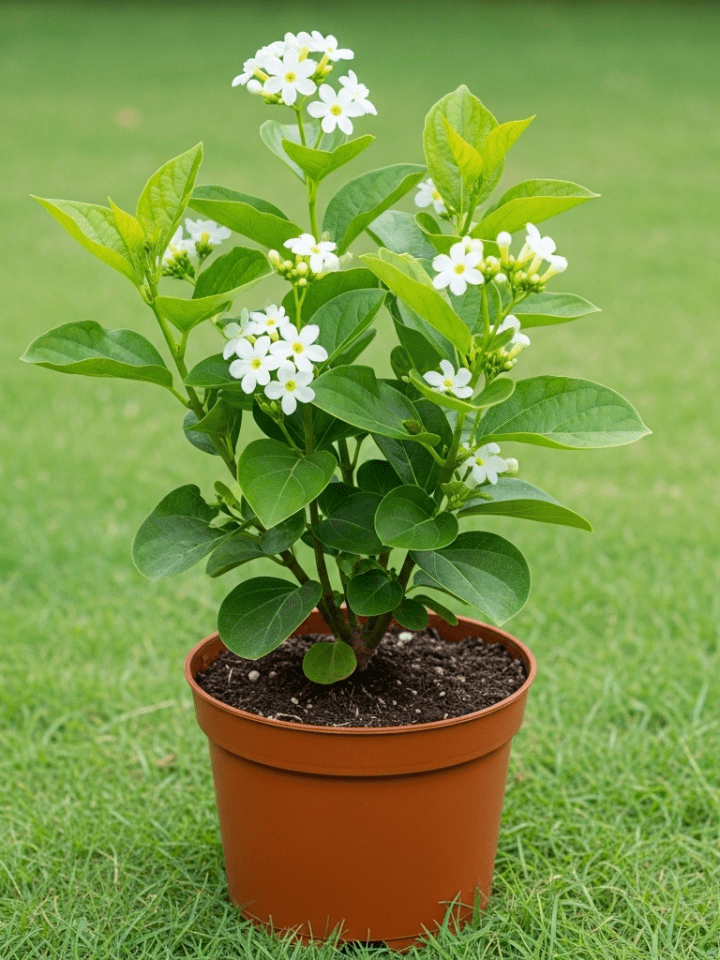
- Flowers. Small, star-like, 1.5–2 cm across, with five to eight white petals around a deep orange tube. They grow in clusters, open after sunset and fall before mid-morning.
- Scent. Sweet, honeyed and strongest in the evening. A single tree can scent a whole courtyard.
- Leaves. Rough and slightly hairy, like fine sandpaper, 6–12 cm long, in opposite pairs on square-edged stems.
- Bark. Grey and flaky on older wood.
- Seeds. Flat, heart-shaped brown capsules follow the flowers.
It is among the best-known monsoon season flowers in the country, although most flowers arrive after the heaviest rains, in early autumn.
Where should you plant parijat?
Outdoors, in the sunniest spot you can give it, ideally where you can smell it in the evening.
- Garden bed or boundary. Planted in the ground, it grows into a rounded small tree within three or four years. Give it about 2–3 m of space from walls and other trees. It is one of the most rewarding outdoor trees for home gardens, because it grows quickly and flowers young.
- Near the gate, courtyard or puja area. Many families plant it where the fallen flowers can be gathered each morning.
- Terrace in a large container. A pot or drum at least 45–60 cm wide, with drainage holes, keeps it at a manageable size for several years. That makes it one of the few flowering plants and trees for terrace garden setups that bring real scent. Check that the terrace can carry the weight of wet soil.
- Not indoors. Parijat needs direct sun and open air. It will not flower in a room or a shaded balcony.
Product Specifications
- Plant name: Parijat (Harsingar / Shiuli) Plant
- Botanical name: Nyctanthes arbor-tristis
- Common names: Parijat, harsingar, shiuli, shefali, night-flowering jasmine, coral jasmine
- Plant family: Oleaceae (olive and jasmine family)
- Origin: South and Southeast Asia
- Plant type: Flowering shrub or small tree (perennial)
- Foliage: Rough, slightly hairy, opposite leaves, 6–12 cm long
- Flower: Small, white, five- to eight-petalled, with a deep orange tube; in clusters; strongly fragrant at night
- Flowering season in India: Late August to December, peaking in September and October
- Flower life: One night; opens at dusk and drops by morning
- Growth habit: Upright and bushy, becoming a rounded small tree; fast-growing
- Mature size: Usually kept at 2–4 m in gardens and 1.5–2.5 m in large pots; can reach 10 m unpruned
- Suitable placement: Garden bed, boundary, courtyard, near the gate, or a large container on a sunny terrace
- Light requirement: Full sun, at least five to six hours of direct sun
- Water requirement: Moderate; less in winter and heavy rain; never waterlogged
- Soil requirement: Loamy, free-draining soil with compost
- Temperature: Grows best between 18 °C and 38 °C; protect young plants from frost
- Fertiliser: Compost or rotted manure in March and July; half-strength liquid feed monthly from July to September
- Pruning: Light pruning in February or March
- Maintenance: Low
- Difficulty level: Easy
- Suitable environment: Warm Indian plains and coastal regions with good sun. Not suited to indoor rooms or shaded balconies.
- Pet safety: No known reports of harm; not listed by the ASPCA; not confirmed pet-safe
How do you care for a parijat plant?
- Sunlight. Five to six hours of direct sun or more. Full sun gives the heaviest flowering.
- Watering. Water deeply when the top 3–4 cm of soil feels dry. In summer that may be every two or three days for a pot, and weekly in the ground. Water much less in winter and during steady rain. Soggy soil causes root rot and leaf drop.
- Soil. Loamy, free-draining garden soil with compost. For pots, use two parts garden soil, one part compost and one-part coarse sand or cocopeat. It tolerates average soil but not waterlogged clay.
- Feeding. Mix compost or well-rotted cow manure into the top of the soil in March and again in July. A half-strength balanced liquid feed once a month from July to September helps bud formation.
- Pruning. It flowers on the current season's shoots. Prune lightly in February or March, after flowering ends, to shape the plant and remove crossing or dead branches. Avoid heavy pruning from June onwards, or you will cut off the coming season's buds.
- Repotting. Move a potted plant up one size every two years or top-dress with fresh compost if it is already in its final container.
When does parijat flower in India?
From late August to December, with the peak in September and October. The first clusters open as the rains ease, and flowering continues into the cool, dry weeks of early winter. Each flower lasts a single night: it opens at dusk, releases its scent through the night and drops by morning.
A young sapling usually flowers in its first or second autumn after planting, once it has settled and grown new shoots. In north India, flowering may end earlier with the first cold spells.
A year with parijat in Bengal
These notes come from growing shiuli trees at our Kolkata nursery, where they flower in time for Durga Puja every year.
February to April: pruning and new growth. Once the last flowers have gone, prune lightly and feed with compost. Fresh leaves follow within weeks. Water regularly as the days heat up.
May to July: building up. This is the main growing period. Keep the soil moist but never waterlogged during the first rains, and check for leaf-eating caterpillars, which can be picked off by hand. Stop pruning from June.
August to October: flowering season. In Bengal the tree starts flowering as the monsoon eases, and by the time of Durga Puja the ground beneath it is white and orange every morning. Water when the soil dries and give a light feed in August. For garden plants and trees that flower alongside it, our home-garden guide lists more Indian favourites.
November to January: winding down. Flowering slows and some leaves yellow and drop. Water less. In north India, protect young plants from frost and cold winds below about 5 °C; in Bengal no protection is needed.
Why is my parijat not flowering? Common problems and fixes
- Healthy leaves, no flowers. Usually too little sun, heavy nitrogen feeding or a plant that is still young. Move it into full sun, feed with compost rather than urea, and give a new sapling a season to settle.
- Buds forming, then dropping. Irregular watering or a sudden cold spell. Keep watering steady from August onwards.
- Yellow leaves and wilting in the rains. Waterlogging. Improve drainage, raise the pot on feet and let the soil dry slightly between waterings.
- Leaves chewed or rolled. Caterpillars. Pick them off, or spray neem oil every seven to ten days if the attack is heavy.
- White, cottony patches on stems. Mealybugs. Wipe them off and spray neem oil or insecticidal soap.
- Leaves dropping in winter. Normal. Parijat sheds some leaves in the cool, dry months and recovers in spring.
Parijat in tradition, Vastu and daily life
Few trees have a bigger place in Indian mythology. The Puranas and the Mahabharata tell of a divine parijat tree that rose during the churning of the ocean, and of Krishna bringing it to earth. Its flowers are offered in worship, and by long custom they are gathered from the ground rather than picked from the tree.
In Vastu, it is regarded as an auspicious tree for the home garden, and practitioners often suggest planting it in an open, sunny spot on the north or east side of the house. It is one of the answers people receive when they ask which tree is good for home under Vastu. Our guide to what Vastu says about sacred trees in the garden covers placement in more detail. These are traditional beliefs rather than proven effects.
The orange flower tubes were used in the past as a natural saffron-coloured dye, and the leaves have a place in traditional Ayurvedic practice. These are cultural uses only. Do not use any part of the plant as medicine without advice from a qualified doctor.
Is parijat safe for pets and children?
No harmful effects on pets are commonly reported, but parijat is not listed by the ASPCA either way, so it cannot be called confirmed pet-safe. The leaves are rough and bitter, which puts most animals off. As with any garden plant, discourage pets and small children from chewing the leaves or seeds, and call a vet if a pet eats a large amount.
What to grow with parijat
This tree gives you autumn scent; a few companions carry fragrance through the rest of the year. Before it starts flowering, gandharaj, which scents the summer before parijat takes over, fills the same months with creamy white blooms. Plant a champa that flowers through the hot months while parijat rests in the same bed for summer colour. Train a jui jasmine along the fence behind it for evening scent during the rains. When the last shiuli flowers fall, kunda to carry white flowers on into winter takes over.
Bring the scent of autumn home
Order a sapling now and plant it before the rains, so it settles in time for its first flowering season. Every plant is raised at our own nursery and packed upright for the journey, by an online gardening store in India that grows its own trees and shrubs. Looking for more colour? Browse our range of flower plants for home garden in India for beds, pots and terraces.

































There are no reviews yet.