Allamanda is the common name for Allamanda cathartica, a woody, evergreen plant of the dogbane family, Apocynaceae, the same family as kaner (oleander), champa and nayantara. It is native to northern South America, from Brazil to Venezuela and the Guianas, and has been grown in Indian gardens for generations for its bright summer colour. In English it is also called golden trumpet, yellow allamanda or common trumpet vine.
Botanically it is a scrambling shrub rather than a true climber. It has no tendrils and its stems do not twine, so it leans on whatever is near it. Tied to a trellis or grille, it behaves like a vine; pruned hard every year, it can also be kept as a loose, rounded shrub.
What you notice first:
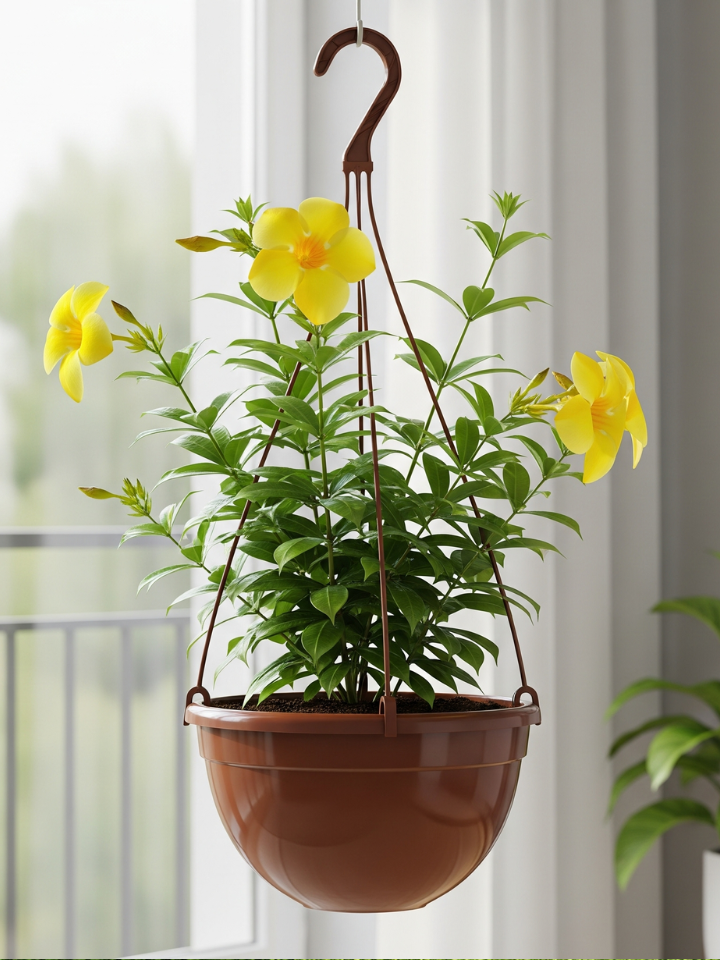
- Flowers. Golden-yellow trumpets, 5–8 cm across, with five broad, overlapping petals and a narrow tube. The throat often carries faint orange-brown streaks. They open in clusters at the tips of new shoots.
- Buds. Slim and pointed before they open, often with a brownish tint.
- Leaves. Glossy, dark green and leathery, 10–15 cm long, usually held in whorls of three or four around the stem.
- Sap. A white, milky latex bleeds from any cut stem or torn leaf. This is normal for the family and is the reason to wear gloves when pruning.
- Seed. Round, spiny green capsules form now and then, but most plants in Indian gardens rarely set seed. Nursery plants are raised from cuttings.
The flowers have little or no scent. This is a plant grown for colour, and very few climbers flower as long or as heavily through the hot months.
Does allamanda climb on its own?
No. Allamanda needs to be tied to a support, at least until its stems are long and woody enough to rest across it.
- Fix the support first. A trellis, wire mesh, balcony grille, arch or taut horizontal wires. Put it up before planting, while the roots are easy to work around.
- Tie as it grows. Fasten young stems loosely to the support with soft twine or plant ties every 20–30 cm. Check the ties every few weeks in the growing season, because new shoots grow quickly and soon flop forward.
- Train sideways. Spread the main stems in a fan or along horizontal wires. Each new side shoot carries flower clusters at its tip, so width means more flowers.
- Or grow it as a shrub. Without a support, cut it back hard every February and pinch the tips during the growing season. It forms a loose, spreading bush about 1–1.5 m tall.
Where should you grow allamanda?
Outdoors, in the sunniest spot you have, where the yellow can be seen from inside the house or the gate.
- Over a gate, arch or boundary wall. Among yellow climbing flowers, few give a longer season, and a single plant can frame a gateway within a year or two.
- On a terrace. Grow it in a half drum or large planter against a parapet trellis. It is one of the more rewarding perennial flowering plants for a terrace garden, because it keeps flowering for months with little more than water and an annual prune.
- On a sunny balcony grille. A south- or west-facing balcony suits it well. It belongs among the climbing flowering plants for a balcony that turn a plain railing into a screen of green and yellow.
- As a garden shrub or hedge. Pruned each year, it makes a colourful informal hedge along a drive or boundary. For more ideas in the same spirit, browse our Indian outdoor plants grown for heat and full sun.
- Not indoors or in shade. Without direct sun, the stems stretch, the leaves pale and flowering almost stops.
Product Specifications
- Plant name: Allamanda (Golden Trumpet Vine) Plant
- Botanical name: Allamanda cathartica
- Also known as: Golden trumpet, yellow allamanda, common trumpet vine
- Plant family: Apocynaceae (dogbane family)
- Origin: Northern South America (Brazil, Venezuela, the Guianas)
- Plant type: Evergreen, woody, perennial flowering climber (scrambling shrub)
- Foliage: Glossy, dark green, leathery leaves 10–15 cm long, usually in whorls of three or four
- Climbing method: None of its own; stems must be tied to a support
- Flowers: Golden-yellow, trumpet-shaped, 5–8 cm across, in clusters at the shoot tips
- Fragrance: Little or none
- Flowering season in India: Mainly April to October; rests in winter in the north
- Growth habit: Vigorous, sprawling climber that can also be pruned into a shrub
- Growth rate: Fast
- Mature size: 2–3 m on a trellis in a large pot with yearly pruning; 5 m or more in the ground if unpruned
- Suitable placement: Gate, arch, pergola, boundary wall, fence, terrace parapet or sunny balcony grille; outdoors only
- Light requirement: Full sun, six hours or more of direct light
- Water requirement: Moderate to high in summer; keep evenly moist but never waterlogged
- Soil requirement: Fertile, organic-rich, free-draining, slightly acidic mix
- Support needed: Yes; trellis, grille, mesh, arch or wires, with ties
- Temperature: Grows best at 18–35 °C; leaf drop below about 10 °C; not frost-hardy
- Fertiliser: Monthly compost March to October; balanced liquid feed every two to three weeks in flower
- Pruning: Once a year in February or early March, plus light tip-pinching in summer
- Common pests: Aphids, mealybugs, whitefly, scale and spider mites
- Maintenance: Low to moderate (tying in and yearly pruning)
- Difficulty level: Easy
- Suitable environment: Sunny, warm outdoor spaces across most of India
- Pet safety: Toxic if eaten; milky sap irritates skin. Not pet-safe.
How do you care for allamanda in a pot?
- Sunlight. Six hours or more of direct sun. Morning sun with light afternoon shade works in the hottest parts of India, but full sun gives the heaviest flowering.
- Pot. Start in a 12–14 inch pot and move to an 18–24 inch pot or half drum within a year. Drainage holes are essential.
- Soil. Rich, free-draining and slightly acidic: two parts garden soil, one part compost or vermicompost and one part coarse sand or cocopeat. Very alkaline or chalky soil often causes yellow leaves with green veins.
- Watering. Water deeply when the top 2–3 cm feels dry. It likes steady moisture in summer but not standing water, so empty saucers after rain.
- Feeding. Allamanda is a hungry plant. Add compost every month from March to October, plus a balanced liquid feed every two to three weeks while it is in flower. Too much nitrogen gives lush leaves and fewer flowers, so switch to a potash-rich feed if that happens.
- Pruning. Once a year, in February or early March, before new growth starts. Shorten long stems by a third to a half and remove weak, dead or crossing growth. It flowers on new shoots, so this spring prune is what brings the summer display. Pinch shoot tips lightly through the season to keep it bushy.
- Handling. Wear gloves when you prune, and wash your hands and tools afterwards. The milky sap can irritate skin and eyes.
- Repotting. Every two years in March, or top-dress with fresh compost once it is in its final container.
When does allamanda flower in India?
Mainly from April to October, right through the summer and the monsoon. It is one of the few climbers that keeps its colour in full summer heat, and with enough sun it is in flower for six months or more. In the warm, frost-free south and along the coasts, a few flowers can appear in almost any month. In north India it slows down or rests from December to February, and a cold snap can scorch the leaves.
A young plant set out in spring usually flowers in its first summer.
A year with allamanda in Bengal
These notes come from the allamanda hedges along our Rishra nursery fence, in the warm, humid climate of Kolkata.
February and March: prune and feed. Cut the plant back, clear old mulch and add compost. New shoots appear within two to three weeks as the days warm.
April and May: the first flush. Flower clusters open at the tip of almost every new shoot. It is one of the most dependable summer garden flowers for a Bengal terrace, even when the afternoons pass 38 °C. Water pots daily in the hottest weeks and keep tying in new stems.
June to September: flowering through the rains. Heavy showers bruise some petals, but new buds keep opening. It is among the monsoon flowers in India that hold colour on a wall when most summer annuals have given up. Check that pots drain freely and watch for aphids and mealybugs on soft shoots.
October and November: the last flowers. Flowering tapers off as the nights cool. Reduce watering and stop feeding.
December and January: rest. Growth slows and a few leaves may yellow and drop. Keep the soil barely moist and do not prune yet.
Why is my allamanda not flowering? Common problems and fixes
- Plenty of leaves, no flowers. Usually too little sun, too much nitrogen or no spring prune. Move it into full sun, feed with potash from spring and prune every February.
- Long, bare stems with flowers only at the ends. It needs pruning. Cut back by a third to a half in late winter and pinch the tips in summer to encourage branching.
- Yellow leaves with green veins. Iron deficiency, common in alkaline soil or hard water. Add compost and a chelated iron or micronutrient feed.
- Yellow leaves in the rains. Waterlogging. Improve drainage, raise pots on feet and let the top of the soil dry between waterings.
- Leaves dropping in winter. Normal in north India when nights fall below about 10 °C. It regrows in spring.
- Sticky leaves, sooty black mould or cottony insects. Aphids, mealybugs, whitefly or scale. Wash them off with a strong spray of water and follow with neem oil every five to seven days.
- Stems flopping over. Allamanda does not climb by itself. Tie the stems to the support.
- Leaves dropping after delivery. Transit shock. It settles within two to three weeks in a sunny spot.
Is allamanda poisonous to pets and children?
Yes. All parts of the plant are considered toxic, and eating the leaves, flowers or seeds can cause vomiting and diarrhoea. The milky sap can also irritate skin and eyes. The ASPCA does not list allamanda either way, but university horticulture sources treat it as toxic, so it is not a pet-safe plant. Train it where pets and small children will not chew it, wear gloves when pruning, and call a vet or doctor if a large amount is eaten.
What to grow with allamanda
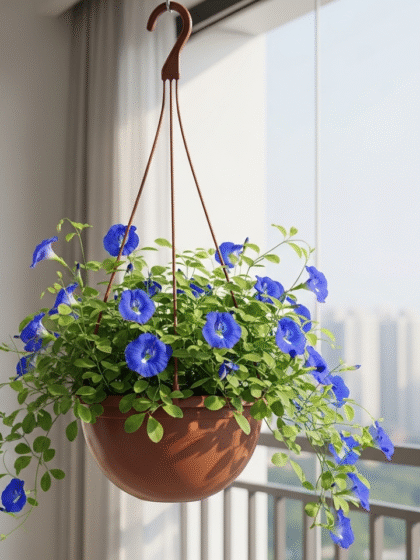
Allamanda gives you yellow from spring to autumn; a few companions add contrast and carry the colour into the cool months. Train aparajita, whose blue flowers look striking against the yellow, up the same grille for a two-colour screen. On the next sunny wall, plant bougainvillea, which asks for even less water, for pink or magenta alongside. For winter, when allamanda rests, add sankrant vel, which takes over with orange flowers in January. New to growing outdoors? Our guide on which outdoor plants forgive a beginner's mistakes is a good place to start.
Plant it now for next summer's colour
Order now and plant it before the next flowering season, so it has time to root and reach the top of its support. Every plant is raised at our own nursery and packed upright for the journey to the regions of India we currently ship live plants to. Want more colour for beds and pots? Browse our live flower plants online for every season.






























There are no reviews yet.