A grafted mango plant is a young tree joined onto hardy rootstock, so it carries the exact fruit of its parent variety and starts bearing in about three to four years instead of the seven or more a seedling takes. Plant it in full sun, in open ground or a half-drum of at least 20 inches, water it deeply while young, and it can give you home-grown aam every summer for decades.
Quick-care strip
- Light: Full sun, at least six hours a day.
- Water: Deeply when the top 5 cm of soil is dry; less from November to January.
- Size: Supplied at [CONFIRM] cm. Dwarf types stay about 2–3 m in a large container; standard types grow into full trees in the ground.
- Fruit: Usually from the third or fourth summer after planting.
- Difficulty: Easy in the ground; moderate in a container.
Grafted sapling from our West Bengal nursery · Delivered across India in 2–7 business days · Free shipping above ₹999 [CONFIRM]
What is a mango plant?
The mango, Mangifera indica, is an evergreen fruit tree of the cashew family, Anacardiaceae. It is native to the region spanning north-east India, Bangladesh and north-west Myanmar, has been grown across the subcontinent for thousands of years, and is India's national fruit. In Bengal it is simply aam, and a family tree in the courtyard is still one of the most loved things a home can have.
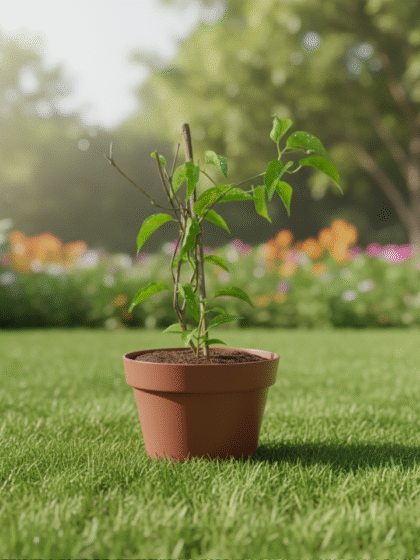
What you receive is a sapling, not a tree. What you will notice first:
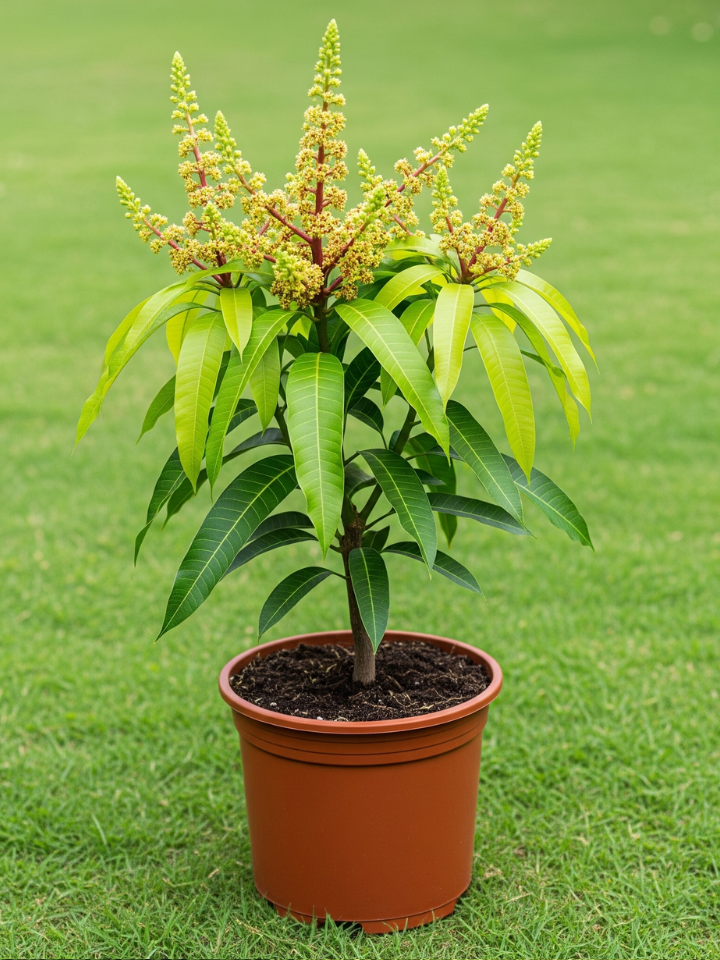
- Leaves. Long, narrow and leathery. New flushes open soft and copper-red or bronze, then harden to glossy dark green.
- Stem. A single upright trunk with a visible graft union, a slight knot or angled scar a few centimetres above the soil.
- Flowers. Later in life, cone-shaped clusters called panicles carry hundreds of tiny, cream-to-pink, lightly scented flowers at the branch tips in late winter.
- Fruit. Green, yellow or blushed mangoes that ripen in early to mid-summer, depending on variety.
Why buy a grafted mango instead of growing one from a seed?
Grafting is the reason a nursery sapling is worth paying for. A shoot, called the scion, is cut from a proven parent tree of a named variety and joined onto a vigorous seedling rootstock. The result:
- True to type. A grafted Himsagar gives Himsagar. A tree grown from a stone may give fibrous, sour or unpredictable fruit.
- Fruit years sooner. Grafted plants usually flower from the third or fourth year; seedlings often take seven to ten.
- Smaller, more manageable trees. Grafted trees branch lower and are easier to prune and harvest, which matters on a rooftop or in a small plot.
Our sapling is Katimon. For reference, Himsagar and Langra are prized for flavour and grow into large trees, Fazli gives big late-season fruit, and Amrapali is a genetically dwarf hybrid bred for close planting that bears most years, which makes it the usual choice for containers.
Where does a mango plant grow best?
A mango needs sun, heat and room for its roots. It suits:
- A garden or open plot. The ground is always the best home. Leave about 5 m from walls and other trees for standard varieties, or about 2.5–3 m for a dwarf. It will stand with other outdoor tree plants that need open sky.
- A sunny rooftop. Among fruit plants for a terrace garden, a grafted mango is the one most people want. Plant it in a half-drum or a large grow bag, keep it on a stand or bricks so the roof stays dry, and check that the roof can take the weight of a wet drum of soil.
- A large, south-facing balcony. Only a dwarf variety, and only with a big container and a full day of sun. It can then sit beside smaller fruit plants for balcony gardens such as lemon and pomegranate.
It is not an indoor plant. Without direct sun it stretches, drops leaves and will not flower. If your site is a mix of sun and shade, our guide to the fruits and flowers that love full sun will help you pick the brightest spot.
Product Specifications
- Plant name: Mango Plant (grafted)
- Botanical name: Mangifera indica
- Common names: Aam (Hindi, Bengali), mamidi (Telugu), maanga (Tamil, Malayalam), amba (Marathi)
- Variety: Katimon
- Plant family: Anacardiaceae (cashew family)
- Origin: North-east India, Bangladesh and north-west Myanmar
- Plant type: Evergreen fruit tree
- Propagation: Grafted onto seedling rootstock
- Foliage: Long, narrow, leathery leaves; new growth bronze to red, maturing to glossy dark green
- Flowers: Small cream to pinkish flowers in upright panicles at the branch tips
- Flowering season in India: About December to February on the plains
- Fruiting season in India: About April to August depending on region and variety; late May to July in Bengal
- Years to first fruit: Usually three to four years after planting for grafted plants
- Growth habit: Upright, spreading tree; dwarf varieties stay compact with pruning
- Growth rate: Moderate
- Mature size: About 2–3 m for a dwarf variety in a large container; 10 m or more for standard varieties in the ground
- Suitable placement: Garden or open plot, sunny rooftop terrace, large south-facing balcony (dwarf types only); outdoors only
- Light requirement: Full sun, at least six hours of direct sun a day
- Water requirement: Moderate; deep watering when the top 5 cm is dry, reduced from November to January for established trees
- Soil requirement: Deep, loamy, free-draining soil with compost; no waterlogging
- Temperature: Grows best at about 24–35 °C; young plants need protection from frost
- Fertiliser: Compost or cow dung manure twice a year; potash before flowering; low nitrogen in winter
- Common pests and problems: Mango hopper, mealybug, fruit fly, leaf-cutting weevil, powdery mildew, anthracnose and malformation
- Maintenance: Moderate; yearly pruning, seasonal feeding and pest checks at flowering
- Difficulty level: Easy in the ground; moderate in a container
- Suitable environment: Tropical and subtropical plains across India; frost-free areas
- Safety: Sap and fruit peel can irritate sensitive skin; the fruit stone is a choking hazard for dogs. Not classed as pet-safe.
Can you grow a mango plant in a pot?
Yes, with the right variety and a big enough container. A pot limits the tree's size, so expect a smaller harvest than from a tree in the ground, but a well-kept container mango can fruit for many years.
- Container. Start in a 16–18 inch pot, then move up within a year or two to a half-drum, a 20–24 inch grow bag or a pot at least 50 cm deep. Plastic or metal drums work well for a terrace mango if you drill plenty of drainage holes and paint the outside a light colour to keep the roots cool.
- Soil. One part garden soil, one part well-rotted cow dung manure or compost and one part coarse sand or cocopeat, with a handful of bone meal. It must drain freely; mango roots rot in soggy soil.
- Planting depth. Keep the graft union well above the soil line. Burying it lets the rootstock take over.
- Staking. Tie the young stem loosely to a bamboo stake for the first year, especially on a windy roof.
- Repotting. Every two to three years, trim the outer roots a little and refresh a third of the soil.
How do you care for a mango plant?
- Sunlight. Six or more hours of direct sun. More sun means more flowers.
- Watering a young plant. Water deeply when the top 5 cm feels dry, which may be every day in April and May for a sapling in a pot and every three to five days in cooler weather. Never leave water standing in a saucer.
- Watering an older plant. Once the tree is three years old, cut watering back from November to January. A dry, cool spell encourages flowering; heavy watering then pushes new leaves instead.
- Feeding. Add compost or cow dung manure twice a year, at the start of the rains and again after harvest. Mix in a potash-rich feed, such as wood ash or a fruiting fertiliser, in October and November to build flower buds. Go easy on nitrogen.
- Pruning. In the first two years, pinch the tip at about 60–75 cm so the sapling branches into three or four evenly spaced limbs. After each harvest, remove crossing, weak and inward-growing shoots. Always rub off any shoot that appears below the graft union. Wear gloves: the sap can irritate skin.
- Removing early flowers. Pinch off any flower panicles in the first two years so the plant puts its energy into roots and branches. Let it fruit from the third year.
- Mulch. A layer of dry leaves or straw keeps the soil cool in summer and moist through the dry months.
When does a mango plant flower and fruit in India?
On the plains, mango trees flower from about December to February, with the south flowering first and the north last. The fruit takes roughly three to four months to ripen, so harvest runs from April in the south to July and August in the north. In Bengal, early varieties such as Himsagar ripen in late May and June, Langra follows in June and July, and Fazli and Amrapali come last, in July. A grafted plant usually flowers for the first time in its third or fourth year, and yields rise every year after that.
A year with a mango plant in Bengal
Our mango plant nursery in Kolkata raises its saplings in the same humid Kolkata heat described here, so these timings hold for most of the eastern plains.
June to August: planting time. The start of the rains is the best time to plant. The soil stays warm and moist, and a new sapling settles fast. Make sure the pit or drum drains; standing water in the monsoon is the main thing that kills young mango plants.
September to November: building the tree. New leaf flushes appear in bronze and red. Feed after the rains, add potash in October, and keep an eye out for leaf-cutting weevils on the soft new shoots.
December to February: flowering. Established trees throw up panicles. Hold back water, and watch for mango hoppers, the tiny jumping insects that suck the flower stalks, and for powdery mildew on foggy mornings. A neem oil spray every seven to ten days while flowers are opening helps; for a large infestation, ask your local agriculture office for a suitable treatment.
March to July: fruit. Water steadily once fruit has set, because sudden drought makes young mangoes drop. Bag the fruit or hang fruit fly traps as it swells, and harvest when the shoulders fill out and the skin starts to change colour.
Why is my mango plant not flowering or fruiting?
- It is still too young. Grafted plants rarely flower before the third year. Be patient and keep feeding.
- Not enough sun. Anything less than six hours of direct sun gives leaves, not flowers.
- Too much water or nitrogen in winter. Both push new leaves at the time the tree should be forming flower buds.
- Flowers turning black and dropping. Usually mango hoppers or powdery mildew, both worse in damp, cloudy weather. Treat as soon as panicles appear.
- Tiny fruits falling in spring. Some drop is natural. Heavy drop means the soil dried out, so water more steadily from March.
- Curly, bunched flower heads. This is mango malformation. Cut the affected shoots off well below the damage and burn them.
- Only one good crop every other year. Many traditional varieties bear heavily one year and lightly the next. Amrapali is far more regular.
Is the mango plant safe around children and pets?
Keep sensible care. Mango sap and the peel of the fruit contain urushiol-type compounds, related to those in poison ivy, and can cause an itchy rash on sensitive skin, so wear gloves when pruning. The large stone inside the fruit is a choking and gut-blockage hazard for dogs, so do not let pets chew fallen mangoes. Mango is not on the ASPCA list of plants toxic to dogs, but we do not class it as a pet-safe plant.
What to plant with a mango tree
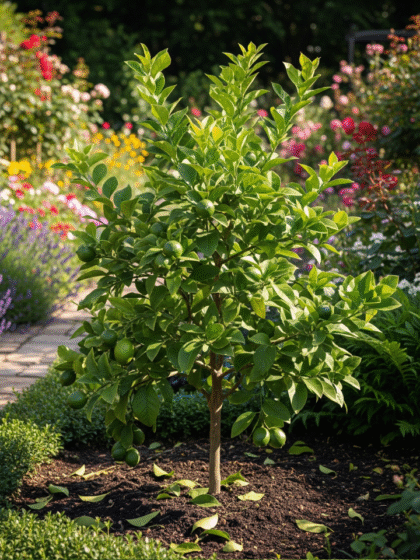
A mango crop comes once a year, so pair it with fruit that fills the other seasons. A lemon plant that fruits in a smaller pot gives you juice through much of the year from a corner of the same terrace. An anar sapling that bears within two or three years likes the same sun and dry winters. And a chiku tree that crops in the cooler months keeps the fruit coming long after the last mango is eaten. For the full range, browse our fruit and spice plants for home gardens.
Plant your own aam tree this season
Order during the rains and your sapling has the whole growing season to settle in before its first winter. Every plant is raised and packed at our online nursery for fruit saplings and sent out ready to plant. Choose the sunniest spot you have, give it room, and in a few summers you will be picking mangoes from your own tree.





























There are no reviews yet.