Morning glory is the common name for a group of twining vines in the genus Ipomoea, part of the bindweed family, Convolvulaceae. The same family gives Bengal its kalmi shak and sweet potato. The ornamental vines came originally from tropical America and have been grown in Indian gardens for so long that the blue kind has names in most Indian languages: kaladana or neelkalmi in Hindi, kaladana in Bengali and Marathi, and neelpushpi in Marathi.
What you notice first:
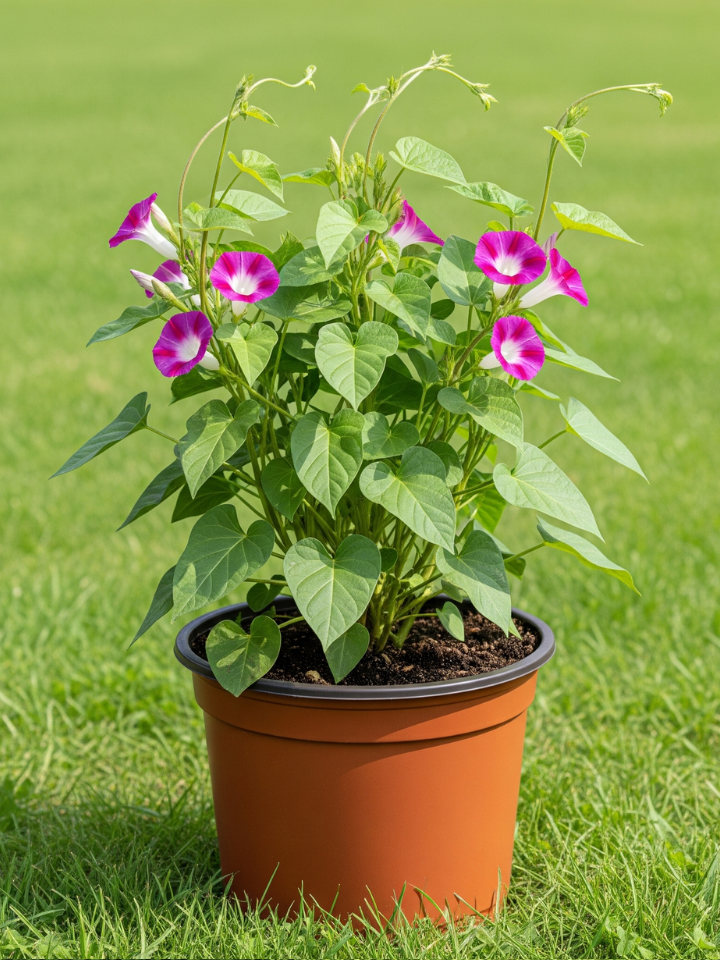
- Flowers. Wide funnels or trumpets, usually 5–8 cm across, in sky blue, violet, purple, magenta, pink or white, often with a pale throat and a star of darker bands.
- Leaves. Soft, green and heart-shaped, sometimes with three lobes, on long stalks along the stem.
- Stems. Thin, flexible and slightly hairy. They twist around anything narrow they touch: string, wire, a bamboo cane or the bars of a grille.
- Seeds. Round capsules follow each flower and hold a few hard, black or brown seeds.
Each bloom lasts a single morning. Buds unfurl around dawn, stay open through the cooler hours and fold up by early or mid-afternoon; on cloudy days they stay open longer. A healthy vine opens a fresh batch every day, which is why a fence covered in it looks new each morning.
Is it an annual or a perennial?
That depends on the species. Common and blue morning glories (Ipomoea purpurea and Ipomoea nil) are annuals: they grow fast, flower heavily for a few months, set seed and die back, and the next generation comes up from that seed. The blue dawn flower (Ipomoea indica) is a perennial that lives for years in warm climates and keeps growing from the same woody base. The vine we supply is so expect.
Where does morning glory grow best?
Sun and something thin to wind around decide everything. It suits:
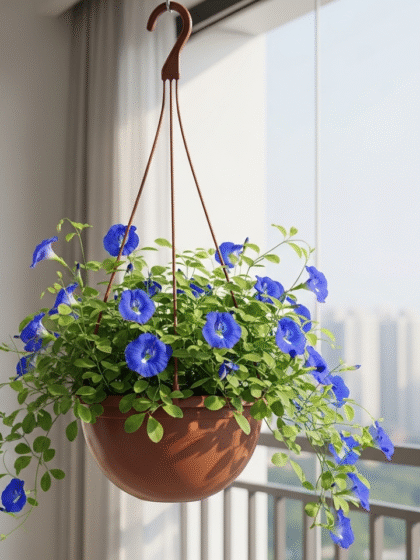
- A balcony grille or railing. Few best climbing plants for a balcony in India cover metal bars so quickly. South, east and west faces work; a north-facing balcony is too dim.
- A terrace screen. Run strings or mesh between two poles and one or two vines make a green, flowering curtain, a cheap option among the best plants for terrace privacy in India.
- A fence, gate or pergola. It is one of the quickest climbing vines for softening chain-link or a bare boundary while slower climbers establish.
- A garden bed. Planted in the ground beside a trellis, it grows larger and flowers harder than in a pot, and it mixes easily with other outdoor garden plants in a sunny border.
It will not climb a flat wall on its own, because it has no clinging roots or tendrils. Fix wires, a trellis or garden netting to the wall first. It is not an indoor plant: kept inside, it stretches, drops its buds and attracts mites.
Product Specifications
- Plant name: Morning Glory Plant
- Botanical name: Ipomoea sp.
- Also known as: Blue dawn flower (I. indica); common morning glory (I. purpurea); kaladana, neelkalmi, neelpushpi (I. nil)
- Plant family: Convolvulaceae (bindweed family)
- Origin: Tropical America; long naturalised in India
- Plant type: Twining flowering climber; annual or perennial depending on species
- Foliage: Soft green, heart-shaped leaves, sometimes three-lobed
- Flowers: Funnel-shaped, about 5–8 cm across; blue, violet, purple, pink, magenta or white
- Flower timing: Open at sunrise, close by afternoon; each flower lasts one morning
- Flowering season in India: Mainly late monsoon to early winter (about September to December on the plains)
- Climbing method: Twining stems; no tendrils or clinging roots, so it needs a string, wire, mesh, grille or trellis
- Growth habit: Vigorous climber, or a sprawling ground cover without support
- Growth rate: Fast; can climb several metres in one season
- Mature size: About 2–3 m for annual types; 5 m or more for perennial types
- Suitable placement: Sunny balcony grille or railing, terrace screen, fence, gate, pergola or garden trellis; outdoors only
- Light requirement: Full sun, at least six hours a day
- Water requirement: Moderate; water when the top 2–3 cm is dry, never waterlogged
- Soil requirement: Light, free-draining garden mix with cocopeat and compost; rich soil not needed
- Temperature: Grows best at about 20–35 °C; growth stops in frost
- Fertiliser: Compost monthly; potash-rich feed once buds form; avoid heavy nitrogen
- Propagation: Seed (soak overnight before sowing); stem cuttings for perennial types
- Common pests: Aphids, spider mites, whitefly, caterpillars and tortoise beetles
- Maintenance: Low; guide young shoots, deadhead, and prune perennial types yearly
- Difficulty level: Very easy
- Suitable environment: Warm, sunny climates across the Indian plains; summer climber in the hills
- Attracts: Bees and butterflies
- Pet and child safety: Toxic to dogs, cats and horses (ASPCA); seeds contain lysergic alkaloids and must not be eaten. Not pet-safe.
How do you grow morning glory in a pot?
- Pot. At least 12–14 inches wide and deep, with drainage holes. One plant per pot; two if the pot is 18 inches or more.
- Soil. Light and free-draining: two parts garden soil, one part cocopeat and one part compost or vermicompost. Rich soil is not needed.
- Support. Put the support in on the first day. Tie a string or wire from the pot up to the grille or railing and guide the young shoot onto it. After that it climbs by itself, twisting around the line.
- Light. Six or more hours of direct sun. In partial shade it grows leaves but few flowers.
- Watering. Water deeply when the top 2–3 cm of mix is dry, which may be daily in April and May for a pot in full sun and every two to four days in cooler weather. Empty saucers during the rains.
- Feeding. A handful of compost once a month is enough. Switch to a potash-rich feed, such as a banana-peel liquid or a bloom booster, once buds appear. Too much nitrogen gives a mass of leaves and very few flowers.
- Pinching. Pinch the growing tip once the vine is 30–40 cm tall, so it branches low and covers the support evenly.
- Deadheading and seed. Pick off faded flowers and green seed capsules to keep the vine blooming longer. Let a few pods ripen and dry if you want seed to sow next year.
- Pruning. Perennial types need a firm trim after flowering, and whenever they reach for gutters, trees or a neighbour's wall.
When does morning glory flower in India?
On the plains, flowering usually begins in the late monsoon and runs into winter, peaking from about September to December. Some kinds, blue kaladana in particular, wait for the shortening days after August before they bud, which is why a vine planted in spring may put on leaves for weeks first. In the hills, flowering shifts to summer and early autumn. Perennial blue dawn flower can open blooms on and off for much of the year in warm places, with the heaviest flush after the rains.
A year with morning glory in Bengal
These notes come from growing morning glory over the fences of our Rishra nursery in the warm, humid Kolkata climate and they hold roughly across the eastern and central plains.
March to May: getting started. The best time to plant a young vine or sow seed. Set it in the sunniest spot you have, fix the support and water often; growth is fast once nights stay warm.
June to August: the green curtain. The rains push stems up the grille at an astonishing rate. Let the top of the soil dry between waterings, check for aphids on new tips and pinch any runaway shoots. It sits comfortably among rainy season flowers in India, and our guide to plants that grow in rainy season covers how to keep potted climbers healthy through weeks of downpour.
September to December: peak colour. Clear mornings and shortening days bring the heaviest flowering. By November it is one of the brighter winter flowers in West Bengal, opening on crisp mornings and staying open longer in the soft winter light.
January and February: winding down. Annual types finish, set seed and dry out; collect the seed, then pull the old vine. Perennial vines slow down; cut them back by a third and feed lightly in March.
Why is my morning glory not flowering? Common problems and fixes
- Lots of leaves, no flowers. Too much nitrogen or too little sun. Stop leafy feeds, give potash and move it to full sun. Also be patient: some kinds wait for the shorter days of late monsoon before budding.
- Flowers closed by noon. Normal. Each flower opens at dawn and folds by afternoon. Look early in the day.
- Yellowing lower leaves. Overwatering or poor drainage, especially in the rains. Let the mix dry a little between waterings.
- Curled, sticky new shoots. Aphids. Wash them off with a jet of water and spray neem oil every five to seven days.
- Pale, speckled leaves with fine webbing. Spider mites in hot, dry weather. Rinse leaf undersides and spray neem oil.
- Round holes in the leaves. Caterpillars or tortoise beetles, which also feed on sweet potato. Pick them off by hand in the morning.
- Vine flopping off its support. It was never guided onto it. Tie the stems loosely and wind them the same way they are already turning.
Is morning glory poisonous to pets and children?
Yes. The ASPCA lists morning glory (Ipomoea spp.) as toxic to dogs, cats and horses. The seeds are the main risk: they contain lysergic alkaloids, and eating them can cause vomiting, and in large amounts hallucinations. Grow it where pets and small children cannot reach the ripening pods, collect seed while it is still green if a pet lives nearby, and never eat the seeds or use them as a home remedy. Call a vet or doctor if seeds are swallowed.
For a flowering climber in a home with a cat or dog, consider a jui jasmine, a climber the ASPCA lists as non-toxic to cats and dogs, which twines up a grille in the same way.
What to plant with morning glory
For a trellis that stays in flower all year, pair it with aparajita, a longer-lived blue climber for the same fence, which flowers through the summer while this vine is still climbing. Then let sankrant vel take over the fence with orange flowers in January, just as the last blue trumpets fade.
Bring home a vine that opens every sunrise
Order now and a young vine has time to reach the top of its support before the flowering season peaks. Every plant is raised and packed at our own nursery, and we deliver to homes across India. For more colour on the same balcony or terrace, browse our live flower plants for sale.

































There are no reviews yet.