Ashwagandha is Withania somnifera (L.) Dunal, a small shrub from the nightshade family, Solanaceae, the same family as tomato and brinjal. It grows wild across the drier parts of India, from Rajasthan and Madhya Pradesh to the Deccan, and further west into Africa and the Mediterranean. The name comes from Sanskrit and refers to the horse-like smell of the fresh root. It is called asgandh in Hindi, ashwagandha in Bengali, amukkara in Tamil and Indian ginseng, winter cherry or poison gooseberry in English.
What you will notice:
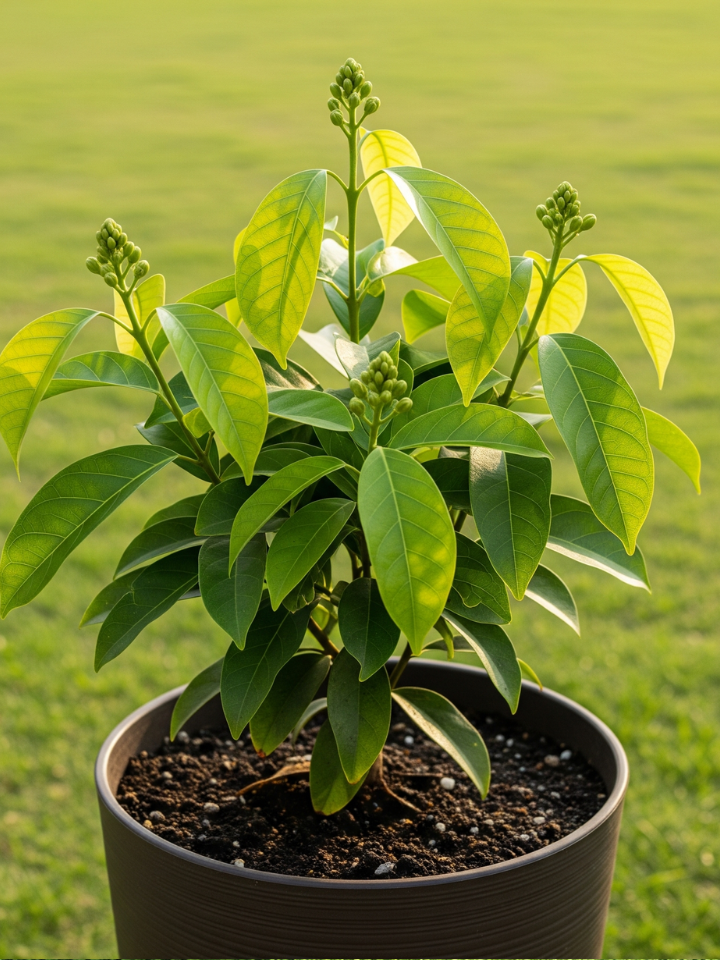
- Leaves. Oval, smooth-edged and dull green with a soft grey sheen, usually 5–10 cm long. The undersides are covered in fine hairs, so they feel velvety.
- Stems. Upright and branching, turning woody at the base as the plant ages, with a light coat of star-shaped hairs.
- Flowers. Small, bell-shaped and pale green to yellow, tucked in clusters where the leaves meet the stem. Easy to miss.
- Berries. Pea-sized, smooth and orange-red when ripe, each hidden inside a papery, lantern-like husk that turns from green to straw-brown.
- Height. Usually 40–75 cm in a pot, and up to about a metre in open ground.
Ashwagandha or rasbhari: how to tell them apart
The berry in a papery lantern makes ashwagandha easy to confuse with rasbhari, the cape gooseberry (Physalis peruviana), which belongs to the same family.
- Ashwagandha (this plant). A woody, upright shrub with grey-green, velvety leaves and small red berries in a husk about 2–3 cm long. The berries are not eaten.
- Rasbhari (Physalis). A softer, sprawling herb with larger, toothed leaves and golden-yellow fruit in a larger husk. The ripe fruit is edible.
- Winter cherry (Solanum pseudocapsicum). An ornamental shrub, also called Jerusalem cherry, with glossy leaves and round orange berries that hang openly, with no husk. It is a different plant, and it is poisonous.
Where should you keep an Ashwagandha plant at home?
Pick the sunniest, driest spot you have. Good choices include:
Not indoors. Even beside a bright window it grows thin and weak, and it rarely sets berries. Keep it outside.
Product Specifications
- Plant name: Ashwagandha Plant (Indian Ginseng)
- Botanical name: Withania somnifera (L.) Dunal
- Common names: Ashwagandha, asgandh, amukkara, Indian ginseng, winter cherry, poison gooseberry
- Plant family: Solanaceae (nightshade family)
- Origin: Dry regions of India, Africa and the Mediterranean
- Plant type: Short-lived perennial woody herb (sub-shrub)
- Propagation of supplied plant: Seedling
- Leaves: Oval, smooth-edged, dull grey-green, 5–10 cm long, velvety underneath
- Flowers: Small, bell-shaped, pale green to yellow, in clusters at the leaf joints
- Fruit: Pea-sized orange-red berries inside papery, lantern-like husks
- Growth habit: Upright and branching, woody at the base
- Height: About 40–75 cm in a pot; up to about 1 m in open ground
- Suitable placement: Sunny terrace or rooftop, south- or west-facing balcony, raised garden bed; outdoors only
- Light requirement: Full sun, six hours or more of direct light
- Water requirement: Low; water when the top 3–4 cm of soil is dry; keep nearly dry in the monsoon
- Soil requirement: Sandy or gritty, very well-drained, neutral to slightly alkaline
- Temperature: Grows best in warm, dry weather; tolerates roughly 10–38 °C; not frost-hardy
- Fertiliser: Compost or vermicompost every six to eight weeks
- Maintenance: Low in dry weather; rain protection needed in the monsoon
- Common pests and problems: Root rot and leaf spot in wet weather; aphids, mites, whitefly
- Difficulty level: Easy to moderate
- Suitable environment: Best in drier parts of India; grows in humid regions with sharp drainage and monsoon cover
- Safety: Considered poisonous if eaten; not listed by the ASPCA and not classed as pet-safe. Not for home remedies without medical advice
How do you care for an Ashwagandha plant in a pot?
- Soil. Use a light, gritty mix: two parts garden soil, one part coarse sand and one part compost. A handful of crushed brick or a spoon of lime helps, since the plant prefers soil that is neutral to slightly alkaline. Avoid heavy clay and pure cocopeat, both of which stay wet.
- Watering. Water thoroughly, then wait until the top 3–4 cm of soil is dry. That is roughly every three to five days in a hot summer, once a week in winter and often not at all in the rains. Too much water kills it far more often than too little.
- Light. Six hours of direct sun or more. In shade the stems stretch, the leaves turn pale and it sets few berries.
- Feeding. A little compost or vermicompost every six to eight weeks is enough. Rich feeding gives soft, leafy growth that rots easily.
- Pruning. Pinch the tips once or twice while the plant is young to make it bushier. Later, trim back straggly or dead stems after the berries are picked.
- Repotting. Its long taproot dislikes disturbance. Move it only once, into its final 10–12 inch pot, and keep the root ball whole.
- Seed. When the husks turn papery and the berries are fully red, pick a few, crush them in water, rinse out the small seeds and dry them in the shade. They usually sprout within two weeks in warm weather.
A year with Ashwagandha in Bengal
These timings suit the humid eastern plains.
October to February: the best months. As the rains end, the air dries and the plant grows strongly. Give it full sun and steady but light watering. Flowers and berries form through these months, and a plant ordered now has the whole dry season to settle in.
March to May: heat and harvest. The plant handles the heat well. As older leaves dry and the berries turn red, collect the seed. Water a little more often in the hottest weeks, always letting the top of the soil dry first.
June to September: the dangerous months. Constant rain and humid air rot the roots and spot the leaves. Move the pot under a shade or roof overhang that keeps out direct rain but still gets light, raise it on bricks and stop watering on a schedule. Some leaf drop is normal; a soft, blackened stem base is not. Healthy plants pick up again once the rains stop.
How do you grow Ashwagandha from seed?
In Bengal, sow fresh seed in late August or September, as the heavy rains ease, or in February. Sow thinly on a moist, sandy seed mix, cover lightly and keep it warm and just damp. Seedlings usually appear within one to two weeks. Move them to their own pots after about five weeks, when they have four to six leaves. On farms the crop is raised from seed and the roots are lifted about five to six months after sowing, once the leaves dry and the berries turn yellow-red.
Why is my Ashwagandha plant dying?
- Yellow leaves, then a soft, dark stem base. Root rot from too much water or poor drainage, the most common problem. Let the soil dry, move the pot out of the rain and repot into a grittier mix if the roots are still firm.
- Thin, leaning stems and few leaves. Too little sun. Move it somewhere with six or more hours of direct light.
- Brown spots spreading over the leaves in wet weather. Leaf spot or blight. Remove the affected leaves, water at the base only and keep the plant dry and airy.
- Curled leaves, sticky film or tiny insects. Aphids, mites or whitefly. Wash them off with a strong jet of water, or spray diluted neem oil every seven to ten days.
- Leaves drying after the berries ripen. Often the natural slowdown after fruiting. Trim dead stems and wait for new growth.
Ashwagandha in Ayurveda and Indian homes
Ashwagandha has been part of Ayurveda for centuries, where its root is valued as a tonic, and today it is one of the most widely sold herbal supplements in the world. That is tradition and trade, not medical advice. Ashwagandha products can cause drowsiness, stomach upset and, rarely, allergic reactions or liver injury. Their safety in pregnancy and breastfeeding is not known, and they may interact with thyroid and other medicines. Please speak to a doctor before using any part of the plant as a remedy, especially if you are pregnant, have thyroid or liver problems, or take regular medication.
Is the Ashwagandha plant safe around children and pets?
Treat it with care. Like many members of the nightshade family, the plant is considered poisonous if eaten, and the bright berries can tempt small children. The ASPCA has no entry for Withania somnifera, so we do not class it as pet-safe. Keep it where pets and young children cannot chew the leaves or berries.
What to plant with Ashwagandha
Ashwagandha wants dry feet, so pair it with herbs that share its sun but keep their own water. A curry leaf shrub for the next pot along enjoys the same hot terrace. Set a brahmi pot for the wet tray beside it and the two plants never have to share a watering can. For the slightly shadier ledge, add kalmegh, a bitter annual herb that takes more water. To grow a full medicinal plant garden, mix aromatic, leafy and root herbs in one sunny corner, and see the herbs and shrubs that need a full day of sun for more ideas.
Start your ashwagandha plant this dry season
Order now and it can settle in while the weather is cool, dry and sunny, exactly as it likes. Every plant is raised and packed at our own nursery in West Bengal and sent to every part of India our medicinal plants travel to. Give it sun, sandy soil and a light hand with the watering can, and it will reward you with velvety leaves and red lantern berries for years.





















There are no reviews yet.