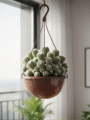
This plant is Parodia magnifica, a globe-shaped cactus from the cool, dry grasslands of southern Brazil. Gardeners also know it as the balloon cactus or blue ball cactus, and older books list it as Notocactus magnificus. It is one of the most decorative small cacti in cultivation and holds the Royal Horticultural Society's Award of Garden Merit.
In the wild it is listed as Endangered by the IUCN, because its native populations are small and scattered. The plants sold in nurseries, ours included, are raised in cultivation from seed or offsets, so buying one puts no pressure on wild stands.
What you will notice when it arrives:
- Shape. A neat sphere that slowly becomes a short, upright cylinder over many years. Single heads usually reach 7–15 cm across.
- Ribs. Eleven to fifteen straight, sharp-edged ribs give it a crisp, almost geometric look.
- Colour. A blue-green body with a faint waxy bloom, which makes it look frosted in good light.
- Spines. Clusters of fine, golden-yellow bristles, 8–20 mm long, run down every rib. They are thinner and softer-looking than desert cactus spines, but they still prick.
- Flowers. Mature plants carry funnel-shaped, sulphur-yellow blooms about 5 cm wide at the crown, in the warm months.
- Pups. Over time the plant forms offsets around its base and builds into a mound of several globes.
Where does a ball cactus look best?
Its tidy, symmetrical shape suits modern spaces, and it stays small enough for almost any sunny surface.
It does not suit a dark room, a windowless bathroom or a spot several metres from the glass. For a dimmer window, a spine-free haworthia that copes with softer light is the better choice.
Product Specifications
- Plant name: Ball Cactus
- Other common names: Balloon cactus, blue ball cactus
- Botanical name: Parodia magnifica (syn. Notocactus magnificus, Eriocactus magnificus)
- Plant family: Cactaceae (cactus family)
- Native range: Southern Brazil (cool, dry grassland)
- Conservation status in the wild: Endangered (IUCN); the plant supplied is nursery-raised
- Plant type: Evergreen globular cactus
- Growing medium supplied: Cactus and succulent potting mix
- Body: Blue-green globe with 11–15 sharp, straight ribs and a faint waxy bloom
- Spines: Fine, golden-yellow bristles, 8–20 mm long
- Flowers: Sulphur-yellow, funnel-shaped, about 5 cm across, on mature plants in the warm season
- Growth habit: Solitary globe at first; slowly forms offsets and a clustered mound
- Growth rate: Slow
- Mature size: Single heads usually 7–15 cm across; clusters wider with age
- Suitable placement: Sunny windowsill, bright desk near a window, covered balcony or terrace ledge, dish garden
- Not suitable for: Dark rooms, windowless bathrooms, or open spots exposed to monsoon rain
- Light requirement: Bright light with three to five hours of sun; light afternoon shade in peak summer
- Water requirement: Low; water only when the soil is completely dry
- Soil requirement: Gritty, fast-draining cactus mix
- Fertiliser: Quarter-strength liquid feed monthly, February to June
- Temperature: About 15–32 °C ideal; keep above about 10 °C
- Propagation: Offsets (pups) or seed
- Common problems: Rot from overwatering or rain, stretching in low light, sunburn, mealybugs
- Maintenance: Very low
- Difficulty level: Easy
- Suitable environment: Bright homes, offices and covered balconies across India; extra care in the monsoon
- Pet and child safety: Not listed as toxic by the ASPCA; spines can cause injury, so keep out of reach
How do you care for a ball cactus?
The short answer: plenty of light, very little water, and soil that drains fast.
- Light. Three to five hours of sun a day, with morning sun the safest. This species comes from grassland rather than open desert, so it appreciates light shade from the fierce afternoon sun of an Indian May and June.
- Watering. Use the "soak and dry" method. Water slowly until it runs out of the drainage hole, empty the saucer, then wait until the soil is dry all the way down. That usually means every 10–14 days in summer and every three to four weeks in winter. Water the soil, not the crown.
- Soil. It comes potted in a cactus and succulent mix. When repotting, use a gritty blend: one part cocopeat or garden soil, one part coarse sand and one part perlite or small brick chips.
- Pot. Keep it in a pot with a drainage hole. It grows slowly, so repot only every two to three years, in late winter or spring, into a pot just one size larger. Hold the globe with folded newspaper or thick gloves.
- Feeding. A quarter-strength liquid fertiliser once a month from February to June is plenty. Do not feed during the monsoon or winter.
- Temperature. It is happiest between about 15 and 32 °C and should not be left below about 10 °C.
Because it asks for so little, it sits comfortably among plants that forgive a month of missed watering.
Will a ball cactus flower?
Yes, once it is mature. Plants usually start flowering after a few years, sending up clusters of glossy, sulphur-yellow flowers from the crown in the warm season. A young plant from a 4-inch pot may not flower in its first year.
To encourage blooms, give it as much bright light as possible through spring and summer, and keep it cooler and drier from November to January. That winter rest is the single biggest trigger for flowering.
Ball cactus through the Indian year
These timings come from growing cacti in the humid Kolkata climate and suit most of eastern and southern India.
February to May: active growth. Warm, bright and dry weather suits it best. Water when dry, feed lightly, and repot now if needed.
June to September: monsoon caution. This is the riskiest season. Keep the pot under cover and out of the rain, in the brightest airy spot you have. Water only when the soil is bone dry, which may mean not at all during long wet spells.
October to January: rest. Growth slows. Water once every three to four weeks at most. In north India, bring it indoors on nights that fall below about 10 °C.
What problems affect a ball cactus?
- Soft, brown or mushy base. Rot from overwatering or rain. Stop watering, move it somewhere dry and bright, and repot into dry gritty mix if the roots are affected.
- Pale, stretched or leaning growth. Too little light. Move it gradually to a brighter spot over a week or two.
- Yellow or bleached patches on one side. Sunburn, usually after a sudden move into strong afternoon sun. Acclimatise it slowly.
- Shrivelled, wrinkled body in summer. Thirst. Give it a thorough soak; it should firm up within a few days.
- White cottony specks between the spines. Mealybugs. Dab them with a cotton bud dipped in rubbing alcohol and repeat weekly until clear.
Is a ball cactus safe for pets and children?
It is not known to be poisonous: Parodia magnifica is not on the ASPCA's list of toxic plants, and cacti of this kind do not have toxic sap. The problem is the spines. They are fine and dense, and they can lodge in a curious pet's mouth or paws, or in small fingers. Place it on a high shelf or windowsill out of reach.
If you share your home with a cat or dog, a spineless Christmas cactus that the ASPCA lists as non-toxic is a safer cactus to keep within reach.
Is a ball cactus good for the home as per Vastu?
Traditional Vastu advice often keeps thorny plants out of the bedroom and the main entrance, and places them on a balcony, terrace or garden instead. This is a matter of belief rather than horticulture, and many people happily keep small cacti indoors. If Vastu matters to you, how Vastu traditions place plants room by room explains the usual directions.
Does a ball cactus purify the air?
Not in any way you would notice. All plants exchange a little air, but research shows that a few pots have no measurable effect on the air in a room compared with opening a window. For the details, read what the research actually shows about plants and indoor air. Buy this plant for its looks and its easy nature.
A small cactus with a lot of character
Each Ball Cactus is raised, potted and packed at our own nursery, then sent as one of the live cacti delivered to cities across India. Give it sun and a light hand with the watering can, and it will reward you with golden spines all year and yellow flowers in the years to come.

































There are no reviews yet.