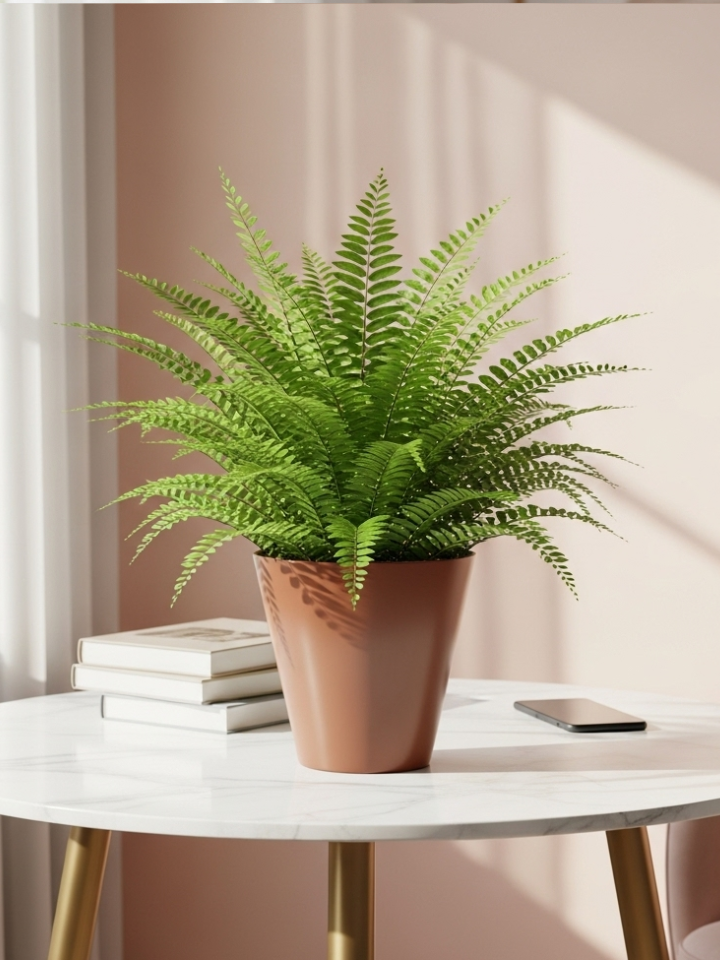
Boston Compacta (Nephrolepis exaltata 'Bostoniensis Compacta') is a smaller, denser selection of the familiar Boston fern. The standard form throws long, sprawling fronds that can outgrow a shelf within a year. This one grows shorter, more closely set fronds that arch outward from the centre in a tidy, rounded clump. The leaflets are small, soft to the touch and a fresh mid-green, and every new frond unfurls from a tightly coiled fiddlehead, which is worth a close look.
Because the shape stays full and manageable, it looks lush in a modest pot rather than demanding a large planter. Growth is steady through the warm, humid months and slows in winter. Like all ferns it does not flower; the whole appeal is the foliage.
Where does it look best?
Place it where the arching fronds can be seen from the side: on a bookshelf, a plant stand, a console table, or hung at eye level. A spot near an east-facing window, or a few feet back from a north-facing one, gives the bright indirect light it wants. It suits a bathroom with a window, a living room corner alongside other interior plants for living room displays, and a hanging pot in the manner of classic hanging basket plants. On a covered balcony, the range of plants for shady balcony is where it belongs, provided it stays out of hot afternoon sun.
Product Specifications
- Plant name: Boston Compacta Fern
- Botanical name: Nephrolepis exaltata 'Bostoniensis Compacta'
- Also known as: Compact Boston fern, dwarf Boston fern
- Plant type: Evergreen perennial fern, grown for foliage
- Suitable placement: Shelf, plant stand, console table, hanging pot, bathroom with a window, covered or shaded balcony
- Light requirement: Bright indirect light; tolerates moderate light with slower growth; no hot direct sun
- Water requirement: Keep the soil evenly moist but never waterlogged; check every 2–3 days in summer, less in winter
- Soil requirement: Rich, loose, moisture-retentive and well-draining; a mix of potting soil, coco peat and compost works well
- Humidity: Prefers humid air (above about 50%); dislikes air-conditioner draughts
- Temperature: Comfortable between roughly 16 °C and 30 °C
- Growth habit: Clumping, with arching fronds from a central crown
- Growth rate: Moderate in the warm season, slow in winter
- Flowers: None; a fern reproduces by spores
- Propagation: Division of the clump in the warm season
- Difficulty level: Easy to moderate
- Suitable environment: Humid, bright indoor spaces and sheltered balconies
Pet safety: Non-toxic to cats and dogs (ASPCA)
Is it safe around cats and dogs?
Yes. The ASPCA lists Boston fern as non-toxic to both dogs and cats, which makes it a sensible green choice for a home with pets. Non-toxic does not mean edible: a cat that chews a lot of any plant may still be sick, and a curious kitten can wreck the fronds. Hanging it or setting it on a stand keeps both the plant and the pet happy. More options are gathered among non-poisonous plants.
How does it cope with Bengal's climate?
Ferns are one of the few plant groups that like the humid air of West Bengal. The monsoon, roughly June to September, is peak growth: fronds fill in fast and the plant rarely complains. Summer, from March to May, is the harder season. Small pots dry out in two to three days, and hot west-facing glass scorches the fronds, so check the soil often and keep it back from direct sun. In winter, growth slows, watering drops, and a few older fronds may yellow and fall, which is normal. The biggest year-round risk is a room with constant air conditioning, which dries the air and turns frond tips crisp and brown. Our notes on indoor plants that thrive in Bengal's humid monsoon air cover the season-by-season detail, and the rainy season plants in India guide is useful if you plan to keep it on a sheltered balcony through the rains. Raised at a nursery in West Bengal, it arrives already used to this humidity.
Does it clean the air?
Boston fern was among the plants in NASA's 1989 sealed-chamber study, where it removed formaldehyde. Later research, including a 2019 review by Cummings and Waring, found that in an ordinary room a plant cleans air far too slowly to replace ventilation. So, enjoy it for the greenery and the humidity it adds, not as a purifier. The air filtering houseplants range shows what else is available, and the evidence is set out fully in how much air a houseplant really cleans.
Who is this fern for?
It suits someone who can check a pot every few days, wants a soft, full look, and has bright indirect light. It is not the plant for a dry, sun-baked window or a sealed air-conditioned room, and it needs more attention than a snake plant or a jade. If your space is bright but dry, a peacock plant also enjoys humidity, while an upright green peperomia is less demanding and also pet-safe. For a gift, it works among the small plants gifts in a bright home. Every plant is nursery-grown and part of our range of online nursery plants, and the delivery locations we serve across India are listed in full.



































There are no reviews yet.