The peepal is Ficus religiosa, a large fig tree in the mulberry family, Moraceae, native to the Indian subcontinent and Indochina. It is pipal or peepal in Hindi, ashwattha in Sanskrit and Bengali, pimpal in Marathi, piplo in Gujarati, arasa maram in Tamil, raavi in Telugu, arali in Kannada and arayal in Malayalam. In English it is the sacred fig or the bodhi tree.
What you will notice:
- Leaves. Broad, heart-shaped and glossy, about 10–18 cm long, ending in a distinctive tail-like "drip tip" that helps rain run off. They hang on long, slender stalks, which is why a peepal seems to rustle even when the air feels still.
- New growth. Fresh leaves open a soft pink to coppery red before turning deep green.
- Bark and branches. Smooth and grey on young plants. Cut a leaf or twig and a white, milky latex appears.
- Figs. Small, paired figs sit where the leaves join the stem, ripening from green to purple. Each one is pollinated by its own tiny fig wasp, and birds feast on them. A young potted plant rarely fruits.
- Habit. Fast and upright when young, spreading into a wide crown with age. In the wild, birds drop its seeds on walls and other trees, where it starts life as an epiphyte and sends roots down to the ground.
Can you keep a peepal plant at home?
Yes, as long as you plan for the tree it will become. Here is the honest picture:
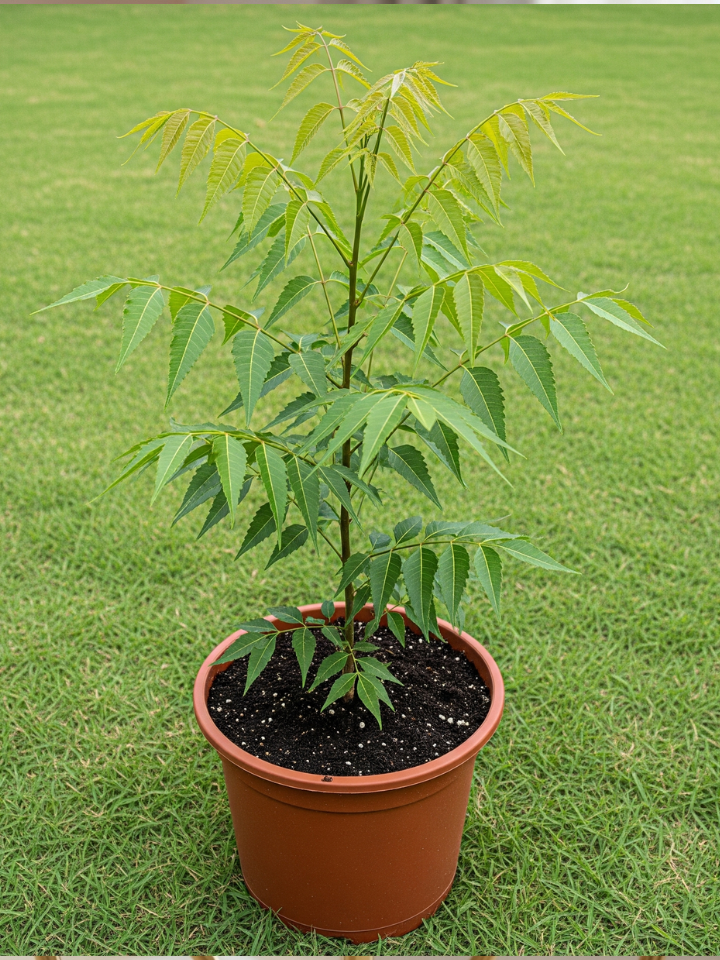
- In a large pot, for a few years. A young sapling grows happily in a 14–18 inch pot or grow bag on a terrace, a balcony with strong sun, or a courtyard. Pinch out the tips and prune once or twice a year and it will stay at one to two metres.
- As a bonsai. Its quick growth, small-ish leaves on mature wood and tough nature make the pipal a popular bonsai species in India. Root-pruning every year or two keeps it small for decades.
- In open ground, with plenty of space. This is where a peepal truly belongs. Plant it in a temple ground, park, school, farm or large compound, well clear of buildings, boundary walls, pipes and septic tanks. It grows into one of the outdoor trees that give a lifetime of shade.
- Not indoors. It needs strong light and drops leaves in a dim room. Bring a pot inside for a puja or a ceremony, then return it to the sun.
- Never against a wall or on a slab. Peepal roots are strong enough to split brick, plaster and concrete. Do not let a pot stand on a terrace drain, and do not let roots escape through the pot's holes into cracks.
If you want a fig for a sunny window rather than the garden, a trained ficus bonsai for an indoor shelf is the closer fit.
Product Specifications
- Plant name: Peepal Plant / Pipal / Sacred Fig / Bodhi Tree / Ashwattha
- Botanical name: Ficus religiosa
- Common names: Peepal or pipal (Hindi), ashwattha (Sanskrit, Bengali), pimpal (Marathi), piplo (Gujarati), arasa maram (Tamil), raavi (Telugu), arali (Kannada), arayal (Malayalam)
- Plant family: Moraceae (fig and mulberry family)
- Origin: Indian subcontinent and Indochina
- Plant type: Large tree, evergreen to briefly deciduous; supplied as a young sapling
- Growing medium supplied: Cocopeat-based soil mix
- Leaves: Heart-shaped, glossy, about 10–18 cm long, with a long tail-like tip; pink to coppery when new
- Sap: Milky white latex
- Fruit: Small paired figs, green ripening to purple; rarely produced on young potted plants
- Growth habit: Upright and fast-growing when young; wide-spreading crown with age; strong, invasive roots
- Growth rate: Fast in warm, wet weather
- Mature size: About 20 m in open ground; can be held at 1–2 m in a large pot with pruning, or smaller as a bonsai
- Lifespan: Very long-lived; trees several centuries old are well documented
- Leaf change: Sheds many older leaves in late winter or early spring; new flush follows by about April
- Suitable placement: Outdoors in full sun: terrace or courtyard in a large pot, bonsai bench, or open ground well away from buildings, walls, pipes and septic tanks
- Not suitable for: Indoors long-term, narrow balconies, or planting beside foundations
- Light requirement: Full sun, at least five to six hours daily
- Water requirement: Moderate in a pot; low once established in the ground
- Soil requirement: Any well-drained soil; garden soil with compost and coarse sand works well
- Climate: Tropical and subtropical; thrives in heat; young plants need frost protection
- Fertiliser: Compost or vermicompost every 6–8 weeks from March to October
- Maintenance: Low; regular pruning needed to keep it compact in a pot
- Common pests and problems: Leaf galls (psyllids), mealybugs, scale insects, overwatering in heavy soil
- Difficulty level: Easy
- Suitable environment: Plains and coastal regions across India; protect young plants from frost in the north
- Safety: Not pet-safe; sap can irritate skin and eyes
How do you care for a peepal plant in a pot?
- Pot. Start with the nursery pot for two or three weeks, then move it to a 12–14 inch pot with drainage holes. Go up a size each year, or plant it out.
- Soil. It is not fussy. Mix two parts garden soil, one part compost or well-rotted cow dung manure and one part coarse sand or cocopeat. Good drainage matters more than richness.
- Watering. Water thoroughly when the top 3–5 cm of soil feels dry. A small pot in May may need water every day; in the monsoon, often none; in winter, every few days. Established trees in the ground cope with drought.
- Feeding. A handful of compost or vermicompost every six to eight weeks from March to October is plenty.
- Pruning. Prune in late winter or early spring, just before new growth. Wear gloves: the milky sap can irritate skin and eyes.
- Repotting or planting out. The best time is the monsoon, from June to September, when roots settle fastest.
These hardy plants that forgive a missed watering suit busy households, and the peepal is one of the toughest of them once established.
Why does a peepal tree shed its leaves?
Seasonal leaf fall is normal. In much of India, a peepal sheds many of its older leaves in late winter and early spring, often around February and March, and then flushes out a beautiful crop of pink-copper new leaves by April. A potted sapling may drop a few lower leaves in winter for the same reason.
Leaf loss is worth a closer look only if it happens suddenly in the growing season. Check whether the soil has stayed soggy, whether the plant has been moved into shade, or whether it was recently repotted or delivered. A few yellow leaves after the journey are transit shock and pass within two to three weeks.
Does the peepal tree give oxygen at night?
No, not in the way the popular claim suggests. During the day, a peepal photosynthesises like any healthy tree: it takes in carbon dioxide and releases oxygen. At night, without light, it respires and takes in oxygen, just as other plants do. A 2022 genome study of Ficus religiosa found the tree can switch on genes linked to CAM-style carbon fixation at night, which means it may absorb some carbon dioxide after dark, but the researchers found no scientific evidence of oxygen production in darkness.
What is true is impressive enough. A mature peepal is a huge, long-lived tree that shades streets and courtyards, cools the ground beneath it and feeds birds, bats and insects with its figs. The Sri Maha Bodhi in Anuradhapura, Sri Lanka, grown from a cutting of the Bodh Gaya tree, was planted in the 3rd century BCE and is still alive.
Why is the peepal tree sacred?
Few trees carry as much meaning in India. In Hindu tradition the ashwattha is associated with Vishnu, and in the Bhagavad Gita (10.26) Krishna says, "Among all trees, I am the ashvattha." Many families water a peepal and circle it on Saturdays, tie sacred threads around its trunk, and light lamps at its base. In villages across India, including Bengal, a peepal and a banyan are often planted side by side and ceremonially married.
For Buddhists it is the bodhi tree, under which the Buddha attained enlightenment at Bodh Gaya in Bihar. Jains also revere it. Because of this, people often plant a peepal to mark a vow, a birth or the memory of someone loved. It is often worshipped alongside the tulsi that sits at the heart of the household puja, and in Kartik many families also honour an amla sapling, another tree worshipped in the month of Kartik.
Its leaves, bark and figs also have a long place in Ayurveda and folk practice, which is why it sits among traditional plants with a place in Ayurveda. These are traditional uses, not proven treatments, and we make no medical claim for this plant.
Peepal tree and Vastu: what the tradition says
The peepal is honoured in Vastu as a sacred tree, but most Vastu practitioners advise against planting one inside the house compound or close to the walls. Many recommend worshipping it at a temple or in an open public space instead, and some suggest a peepal that is already outside a home is best placed to the west. There is a practical reason behind the advice, too: its roots can damage foundations.
So if Vastu matters in your household, keep your plant in a pot for a limited time, as a bonsai, or plant it out in a temple, park or open land. It belongs among the trees honoured in Vastu and household worship, and our guide to what Vastu tradition says about large trees around a home explains placement in more detail. These are beliefs and conventions, not rules of science.
Peepal through the Bengal year
Our saplings are raised in the warm, humid Kolkata climate, and these timings suit most of the eastern and southern plains.
February to April: leaf change. Older leaves yellow and fall, and coppery new leaves follow within weeks. Prune now, before the new flush.
May to June: heat. The sapling takes full sun in its stride but a small pot dries out fast. Water deeply every day or two and mulch the surface.
July to September: fastest growth. The rains push out long new shoots. This is the best time to plant out, repot or start a bonsai. Make sure the pot drains freely.
October to January: steady and green. Growth slows as the air cools. Water less, stop feeding by December, and in north India keep young pots away from frost.
What problems affect a peepal plant?
- Yellow leaves with wet soil. Overwatering or poor drainage. Let the top few centimetres dry, and check the drainage holes are clear.
- Yellow leaves in February or March. Natural leaf change. New leaves will follow.
- Small raised bumps on the leaves. Leaf galls caused by tiny sap-sucking psyllids. They are cosmetic; remove the worst leaves.
- White, cottony clusters or small brown shells on stems. Mealybugs or scale insects. Wipe them off and spray neem oil weekly until they clear.
- Long, thin, leggy stems. Too little light. Move the pot into full sun and prune back to encourage bushy growth.
- Roots coming out of the drainage holes. Time for a bigger pot, or for planting out.
Is a peepal plant safe around children and pets?
Not fully. The milky sap of fig trees can irritate skin and eyes, and the ASPCA lists the closely related weeping fig (Ficus benjamina) as toxic to cats, dogs and horses because of compounds in that sap. Ficus religiosa is not listed by name, so treat it the same way: keep the pot out of reach of pets that chew leaves, and wash hands after pruning.
Plant a sacred tree that will outlive us all
Every sapling is raised, checked and packed at our plant nursery in West Bengal, then delivered across India. Give it sun, room to grow and a little care in the first year, and your peepal can stand for generations.





























There are no reviews yet.