The plant sold as Brahma Kamal in Indian homes and nurseries is Epiphyllum oxypetalum, a member of the cactus family, Cactaceae. It comes from the tropical forests of southern Mexico and parts of South America, where it grows on tree branches rather than in sand. In English it is called queen of the night, Dutchman's pipe cactus or orchid cactus, and in many Indian homes simply the night lotus.
What you will notice:
- Stems. No spines at all. The plant grows long, flat, green stems with wavy, scalloped edges that look exactly like leaves. Older stems turn round and woody at the base.
- Habit. Upright at first, then arching outward as the stems lengthen. In a pot it usually reaches 1–2 m and benefits from a stake or a hanging basket.
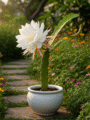
- Buds. Flower buds appear from the notches along the stem edges. They hang down on a long, pinkish tube and then turn upward on the evening they open.
- Flowers. Pure white, cup-shaped and layered, up to about 30 cm long and 17 cm across, with a fine fringe of creamy stamens. The scent is rich and sweet, and strongest around midnight.
Because it is a forest cactus, it behaves more like an orchid than a desert plant. It is one of the most dramatic flowering succulents you can grow on an Indian balcony, but it needs shade, humidity and an airy mix rather than hot sun and sand.
Is this the real Brahma Kamal?
There are two plants with this name, and it helps to know which one you are buying.
- Himalayan Brahma Kamal (Saussurea obvallata). A small alpine plant of the daisy family that grows wild at roughly 3,700–4,600 m in the Himalaya. Its purple flower heads sit inside pale yellow-green, papery bracts, and they appear from July to September. It is the state flower of Uttarakhand and is offered at hill shrines such as Badrinath. It cannot survive on the plains and is not sold as a potted plant.
- The garden form (Epiphyllum oxypetalum). The night-blooming cactus that most Indian families know by this name, and the plant supplied here. It flowers in the same monsoon months, which is one reason the two share a name.
Both are treated with reverence. Only the second one will flower in your home.
When does Brahma Kamal bloom, and for how long?
In Bengal and most of the Indian plains, the main blooming season runs from about July to September, with occasional flowers in late June or October. A bud takes roughly two to three weeks to develop. On the night it opens, the flower begins to unfold after about 8–9 pm, reaches full size around midnight and closes by dawn. Each flower lasts a single night, but a mature plant can open several buds over a season, sometimes many on the same night.
Many families stay up to watch the bloom, light a lamp or say a small prayer beside it. It sits comfortably among the monsoon flowers in India that make the rainy months worth waiting for.
How long does a Brahma Kamal plant take to flower?
A young plant raised from a cutting usually flowers once its stems have matured, typically in its second or third year. A larger, well-established nursery plant may flower in its first full monsoon with you. [CONFIRM age and size of the plant supplied] Flowering depends far more on light, pot size and a cool, dry winter rest than on feeding. A plant kept in deep shade, or moved into a very large pot, can stay green for years without a single bud.
Where should you keep a Brahma Kamal at home?
The ideal spot is bright but sheltered from hard sun. Good choices include:
- A north- or east-facing balcony. Morning sun and bright shade suit it perfectly, which makes it one of the best plants for north facing balcony corners .
- A covered verandah or under a pergola. Filtered light and good airflow keep the stems firm and green.
- A hanging basket. As the stems arch, a basket lets them cascade. It is one of the few hanging flowering plants in India with flowers this large.
- Indoors, beside a bright window. It will live happily for a while but flowers more reliably outdoors in the monsoon. Move it out from June onwards.
Not on an open roof in summer. Afternoon sun from April to June scorches the stems yellow or red.
Product Specifications
- Plant name: Brahma Kamal Plant (Queen of the Night)
- Botanical name: Epiphyllum oxypetalum
- Common names: Brahma Kamal, queen of the night, Dutchman's pipe cactus, orchid cactus, night-blooming cactus
- Not to be confused with: Himalayan Brahma Kamal (Saussurea obvallata), which is not grown in pots
- Plant family: Cactaceae (cactus family)
- Origin: Southern Mexico and parts of South America
- Plant type: Epiphytic forest cactus; perennial
- Stems: Flat, spineless, leaf-like, with wavy scalloped edges; base turns woody with age
- Flowers: Large, white, cup-shaped, up to about 30 cm long; strongly fragrant
- Flowering habit: Opens after dark and closes by dawn; each flower lasts one night
- Flowering season in India: Mainly July to September; occasionally June or October
- Age to first flower: Usually two to three years from a cutting
- Propagation of supplied plant: Rooted stem cutting
- Growth habit: Upright when young, then arching or trailing
- Growth rate: Moderate to fast in warm, humid weather; slow in winter
- Mature size in a pot: About 1–2 m of arching stems
- Suitable placement: North- or east-facing balcony, covered verandah, hanging basket, courtyard in bright shade, bright indoor window for part of the year
- Light requirement: Bright, indirect light with two to three hours of morning sun; no harsh afternoon sun
- Water requirement: Moderate; water when the top 2–3 cm is dry; reduce sharply in winter
- Soil requirement: Airy, fast-draining mix of cocopeat or leaf mould, compost and coarse sand or perlite
- Humidity: Likes moderate to high humidity
- Temperature: Best between about 15 °C and 32 °C; protect below about 10 °C; not frost-hardy
- Fertiliser: Monthly from March to July; potassium-rich feed before flowering; none in winter
- Maintenance: Low; occasional staking and pruning after flowering
- Common pests and problems: Mealybugs, scale, snails, root rot in wet soil, sun scorch, bud drop
- Difficulty level: Easy to grow; moderate to bring into flower
- Suitable environment: Warm, humid plains and coasts across India; needs winter shelter in the north
- Pet safety: Not listed by the ASPCA; no known reports of harm; not confirmed pet-safe
How do you care for a Brahma Kamal plant in a pot?
- Light. Bright, indirect light with two to three hours of morning sun. If the stems turn pale and thin, it needs more light; if they redden or yellow, it is getting too much sun.
- Watering. Water thoroughly when the top 2–3 cm of the mix feels dry, then let the pot drain completely. In April to September that may be every three to five days; in December and January, every ten to fourteen days.
- Soil. An airy, fast-draining mix: about two parts cocopeat or leaf mould, one part compost and one part coarse sand, perlite or brick chips. Heavy clay that stays wet is the main cause of losses.
- Pot. An 8–10 inch pot with large drainage holes is plenty for several years. Brahma Kamal flowers better when its roots are slightly snug, so move up only one size at a time.
- Feeding. A balanced liquid feed or diluted vermicompost tea once a month from March to May, then a feed richer in potassium in June and July to support buds. Stop feeding from November to February.
- Support. Tie long stems loosely to a bamboo stake or trellis, or let them trail from a basket.
- Winter rest. From December to February keep the plant cooler and drier, with no feed. This rest helps set buds for the following monsoon. Protect it from temperatures below about 10 °C.
- Pruning. Trim straggly or damaged stems after flowering ends, in October or November.
How do you propagate Brahma Kamal from a leaf?
What looks like a leaf is a flat stem, and it roots easily. Cut a healthy piece 15–20 cm long, let the cut end dry for two or three days, then push it 3–4 cm deep into a moist, sandy mix. Keep it in bright shade and water lightly. Roots usually form within three to four weeks in warm, humid weather; February–March and the monsoon are the best times. Cuttings from a flowering plant are a traditional gift in many Indian families.
A year with Brahma Kamal in Bengal
Our plants grow in the warm, humid Kolkata climate, and these timings suit most of the eastern and southern plains.
February to April: new growth. Fresh stems appear as the days warm. Repot if needed, start monthly feeding and take cuttings.
May to June: shade and buds. Shield the plant from afternoon heat. Small buds begin to show on the stem edges towards the end of June.
July to September: flowering. The main season. Keep the soil lightly moist, avoid turning or moving the pot while buds are swelling, and watch for the evening the buds turn upward. Raise the pot on bricks so it never sits in rainwater.
October to November: recovery. Prune, tidy up and give a last light feed in October. Many visitors to a cactus plant nursery in Kolkata ask about Brahma Kamal in these weeks, after seeing a neighbour's flowers.
December to January: rest. Cooler, drier and unfed. In north India move the pot indoors near a bright window on cold nights.
Why is my Brahma Kamal not flowering?
- Too little light. The most common reason. Move it to brighter shade with some morning sun.
- A young plant. Cuttings need two to three years to mature. Patience is part of the process.
- Too big a pot. A large pot encourages stems, not flowers. Keep the roots slightly snug.
- Too much nitrogen. Rich, leafy feeds produce long stems and no buds. Switch to a potassium-rich feed before the monsoon.
- No winter rest. A plant kept warm, wet and fed all winter often skips flowering.
Why are the stems turning yellow, soft or red?
- Soft, yellow, limp stems near the base. Root rot from wet soil. Cut away soft parts, repot into a drier, airier mix and water less.
- Red, purple or bleached stems. Too much direct sun or heat. Move to brighter shade.
- Wrinkled, thin stems. Underwatering or very old roots. Water deeply and check the root ball.
- Buds falling before they open. Sudden changes: moving the pot, a dry spell or a cold draught. Keep conditions steady once buds appear.
- White, cottony spots or brown bumps. Mealybugs or scale insects. Wipe them off and spray neem oil every seven to ten days until clear.
- Chewed stem edges. Snails and slugs in the monsoon. Pick them off at night.
Is Brahma Kamal good for Vastu?
In Indian tradition, a blooming Brahma Kamal is widely considered auspicious, and many families treat the night of its flowering as a small celebration. The name links it with Lord Brahma, who is often shown seated on a lotus. Vastu advice commonly suggests keeping it in the north, east or north-east of the home, on a balcony, verandah or near the entrance, which is why it is counted among the plants good for Vastu. A guide on where Vastu guides suggest placing flowering plants covers the common beliefs room by room. These are traditional beliefs, not claims about what the plant does; the practical rule is simply to give it bright shade, wherever that is in your home.
Is Brahma Kamal safe around children and pets?
The plant has no spines, thorns or irritating sap, so it is easy to handle. The ASPCA does not list Epiphyllum oxypetalum as toxic or non-toxic, and there are no well-known reports of poisoning, but that does not confirm it is safe. Keep pets from chewing the stems. If you need a cactus that the ASPCA lists as non-toxic to cats and dogs, choose a Christmas cactus, its winter-flowering forest cousin.
What to grow with Brahma Kamal
Night-flowering plants make a lovely group on a balcony or courtyard. Add shiuli, which also drops its flowers by dawn, in a sunny corner for the autumn nights that follow its season. On a sunny terrace, try dragon fruit, a sun-loving relative that also blooms at night; it belongs to the same cactus family and opens similar white flowers, but it wants full sun and bears fruit.
Bring home a Brahma Kamal before next monsoon
Order now and your plant has the whole cool season to settle in and build mature stems for next year's flowers. Every plant is raised and packed at our own nursery in West Bengal. Give it bright shade, an airy mix and a little patience, and you could be staying up late for its first bloom.





































There are no reviews yet.