Aloe vera is a stemless succulent from the Arabian Peninsula, carried along trade routes so early and so widely that almost nobody thinks of it as foreign any more. In India it has its own name in every language it reached — ghritkumari in Hindi and Bengali, gwarpatha in the north, korphad in Marathi, kattar vazha in Tamil, kalabanda in Telugu. It sits in the family Asphodelaceae, alongside the haworthias and gasterias, and it is a monocot, which is why it grows in a rosette from a central point and never produces a branch.
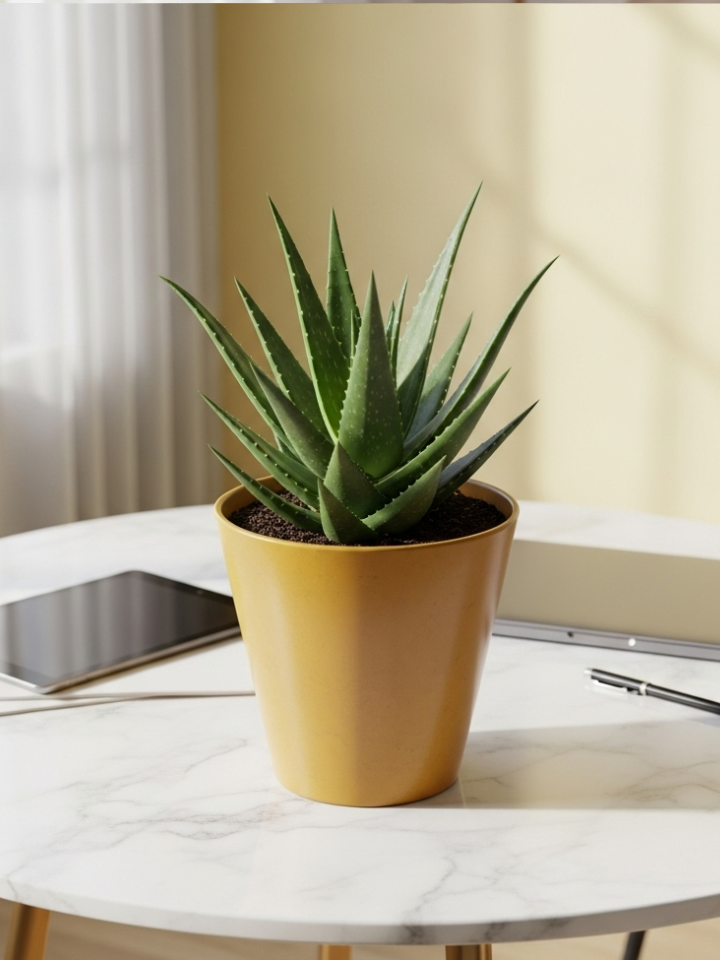
The leaves are the whole plant. Each one is thick and roughly triangular in cross-section, sweeping upward and outward from the base, tapering to a soft point, with a row of pale, pliable teeth running along both margins. The colour runs from grey-green in strong sun to a deeper, softer green in shade. Young plants and mini-sized plants often carry scattered white flecks across the leaf surface, which fade as the plant matures — one of the reasons this size photographs so well, and one of the reasons the mini gets confused with the heavily speckled ornamental hybrids sold under names like Blizzard.
It is a plant that asks almost nothing and quietly rewards being left alone, which is why it belongs among the low maintenance houseplants in our range and sits naturally beside the other cactus and succulents on the bench. It is also the only plant in this catalogue that occupies two shelves at once: it is a decorative succulent and it is one of the medicinal plants to grow at home, and the honest position on that second claim is set out further down. We grow our own stock rather than reselling it, which is the whole reason we set up as nursery plants online in the first place.
Where it looks and grows best
Light is the one thing to get right. An aloe wants a south- or east-facing windowsill, a bright balcony ledge, or the sunniest table in the house — three to five hours of direct morning sun is ideal, and a full day of unfiltered light suits it fine once it has hardened off. Give it less and the change is gradual enough to miss: leaves lengthen, lose their thickness, pale towards a yellowish green, and the rosette slowly opens out and flops sideways instead of standing up. That flattened, stretched shape is not a variety. It is a light problem, and it is reversible if caught early.
Because it is small, upright and needs no humidity, it works as well on a study table as on a sill, and it is one of the more practical living room indoor plants for a bright window seat where a fern would sulk. The kitchen is where it genuinely earns its place — a sunny kitchen window puts the plant exactly where a minor burn happens, which is the reason aloe has sat on Indian kitchen sills for generations and the reason it deserves a slot among the plants to keep in the kitchen. Indoors it is one of the easier indoor live plants to keep alive; outdoors it is perfectly happy in a pot on a terrace or in a bed, which is why it also appears among our outdoor plants for the garden.
Two places to avoid. Anywhere the saucer can stand full of water, and any spot where monsoon rain lands directly in the pot for weeks at a stretch. Both kill this plant the same way, from the roots up, and by the time the leaves show it the damage is usually done.
About the gel — what is fair to say and what is not
Cut a mature leaf across and you get two distinct things. The clear inner jelly is the aloe gel people mean; the thin bitter yellow fluid that seeps from just under the green rind is latex, and it is a different substance with different properties. Rinsing that yellow latex off before use is the step most home guides skip.
What the evidence supports is narrow but real: topical aloe gel has reasonable support for minor first-degree burns, sunburn and small skin irritations, with studies generally small and of mixed quality. What it does not support is anything beyond that. Serious burns, open wounds and infected skin belong with a doctor, not a windowsill. And the yellow latex should not be swallowed — aloin is a strong stimulant laxative, the US FDA withdrew it from over-the-counter laxatives in 2002, and the IARC has classified whole-leaf aloe extract as possibly carcinogenic to humans. That last point is worth knowing before anyone starts blending leaves into a morning juice.
None of this makes the plant less worth owning. A mini aloe is not a pharmacy and was never going to be one, and treating it as a good-looking, near-indestructible succulent that happens to be useful for a scalded finger is both the accurate framing and, in our experience, the one customers trust. Harvesting is also worth pacing: take one outer leaf at a time from a plant that has at least eight or ten, cut flush at the base, and give it a couple of months to recover. A mini simply does not have leaves to spare yet.
Is the Aloe Vera Mini Plant safe for cats and dogs?
No. The ASPCA lists Aloe as toxic to cats, dogs and horses. The toxic principles are saponins and anthraquinones, and the detail that matters is where they sit: concentrated in the bitter yellow latex under the rind, not in the clear inner gel, which the ASPCA separately describes as considered edible. A pet that chews through a leaf gets the latex, and the usual result is vomiting, lethargy, diarrhoea and sometimes reddish urine. It is rarely dangerous and it is genuinely unpleasant.
The practical rule: if you keep a cat that grazes on foliage or a dog that chews, this plant goes on a high shelf or it does not come into the house. If an animal has eaten a quantity of it, call your vet rather than waiting.
If that settles it, the closest honest substitutes we sell are the lucky jade plant, which is Portulacaria afra and ASPCA non-toxic to both cats and dogs while wanting the same sun and the same sparing watering, and the christmas cactus plant, another confirmed non-toxic succulent that flowers into the bargain. For foliage rather than a succulent, the peacock plant is the third confirmed safe choice. Our broader pet-friendly house plants selection is worth browsing with the ASPCA database open beside it, because genus-level toxicity does not always match what a category name implies.
A straight answer on air purification
Aloe vera is one of the few plants marketed this way that was actually tested. It appeared in the 1989 Clean Air Study, where it removed formaldehyde from a small sealed chamber. That is the real finding and it is worth stating accurately, because almost every listing online inflates it into a NASA endorsement that never existed. In an ordinary room the effect does not survive contact with reality: Cummings and Waring calculated in 2019 that you would need somewhere between ten and a thousand plants per square metre to match the air exchange an open window already provides. Aloe also uses CAM photosynthesis and takes in carbon dioxide after dark, which it shares with the sansevieria snake plant — a genuine mechanism, and far too small in quantity to change the air in a bedroom. Our explainer works through how do plants purify air and what the research does and does not show.
Product Specifications
- Plant name — Aloe Vera Mini Plant
- Botanical name — Aloe vera (syn. Aloe barbadensis Mill.) [CONFIRM — see note 2]
- Also known as — Mini aloe, ghritkumari, gwarpatha, korphad, kattar vazha, kalabanda, true aloe, medicine plant
- Plant family — Asphodelaceae
- Origin — Arabian Peninsula; naturalised and cultivated across India for centuries
- Plant type — Evergreen perennial succulent
- Foliage — Thick, fleshy, upward-curving lance-shaped leaves with soft pale marginal teeth; grey-green to deep green, often white-flecked when young
- Growth habit — Stemless rosette forming from a central point; offsets freely from the base
- Growth rate — Moderate in the growing season; near-dormant in the monsoon and in deep winter
- Suitable placement — Sunny windowsill, kitchen window, study or work desk in real light, bright balcony ledge, terrace pot; indoors or outdoors, under cover in heavy rain
- Light requirement — Bright. 3–5 hours of direct sun preferred; tolerates bright indirect light but stretches without real light
- Water requirement — Low. Every 2–3 weeks in summer, monthly in winter, only when the soil is dry right through
- Soil requirement — Gritty, fast-draining cactus and succulent mix; or potting soil cut half and half with coarse sand and perlite
- Temperature — Roughly 13–35 °C; not frost-hardy
- Humidity — No requirement; prefers dry air and should never be misted
- Fertiliser — Balanced liquid feed at half strength two or three times across the growing season; none in the monsoon or winter
- Difficulty level — Very easy; suitable for complete beginners
- Suitable environment — Bright, warm, dry indoor spaces; sheltered outdoor ledges and terraces
- Pet safety — Not pet-safe. ASPCA-listed as toxic to cats, dogs and horses (saponins, anthraquinones)
- Propagation — By offsets (pups) separated from the base; leaf cuttings do not root
- Flowering — Tubular yellow-orange spikes on mature outdoor plants only; not expected on a plant this size
- Air purification — Tested in the 1989 Clean Air Study; no meaningful effect at room scale
Care guide
- Light — Three to five hours of direct sun, morning for preference. Introduce full afternoon sun gradually; a plant moved straight from a shaded nursery bench to a west-facing ledge in May will scorch.
- Water — Soak until water runs from the drainage hole, let it drain completely, then leave the soil to dry right through before the next watering. Roughly every two to three weeks in summer, monthly in winter. Water the soil, never into the crown of the rosette, where trapped water rots the centre.
- Soil — Gritty and fast-draining. A cactus and succulent mix, or ordinary potting soil cut roughly half and half with coarse sand and perlite. Heavy garden soil holds water exactly as these roots cannot tolerate.
- Drainage — Non-negotiable, and the single most common cause of death. Drainage holes in the pot, and a saucer that gets emptied within the hour.
- Pot — Slightly snug rather than generous, and terracotta ahead of plastic if you have the choice. A large pot holds a volume of wet soil the roots cannot use.
- Temperature — Comfortable from about 13 °C to 35 °C, which covers almost every Indian condition outside a hill winter. It is not frost-hardy.
- Humidity — No requirement at all. It prefers drier air than most houseplants and never wants misting.
- Feeding — Very little. A balanced liquid feed at half strength two or three times across the growing season is plenty. Nothing through the monsoon and nothing in winter.
- Repotting — Every two or three years, in spring, one size up. Let the plant dry for a few days after repotting before the first watering.
- Propagation — The easiest part of owning one. Mature plants throw pups from the base; once a pup has three or four leaves of its own, lift the plant, separate the pup with its roots intact, let the cut surfaces dry for two days, then pot it into barely damp gritty mix. Leaf cuttings do not work on aloe — the leaf simply rots.
Growing it through the Bengal year
These notes come from raising succulents on our own benches, which is where the plants we ship are actually grown rather than bought in. If you are working out where to buy plants in Kolkata that have already been hardened to the local climate, that is the difference it makes.
Winter, late November to February. The easiest stretch. Growth slows, water needs drop to about once a month, and the leaves often flush a reddish bronze at the tips in strong winter sun — a stress pigment, not damage. Do nothing except enjoy it.
Summer, March to May. Peak growth, and the months when pups appear. Water every ten days to a fortnight and watch for scorch on plants moved suddenly into harsher light. Our best indoor plants for Kolkata homes guide covers the rest of the collection through the same season.
Monsoon, June to September. The only genuinely difficult stretch, and the one that kills aloes in eastern India. Saturated air, soil that never dries and a pot catching rain add up to root rot, which on a succulent is usually fatal before the foliage looks wrong. Move it under cover, abandon the watering schedule entirely, and test the soil with a finger before even considering it. Through much of August the correct action is none.
Common problems and quick fixes
- Soft, mushy, translucent leaves at the base — Overwatering, almost always. Stop watering, empty the saucer, let the soil dry completely. If the base has gone soft, unpot it, cut back to firm tissue, let it callus for several days and repot into dry gritty mix.
- Flat, stretched rosette with long pale leaves flopping outward — Not enough light. Move it to the brightest spot you have, increasing exposure over a week or two. Existing leaves stay stretched; new growth comes in compact.
- Brown, dry, papery leaf tips — Usually underwatering over a long stretch, sometimes a salt build-up from tap water or feed. Soak thoroughly, then flush the pot with plenty of water to leach out the salts.
- Reddish-brown or bronze leaves overall — Sun stress. Harmless, often attractive, and it fades when light drops. Only worry if it comes with papery patches, which is scorch.
- Leaves curling inward or thinning — Thirst. This plant tells you clearly when it wants water, which is why guessing is unnecessary.
- White cottony specks in the leaf joints — Mealybugs, the commonest pest on aloe. Touch each with a cotton bud dipped in surgical spirit, then spray with diluted neem oil weekly for three weeks.
- Never flowers — Normal indoors. Aloe vera flowers on mature plants with real sun, usually outdoors, and typically not before three or four years. A mini will not flower for a long while yet.
Aloe vera, Vastu and placement
Placement questions make up a surprising share of the Indian search volume around this plant. In Vastu practice, aloe is generally suggested for the east or north-east, the directions associated with health and vitality, and it is commonly recommended for a kitchen or a study rather than a bedroom. Some practitioners keep thorny or toothed plants away from the main entrance; aloe’s teeth are soft and many make an exception for it on the grounds that it is a healing plant.
Said plainly: these plant-by-plant placements are modern convention rather than classical scripture, and they matter to a great many households without being binding on anyone. They also happen to agree with the horticulture here, because east and north-east is where the morning sun is. Our room-by-room guide sets out which plants are good for the home according to Vastu properly.
Who this plant is for
If you have killed houseplants before and concluded you are bad at it, this is the one to try next, and it belongs on any short list of starter plants for first-time growers. It fails only in the direction most beginners do not expect — from too much attention rather than too little — so the instruction is genuinely simple: put it in the sun and forget it for a fortnight. If you want the same tolerance at a larger scale, the larger Blizzard aloe is the fuller, more heavily marked plant in the range.






























There are no reviews yet.